
Windows Kernel Backdoor Hides Itself and Handles C2 Without a User-Mode Component
Summary
Analysis of errdev.sys details a signed Windows kernel backdoor that hides driver and registry artifacts, uses raw TCP for C2, and can inject operator-supplied code. Its connection hiding is unproven, and the second-stage payload was not observed.
Key points
- errdev.sys is a custom 64-bit Windows kernel backdoor that requires administrator rights to install; the article says it does not match a known malware family.
- It connects to 23[.]95[.]31[.]14 on port 443 using raw TCP and AES-256-GCM, rather than HTTPS; the server was not answering when researchers checked.
- The driver can list running processes and inject server-supplied shellcode into a selected process. Researchers did not obtain the second-stage code.
- It blanks its name in the loaded-driver list and protects its service registry key. It also attempts to hide its network connections, but the effectiveness of that filtering is unconfirmed.
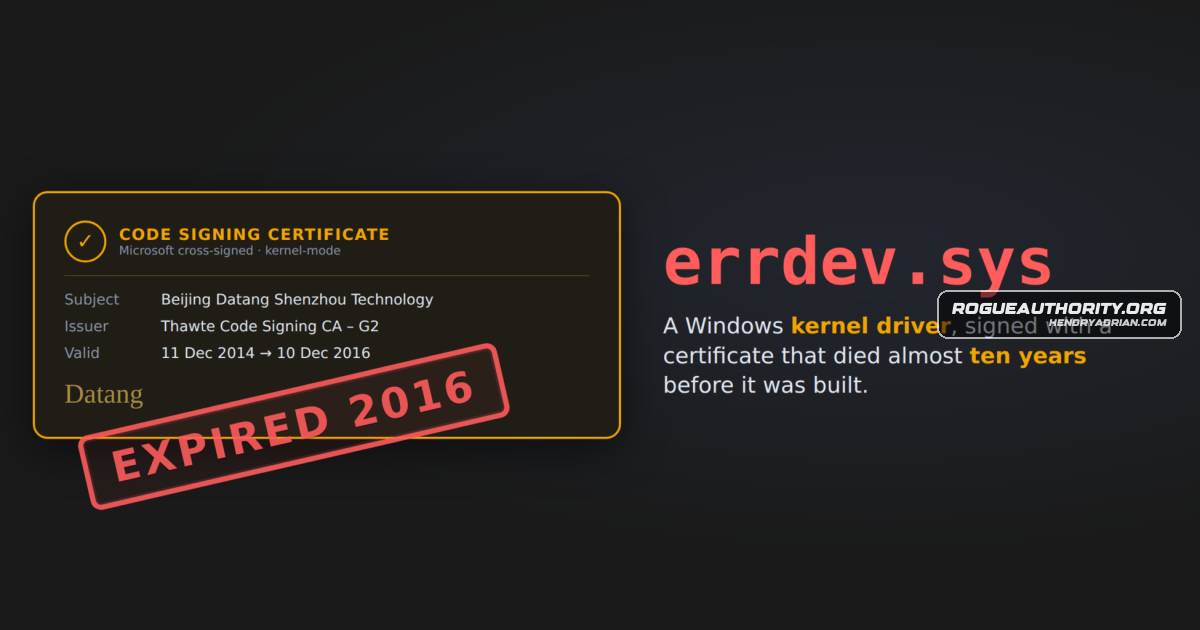
- The driver was signed with a genuine certificate belonging to Beijing Datang Shenzhou that expired in 2016; the authors consider private-key misuse likely but do not know how the key was obtained.
- The driver has no unload routine and blocks deletion of its registry key while running. The article recommends HVCI, Microsoft's vulnerable-driver blocklist, external network monitoring, and reboot-based removal.
Article Details
- Attack Vectors
- An external installer must obtain administrator rights to install and load errdev.sys as a Windows kernel driver; the article does not identify the installer or installation method.
- After loading, the driver connects to 23[.]95[.]31[.]14:443 over raw TCP using custom framing and AES-256-GCM, rather than HTTPS.
- The server can direct the driver to enumerate running processes and inject operator-supplied shellcode into a selected process.
- Defensive Notes
- Keep Windows updated, enable memory integrity (HVCI) and Microsoft's vulnerable-driver blocklist, and avoid running untrusted installers with administrator rights.
- Use an App Control / WDAC signer deny rule for Beijing Datang Shenzhou and monitor externally for traffic to 23[.]95[.]31[.]14 and raw TCP payloads beginning with 9A F2 B7 E4.
- Hunt for a kernel driver with blanked name fields, a registry callback at altitude 380000, a filter attached to \\Device\\Nsi, and an errdev.sys driver not signed by Microsoft.
- The driver cannot be unloaded with sc stop and blocks deletion of its service key while running. The article recommends disabling its start type and rebooting, or editing the registry offline from a clean boot before deleting the file.
Indicators of compromise
| Type | Indicator | Context |
|---|---|---|
| IPV4 | 23[.]95[.]31[.]14 | C2 server contacted by the driver over raw TCP on port 443. |
| MD5 | 00b99c19bd24ffc1247e74498d4a0365 | MD5 hash identified for the errdev.sys malware driver. |
| SHA1 | d5dfc60a63446f52def563d318b7535e4f390bb0 | SHA-1 certificate thumbprint for the Beijing Datang Shenzhou signer; the article recommends blocking it with a WDAC signer deny rule. |
| SHA256 | dda67a294e6a086022e1ba51f2ff9a63addf16dc865d9205741caa9a35df0d33 | SHA-256 hash identified for the errdev.sys malware driver. |
MITRE ATT&CK
T1014 · RootkitThe driver hides its loaded-driver name and filters its own network connections from the connection list; it also attempts to lock its registry key.T1055 · Process InjectionOn command, the driver writes server-supplied shellcode into a selected process and starts it running.T1057 · Process DiscoveryA server command makes the driver list running processes, including their IDs and architecture flags.T1095 · Non-Application Layer ProtocolThe driver communicates with its server using raw TCP with custom framing, not an application-layer web protocol.T1105 · Ingress Tool TransferThe C2 server can supply shellcode to the driver for injection into a selected process.T1112 · Modify RegistryThe driver registers a kernel callback to block deletion or renaming of its service registry key and strips permissions on that key.T1547.006 · Kernel Modules and ExtensionsThe driver is installed and loaded as a kernel driver and sets itself to start automatically at every boot.T1553.002 · Code SigningThe malware driver is signed with an expired code-signing certificate belonging to Beijing Datang Shenzhou; the article assesses that the private key is likely being misused, but says how it was obtained is unknown.T1573.001 · Symmetric CryptographyThe driver encrypts C2 messages with AES-256-GCM using a symmetric key embedded in the file.
People
Vendors
Products
Tools
ANY.RUNTools used: Malcat, objdump/pefile/capstone, osslsigncode, speakeasy, Censys, and ANY.RUN.CapstoneTools used: Malcat, objdump/pefile/capstone, osslsigncode, speakeasy, Censys, and ANY.RUN.CensysTools used: Malcat, objdump/pefile/capstone, osslsigncode, speakeasy, Censys, and ANY.RUN.MalcatTools used: Malcat, objdump/pefile/capstone, osslsigncode, speakeasy, Censys, and ANY.RUN.objdumpTools used: Malcat, objdump/pefile/capstone, osslsigncode, speakeasy, Censys, and ANY.RUN.osslsigncodeTools used: Malcat, objdump/pefile/capstone, osslsigncode, speakeasy, Censys, and ANY.RUN.pefileTools used: Malcat, objdump/pefile/capstone, osslsigncode, speakeasy, Censys, and ANY.RUN.speakeasyTools used: Malcat, objdump/pefile/capstone, osslsigncode, speakeasy, Censys, and ANY.RUN.