CrocoRAT Hides in a Signed Fake Chrome Installer and Bundles Its Own Python
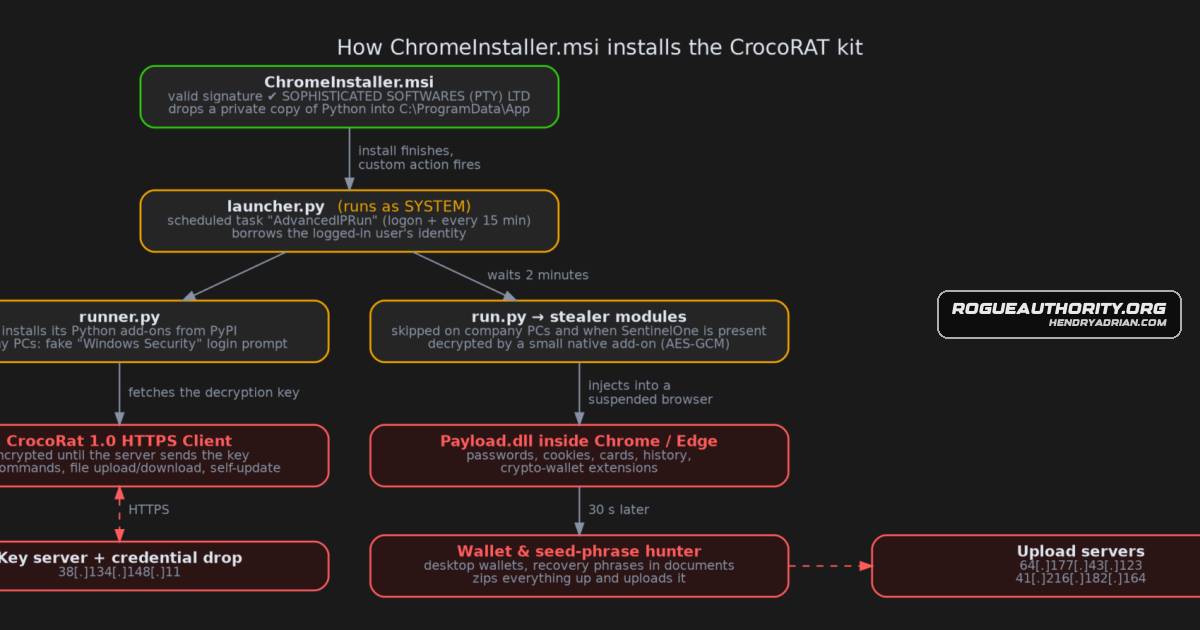
Summary
Analysis traces five CrocoRAT builds hidden in signed fake software installers. The malware can run commands, steal browser and wallet data, and phish credentials; researchers note the October stealer may not run because of an installer check.
Key points
- The 27.8 MB ChromeInstaller.msi is validly signed but unrelated to Chrome; it installs Python and malicious scripts under C:\ProgramData\App\.
- The installer runs a launcher as SYSTEM, which creates the AdvancedIPRun scheduled task to start the RAT loader at logon and every 15 minutes.
- CrocoRAT can execute operator commands, transfer files, report the machine’s IP address, and update or shut down.
- A fake Windows Security credential dialog targets domain-joined and Entra ID machines; entered credentials are checked against Windows and sent to the operator’s server.
- On eligible non-company PCs, a stealer injects code into Chrome and Edge to collect saved passwords, cookies, payment-card details, browsing history, sign-in tokens, and wallet-extension information.
- A second module searches for desktop crypto wallets and, if it finds one, scans files for recovery phrases before uploading collected data.
- The October RAT is encrypted and requires a key from the operator’s server. Researchers warn the SYSTEM-level company-PC check may prevent the stealer from running, and they could not confirm delivery or attribute the activity.
Article Details
- Attack Vectors
- A malicious MSI impersonating a Chrome installer installs a private Python runtime and runs the CrocoRAT kit.
- The installer runs its launcher as SYSTEM and creates the AdvancedIPRun scheduled task to start the RAT loader at logon and every 15 minutes.
- The loader fetches Python add-ons from PyPI and requests a server-side key to decrypt and run the RAT in memory.
- On domain-joined and Entra ID machines, the loader presents a genuine Windows credential dialog and sends verified credentials to the operator's server.
- On non-company PCs without SentinelOne, the stealer injects a DLL into suspended Chrome and Edge processes to collect browser data.
- The wallet module searches for desktop wallet files and, when it detects a wallet, scans documents for recovery phrases before uploading collected data in archive chunks.
- Defensive Notes
- Monitor for pythonw.exe running from C:\ProgramData\App\, C:\ProgramData\advanced-ip-scanner\app\, or C:\ProgramData\trservice\.
- Look for the AdvancedIPRun scheduled task, particularly on systems that do not use Advanced IP Scanner.
- Alert when Python starts chrome.exe or msedge.exe, or when Python outside developer tooling installs packages from PyPI.
- Treat an unexpected credential prompt owned by pythonw.exe as an incident; reset any password entered into it.
- Block the listed RAT key-server and stolen-data-upload IP addresses.
- If found on a home PC, treat browser credentials, cookies, and wallet recovery phrases stored on the machine as compromised; change passwords from a clean device and move funds to a new wallet.
Indicators of compromise
| Type | Indicator | Context |
|---|---|---|
| IPV4 | 103[.]56[.]84[.]221 | August RAT key server. |
| IPV4 | 132[.]243[.]209[.]131 | RAT server used by the July builds. |
| IPV4 | 23[.]26[.]156[.]59 | RAT server used by the July builds. |
| IPV4 | 38[.]134[.]148[.]11 | October RAT key server and credential-drop destination. |
| IPV4 | 41[.]216[.]182[.]164 | October stolen-data upload server. |
| IPV4 | 64[.]177[.]43[.]123 | October stolen-data upload server. |
| SHA256 | 1c05972a1ae4f8c4f46468637f1a80fe08784d60e112ff6740bad5f3a35817dc | SHA-256 hash associated with runner.py in the malicious kit. |
| SHA256 | 75108e48f55e715d105059acd81f9db1003b4ed39df5b929a9b5331c3e3b0a64 | SHA-256 hash associated with launcher.py in the malicious kit. |
| SHA256 | 77e4df8122d4fd0bcb7e04623ed479d2c90841ccaa0c6ad9cfc342f9d622860d | SHA-256 hash of the malicious MSIX build from 14 July. |
| SHA256 | 7b2d729e6912e4374298cdf92ac5ae5e1160f12ad80e852dabd4f9db75cfbda5 | SHA-256 hash of the malicious MSIX build from 13 August. |
| SHA256 | 8b167cb0fe53c839902bd8936ec384bb9fcfa7c8ae81299d3671394607d7c0b7 | SHA-256 hash of the malicious decryptor add-on. |
| SHA256 | 907da6987c3fd2115fd62c8dbcba9837cbdeb8dd00851265c601a93261184343 | SHA-256 hash of a malicious MSIX build from 21 July. |
| SHA256 | 98939c94abb5a8db0dcee4bd319b399f8410ebc837c935b9706751244fdf610c | SHA-256 hash of another malicious MSIX build from 21 July. |
| SHA256 | 9dd26653fdcbcf44889471c3d6f5e30b679abbc77f0cf93a78f88e1d3efbc8ee | SHA-256 hash associated with run.py in the malicious kit. |
| SHA256 | d928b532f3244c0f9d2b459f39054f0c23850f795dac50a51d3b3a795aa79a0b | SHA-256 hash of the browser-injection DLL used by the stealer. |
| SHA256 | de35dd440f4b55682b015290ce207b944b95ea8d4e2ff23023bcbd025c31d9a2 | SHA-256 hash of the October malicious ChromeInstaller.msi. |
MITRE ATT&CK
T1041 · Exfiltration Over C2 ChannelThe RAT sends files to the operator, and the stealer uploads collected data archives to operator servers.T1055 · Process InjectionThe stealer injects a DLL into suspended Chrome and Edge processes.T1056.002 · GUI Input CaptureThe loader displays a genuine Windows credential dialog and checks the entered password against Windows before sending the verified credentials to the operator.T1059.006 · PythonThe installer and malware stages execute Python scripts using the bundled Python runtime.T1105 · Ingress Tool TransferThe RAT can write files delivered by the operator and update itself with a new version.T1539 · Steal Web Session CookieThe browser stealer collects cookies that could enable account access without a password.T1547.009 · Shortcut ModificationThe installer creates the AdvancedIPRun scheduled task to launch the RAT loader at user logon.T1555.003 · Credentials from Web BrowsersThe injected browser module collects saved passwords, cookies, and payment-card information from Chrome and Edge profiles.T1555.004 · Windows Credential ManagerThe wallet module searches user folders and the C: drive for cryptocurrency wallet recovery phrases when it detects a desktop wallet.
Malware
Vendors
Products
Advanced IP ScannerEarlier builds posed as Advanced IP Scanner, a popular free network tool, and the name made sense then.EdgeBrowser theft: a module injected into Chrome and Edge takes saved passwords, cookies, payment cards, browsing history, and notes which crypto-wallet extensions are installed.Entra IDOn domain-joined and Entra ID machines (Entra ID, formerly Azure AD, is Microsoft’s cloud sign-in service for organisations), it then shows a real Windows credential dialog titled “Windows Security” with the textGoogle ChromeChromeInstaller.msi is a validly signed Windows installer that has nothing to do with Chrome.Microsoft WindowsChromeInstaller.msi is a validly signed Windows installer that has nothing to do with Chrome.SentinelOneHow ChromeInstaller.msi installs the CrocoRAT kit. The two-minute wait and the SentinelOne check only apply to the stealer branch.
Tools
ANY.RUNTools used: Malcat, msitools, custom Python decoders, capa, Malcat KesaKode, osslsigncode and OpenSSL, ANY.RUN, Hatching Triage and VirusTotal.capaTools used: Malcat, msitools, custom Python decoders, capa, Malcat KesaKode, osslsigncode and OpenSSL, ANY.RUN, Hatching Triage and VirusTotal.Hatching TriageTools used: Malcat, msitools, custom Python decoders, capa, Malcat KesaKode, osslsigncode and OpenSSL, ANY.RUN, Hatching Triage and VirusTotal.MalcatTools used: Malcat, msitools, custom Python decoders, capa, Malcat KesaKode, osslsigncode and OpenSSL, ANY.RUN, Hatching Triage and VirusTotal.Malcat KesaKodeTools used: Malcat, msitools, custom Python decoders, capa, Malcat KesaKode, osslsigncode and OpenSSL, ANY.RUN, Hatching Triage and VirusTotal.msitoolsTools used: Malcat, msitools, custom Python decoders, capa, Malcat KesaKode, osslsigncode and OpenSSL, ANY.RUN, Hatching Triage and VirusTotal.OpenSSLTools used: Malcat, msitools, custom Python decoders, capa, Malcat KesaKode, osslsigncode and OpenSSL, ANY.RUN, Hatching Triage and VirusTotal.osslsigncodeTools used: Malcat, msitools, custom Python decoders, capa, Malcat KesaKode, osslsigncode and OpenSSL, ANY.RUN, Hatching Triage and VirusTotal.REMnuxThis analysis and write-up were produced by Claude (Opus 5.5), working as an agent in Claude Code on a REMnux analysis VM.VirusTotalTools used: Malcat, msitools, custom Python decoders, capa, Malcat KesaKode, osslsigncode and OpenSSL, ANY.RUN, Hatching Triage and VirusTotal.
Countries
CzechiaSigned, but not by anyone you know: five builds, four certificates from companies in four countries (Finland, Sweden, Czechia, South Africa).FinlandSigned, but not by anyone you know: five builds, four certificates from companies in four countries (Finland, Sweden, Czechia, South Africa).South AfricaSigned, but not by anyone you know: five builds, four certificates from companies in four countries (Finland, Sweden, Czechia, South Africa).SwedenSigned, but not by anyone you know: five builds, four certificates from companies in four countries (Finland, Sweden, Czechia, South Africa).