
Signed Windows Utility Loader Delivers GodRAT Through Process Injection
Summary
Analysis finds a signed 62 MB Windows utility hiding a 9.7 KB loader that retrieves GodRAT over raw TCP and injects it into cmd.exe. The certificate also signed a separate Golden Gh0st loader, but attribution remains undetermined.
Key points
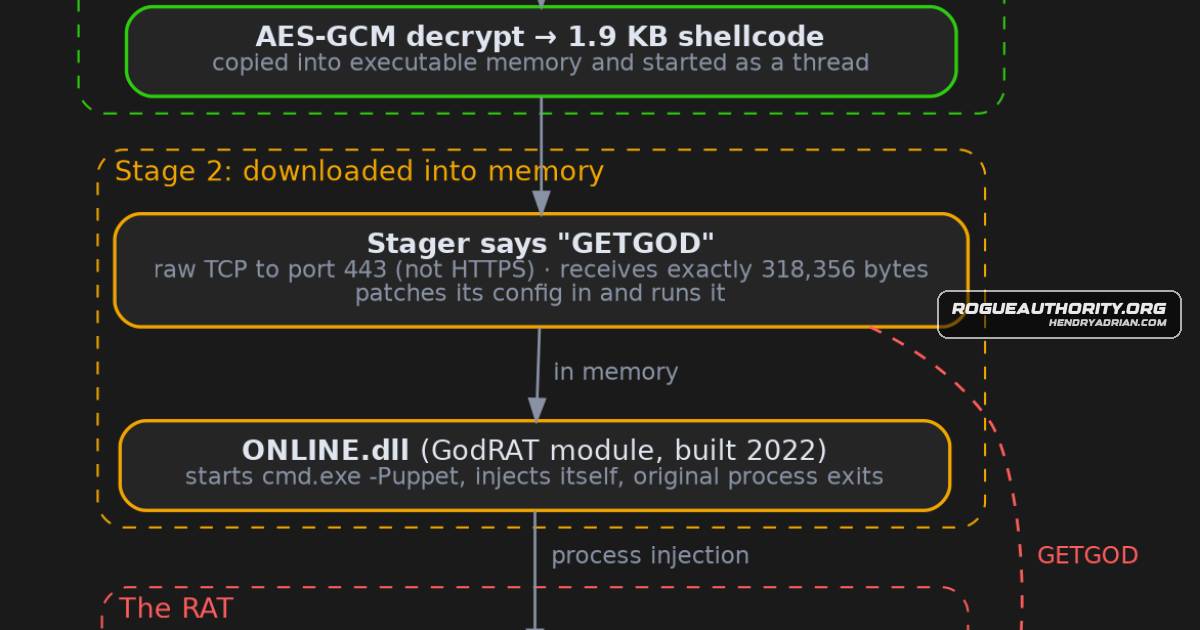
- The 62 MB signed .NET bundle contains a 9.7 KB malicious component that decrypts shellcode and downloads a second-stage payload.
- The stager requests the payload with GETGOD over unencrypted TCP to 103.145.191.136:443.
- The downloaded GodRAT DLL has the same MD5 hash as a sample identified by Kaspersky in 2025.
- GodRAT runs inside a hidden cmd.exe process using the -Puppet argument and reports host, user, Windows, IP, and antivirus details to its server.
- The analyzed server sent no plugins during the sandbox run, so the operator’s intended activity and the RAT’s deployed functions were not observed.
- The same EV certificate signed a separate Golden Gh0st RAT downloader, but differing protocols, servers, keys, and delivery methods leave the relationship between operators unresolved.
- The article recommends blocking the reported IP, hunting for cmd.exe -Puppet and GETGOD traffic, and treating files with the certificate serial as malicious.
Article Details
- Attack Vectors
- The initial delivery method for the signed Windows Utility Suite is unknown.
- The signed .NET bundle contains a small loader that XOR-obfuscates a password and uses it to AES-GCM-decrypt shellcode.
- The shellcode opens a plain TCP connection to 103[.]145[.]191[.]136 on port 443, sends GETGOD, and downloads the next stage into memory.
- The downloaded GodRAT payload is copied into a hidden cmd.exe process using the -Puppet argument.
- GodRAT can receive and run plugins in memory, download and run files from URLs, and open web pages in Internet Explorer; no plugins were delivered during the observed sandbox run.
- Defensive Notes
- Block 103[.]145[.]191[.]136.
- Hunt for cmd.exe launched with the -Puppet argument and TCP streams beginning with GETGOD\0.
- Treat files signed with certificate serial 05923499141496b67bb7b4687809454b as malicious.
- Investigate 62 MB .NET single-file applications whose own code is only a few kilobytes and calls VirtualAlloc and CreateThread.
- Do not treat a valid code-signing signature or company name as evidence that a file is safe.
Indicators of compromise
| Type | Indicator | Context |
|---|---|---|
| IPV4 | 103[.]145[.]191[.]136 | Stage-two download server and GodRAT command-and-control server, contacted over plain TCP on port 443. |
| MD5 | 8008375eec7550d6d8e0eaf24389cf81 | MD5 hash of the GodRAT DLL; the article says it exactly matches the sample listed by Kaspersky. |
| SHA256 | 2ce188196c078cc35ec6e8947821be57f5c061d4c06cf4bd4d329eac590576c8 | SHA-256 hash of the downloaded stage-two payload. |
| SHA256 | 35c65263c0c90b8f15a86503e42ee16d7d6c786f4e54e75375a2794b73688f48 | SHA-256 hash of the decrypted stager shellcode. |
| SHA256 | 36da0b939435ff7dcc43c28f16fa189e7f46893b98d1a09207470f2fb51e3433 | SHA-256 hash of the signed wsu.dll bundle identified as malicious. |
| SHA256 | 3b9fb6ed76ddf3352202db134c5a28e85ea8b891db5b0633a1dc377495d56edc | SHA-256 hash of the embedded .NET loader in the malicious bundle. |
| SHA256 | 98b6951a39071cd8db154b045836347eb7ec916c774a856b83e01cff1a0780dd | SHA-256 hash of the UPX-packed ONLINE.dll GodRAT payload. |
| SHA256 | f1cd4a32a8462f04fc1c1addcf2ce6afdfffaa840d8ded4c911b40cbd5d0b37a | SHA-256 hash of the unpacked ONLINE.dll GodRAT payload. |
MITRE ATT&CK
T1016 · System Network Configuration DiscoveryGodRAT's login packet includes the infected system's local IP address.T1027 · Obfuscated Files or InformationThe loader disguises its password with XOR and stores an AES-GCM-encrypted shellcode blob.T1036 · MasqueradingThe signed program presents itself as a Windows Utility Suite while its embedded code downloads and runs GodRAT.T1055 · Process InjectionThe downloaded payload is copied into a hidden cmd.exe process and started there.T1082 · System Information DiscoveryGodRAT's login packet includes the computer name and Windows version.T1095 · Non-Application Layer ProtocolThe stager and GodRAT communicate with the server over plain TCP, including the GETGOD request and subsequent C2 traffic.T1105 · Ingress Tool TransferThe stager downloads the 318,356-byte second stage from the server.T1140 · Deobfuscate/Decode Files or InformationThe loader reverses the XOR disguise and decrypts the embedded blob with AES-GCM to recover shellcode.T1518.001 · Security Software DiscoveryGodRAT's login packet reports which antivirus products it found, and the article says it checks about 25 products.T1620 · Reflective Code LoadingThe loader runs decrypted shellcode from executable memory without writing that shellcode to disk.
Threat Actors
APT-Q-27Expel attributes the IEProc.exe downloader campaign, which delivered Golden Gh0st RAT, to APT-Q-27. The article gives APT-Q-27 as an alias for GoldenEyeDog; it does not attribute the GodRAT activity to this group.GoldenEyeDogExpel attributes the IEProc.exe downloader campaign, which delivered Golden Gh0st RAT, to GoldenEyeDog. The article gives GoldenEyeDog as an alias for APT-Q-27; it does not attribute the GodRAT activity to this group.
Malware
AwesomePuppetThe -Puppet argument is a family trademark: Kaspersky notes that GodRAT’s predecessor, AwesomePuppet, used it the same way.Gh0st RATThe part the attacker actually wrote is 9.7 KB: it decrypts a small piece of code that downloads GodRAT, a remote-access trojan (RAT) built on Gh0st RAT, injects it into a hidden cmd.exe, and reports to its operator.GodRATThe part the attacker actually wrote is 9.7 KB: it decrypts a small piece of code that downloads GodRAT, a remote-access trojan (RAT) built on Gh0st RAT, injects it into a hidden cmd.exe, and reports to its operator.Golden Gh0st RATTwo weeks after signing this file, the same certificate signed IEProc.exe, a downloader for Golden Gh0st RAT, which Expel attributes to the GoldenEyeDog (APT-Q-27).
Vendors
Products
Tools
ANY.RUNTools used: Malcat, ILSpy, Python (cryptography, pefile, capstone), speakeasy, capa, KesaKode, ANY.RUN, Triage and tshark.capaTools used: Malcat, ILSpy, Python (cryptography, pefile, capstone), speakeasy, capa, KesaKode, ANY.RUN, Triage and tshark.ILSpyTools used: Malcat, ILSpy, Python (cryptography, pefile, capstone), speakeasy, capa, KesaKode, ANY.RUN, Triage and tshark.KesaKodeTools used: Malcat, ILSpy, Python (cryptography, pefile, capstone), speakeasy, capa, KesaKode, ANY.RUN, Triage and tshark.MalcatTools used: Malcat, ILSpy, Python (cryptography, pefile, capstone), speakeasy, capa, KesaKode, ANY.RUN, Triage and tshark.speakeasyTools used: Malcat, ILSpy, Python (cryptography, pefile, capstone), speakeasy, capa, KesaKode, ANY.RUN, Triage and tshark.TriageTools used: Malcat, ILSpy, Python (cryptography, pefile, capstone), speakeasy, capa, KesaKode, ANY.RUN, Triage and tshark.tsharkTools used: Malcat, ILSpy, Python (cryptography, pefile, capstone), speakeasy, capa, KesaKode, ANY.RUN, Triage and tshark.