
OctLurk and SilkLurk Backdoors Target Central Asia and Syria in Espionage Campaign
Summary
Kaspersky researchers detail OctLurk and SilkLurk backdoors used against organizations in Central Asia and Syria since January 2025. Victim-specific loaders, in-memory plugins and related LurkProxy tooling support espionage and persistent access.
Key points
- Researchers observed attacks since January 2025 against organizations in Afghanistan, Kyrgyzstan, Tajikistan, Uzbekistan, Kazakhstan and Syria, including government, healthcare and research institutions.
- OctLurk loaders use a drive serial number in double-XOR payload decryption; SilkLurk uses a computer-name hash and custom algorithms to decrypt and reflectively load its backdoor.
- Attackers deployed OctLurk through scheduled tasks and Windows services, while SilkLurk loaders were side-loaded by legitimate NVIDIA and Realtek executables.
- In-memory plugins enable command shells, file operations, screen capture and clipboard access. Observed follow-on activity included domain-controller credential harvesting, keylogging, browser password theft and network scanning.
- LurkProxy shares architectural features with OctLurk and supports SOCKS5 or transparent proxy operation through a TLS-encrypted C2 connection.
- Researchers observed SilkLurk deploying PlugX and linked the two backdoor families through co-infections, shared staging directories and OctLurk-mediated deployment of a SilkLurk loader.
- Kaspersky assesses with medium confidence that a Chinese-speaking actor operates both backdoors, but could not attribute the activity to a known group. Shared C2 infrastructure also overlaps with TrustFall activity.
Article Details
- Attack Vectors
- Attackers used administrative credentials to create remote scheduled tasks that executed deployment and discovery batch scripts with System privileges.
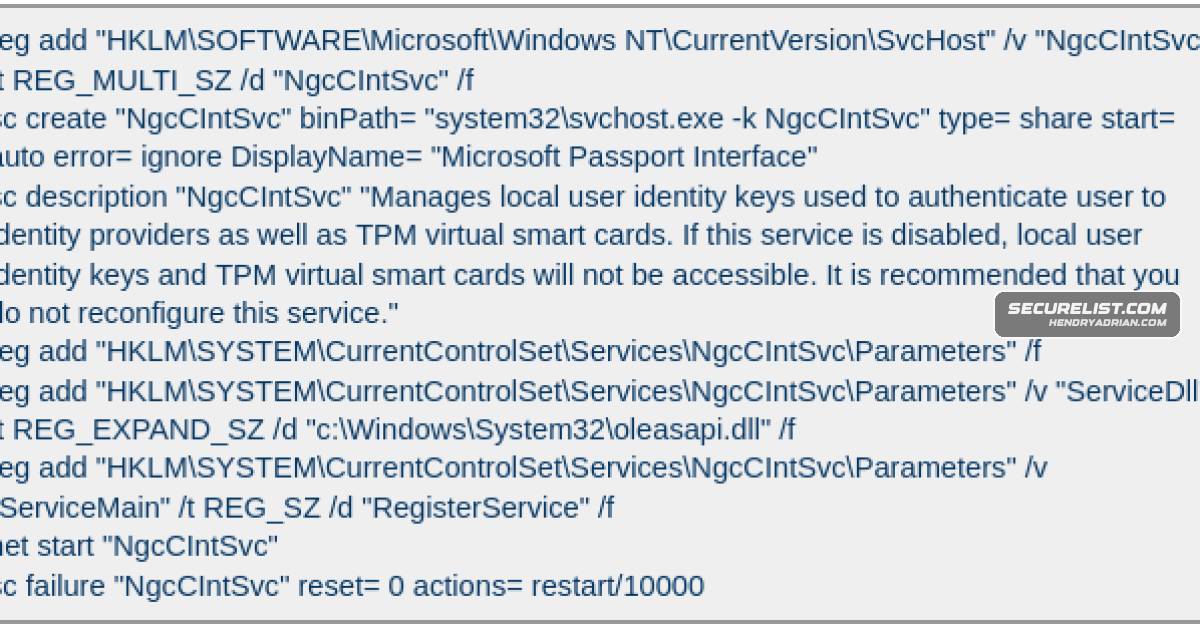
- Windows services loaded OctLurk and LurkProxy DLLs and provided persistence.
- SilkLurk deployment used legitimate executables to side-load malicious DLLs, followed by victim-specific payload decryption and reflective in-memory execution.
- Backdoors downloaded additional plugins into memory, providing command execution, file access, screen capture, and clipboard access.
- Post-compromise activity included domain-controller credential harvesting, browser password theft, keylogging, network scanning, remote-control agent installation, and searches of network shares.
- SilkLurk command-shell access was used to execute a dropper that deployed PlugX.
- Defensive Notes
- OctLurk payload decryption depends on the victim's drive serial number; SilkLurk decryption depends on the computer name, complicating analysis outside the original victim environment.
- Both backdoor families operate primarily in memory, leaving limited loader artifacts on disk.
- The attackers established redundant remote-access pathways, which could preserve access after the original infection mechanism was neutralized.
Indicators of compromise
| Type | Indicator | Context |
|---|---|---|
| DOMAIN | about[.]blsouqs[.]com | Listed OctLurk C2 domain. |
| DOMAIN | api2[.]annoyingremote[.]com | Listed OctLurk C2 domain. |
| DOMAIN | confbase[.]mdpsupport[.]net | Listed OctLurk C2 domain. |
| DOMAIN | ctyuhjerf[.]kozow[.]com | SilkLurk C2 domain observed in an incident involving subsequent PlugX deployment. |
| DOMAIN | digital[.]leroymerling[.]com | Listed OctLurk C2 domain. |
| DOMAIN | dns[.]multitoconference[.]com | Hard-coded OctLurk C2 address contacted on port 443. |
| DOMAIN | dns[.]ssentialserv[.]xyz | LurkProxy C2 domain whose connectivity attackers checked before deployment. |
| DOMAIN | fm01[.]clouddevicemetrics[.]com | Listed OctLurk C2 domain. |
| DOMAIN | gycudore[.]kozow[.]com | C2 domain configured in the PlugX payload deployed through SilkLurk. |
| DOMAIN | rgnojb[.]casacam[.]net | Listed SilkLurk C2 domain. |
| DOMAIN | ssl[.]blsouqs[.]com | Listed OctLurk C2 domain. |
| DOMAIN | tj[.]tajikistandip[.]com | Listed OctLurk C2 domain. |
| DOMAIN | tyhbgtyuj[.]gleeze[.]com | Listed SilkLurk C2 domain. |
| DOMAIN | uyhvfredc[.]accesscam[.]org | Listed SilkLurk C2 domain. |
| DOMAIN | wedfcvbn[.]gleeze[.]com | Listed SilkLurk C2 domain. |
| IPV4 | 154[.]196[.]162[.]76 | LurkProxy C2 server used for TLS-encrypted proxy communications. |
| IPV4 | 45[.]138[.]157[.]165 | Listed OctLurk C2 IP address. |
| IPV4 | 64[.]7[.]198[.]130 | C2 IP address configured in the deployed PlugX payload. |
| MD5 | 082d49ef9f14e6811d68c7e0e82e5069 | OctLurk loader oleasapi.dll loaded by the NgcCIntSvc service. |
| MD5 | 1415a78b75de7db4ba3d1e61d7db4501 | OctLurk Command Shell plugin. |
| MD5 | 2a571f6cee42a17d873f4c942649813f | Keylogger disguised as AnyDesk.exe and persisted through a logon-triggered scheduled task. |
| MD5 | 2f18472866f38c1e1c2c5c14b9a6ab56 | SilkLurk loader vulkan-1.dll staged alongside OctLurk loaders. |
| MD5 | 32a5985543433a4f60da2fafd873b927 | Adobe.exe executable version of secretsdump used to harvest domain-controller password hashes. |
| MD5 | 37dc84e4bcad92fa28f1e7778d088283 | Browser Password Decryptor artifact used to extract Chrome and Firefox credentials. |
| MD5 | 3c9a1ba8e0c7475706adc6376e9d7b7c | kmsonline.exe PlugX dropper executed through SilkLurk command-shell access. |
| MD5 | 7c2f64461bb519c6cbf1fc687675514c | OctLurk loader mscastrac.dll found in a staging directory also used for SilkLurk. |
| MD5 | a4d550a3ba0cd073fe3839b99d98a7a8 | OctLurk Interaction Manager plugin supporting screen capture and clipboard access. |
| MD5 | be4731c09734da2e8eb6814a9c82f266 | SilkLurk loader vulkan-1.dll dropped through an OctLurk command shell. |
| MD5 | ef59aad625eebda8650aec5820d6ce69 | Malicious RasTls.dll PlugX loader deployed by kmsonline.exe. |
| MD5 | f4578e869a735cfad691f927bae3e638 | OctLurk loader msbasesysdc.dll found in a staging directory also used for SilkLurk. |
MITRE ATT&CK
T1027 · Obfuscated Files or InformationLoaders and payloads used extensive obfuscation, encrypted configuration, and victim-specific decryption keys.T1046 · Network Service DiscoveryFscan scanned internal and public networks for exposed services, including SSH on port 22 and MySQL on port 3306.T1053.005 · Scheduled TaskGoogleUpDate tasks executed deployment and discovery scripts; an AnyDesk task launched the keylogger at user logon.T1056.001 · KeyloggingThe deployed AnyDesk.exe keylogger recorded keystrokes in msectdev0.T1059.001 · PowerShellAttackers launched PowerShell through SilkLurk and used PowerShell commands for host and network discovery.T1059.003 · Windows Command ShellCommand-shell plugins launched cmd.exe and executed attacker-supplied commands and batch scripts.T1090 · ProxyLurkProxy forwarded traffic through C2 and supported SOCKS5 and transparent proxy modes.T1105 · Ingress Tool TransferOctLurk downloaded plugins from C2 directly into memory; SilkLurk could receive additional payloads for execution.T1113 · Screen CaptureOctLurk's Interaction Manager could capture the full screen as BMP images, including at specified intervals.T1115 · Clipboard DataThe keylogger stored clipboard contents in msectdev1, and OctLurk's Interaction Manager could retrieve clipboard data.T1543.003 · Windows ServiceAttackers created DLL-loading services including NgcCIntSvc and Cusrxsrv; SilkLurk created the auto-start RmSs service.T1555.003 · Credentials from Web BrowsersBrowser Password Decryptor extracted credentials from Chrome Login Data and Local State files and Firefox logins.json.T1560.001 · Archive via UtilityAttackers used WinRAR and 7-Zip to archive stolen documents.T1574.002 · DLL Side-LoadingSilkLurk loaders were side-loaded by legitimate executables including nvgwls.exe and RtkNGUI64.exe.T1620 · Reflective Code LoadingOctLurk and SilkLurk loaders reflectively loaded decrypted backdoor code into memory.
Malware
LurkProxyThe article describes OctLurk, SilkLurk, and LurkProxy, three closely related implants used since January 2025 against government and other organizations across Central Asia and the Syrian Arab Republic, withMystRodXDuring this campaign, attackers employed the TrustFall (STS internal designation) remote access malware, also known as MystRodX (Qianxin) and SilentRaid (Cisco) and designed for Linux-based operating systems.OctLurkThe article describes OctLurk, SilkLurk, and LurkProxy, three closely related implants used since January 2025 against government and other organizations across Central Asia and the Syrian Arab Republic, withPlugXtheft, keylogging, browser password theft, network scanning, remote access, and the later deployment of PlugX, while infrastructure overlap and shared artifacts suggest a Chinese-speaking threat actor.SilentRaidDuring this campaign, attackers employed the TrustFall (STS internal designation) remote access malware, also known as MystRodX (Qianxin) and SilentRaid (Cisco) and designed for Linux-based operating systems.SilkLurkThe article describes OctLurk, SilkLurk, and LurkProxy, three closely related implants used since January 2025 against government and other organizations across Central Asia and the Syrian Arab Republic, withTrustFallDuring this campaign, attackers employed the TrustFall (STS internal designation) remote access malware, also known as MystRodX (Qianxin) and SilentRaid (Cisco) and designed for Linux-based operating systems.
Products
Google ChromeThe tool offers two options: -help to extract passwords from Chrome and -exit to extract passwords from Firefox.Mozilla FirefoxThe tool offers two options: -help to extract passwords from Chrome and -exit to extract passwords from Firefox.Pandora RC agentRemote access : Pandora FMS agents (Pandora RC agent)
Tools
7-Zip[T1020 ] Data Exfiltration – Used archiving tools to package stolen data for removal [‘To archive the stolen data, they employed … WinRAR and 7-Zip’]Browser Password DecryptorThe Browser Password Decryptor tool C:users[username]libraries64.exe (MD5 37dc84e4bcad92fa28f1e7778d088283) is used to extract passwords from browsers.fscanNetwork scan: FSCANImpacket[T1003.006 ] OS Credential Dumping: DCSync – Used Impacket secretsdump to extract password hashes from domain controllers [‘portable-executable version of Impacket’s secretsdump.py tool’ / ‘extracted password hashessecretsdumpto extract password hashes from domain controllers [‘portable-executable version of Impacket’s secretsdump.py tool’ / ‘extracted password hashes from domain controllers’]WinRAR[T1020 ] Data Exfiltration – Used archiving tools to package stolen data for removal [‘To archive the stolen data, they employed … WinRAR and 7-Zip’]
Countries
AfghanistanVictims are mainly government-related organizations in Afghanistan, Kyrgyzstan, Tajikistan, Uzbekistan, Kazakhstan, and Syria.KazakhstanVictims are mainly government-related organizations in Afghanistan, Kyrgyzstan, Tajikistan, Uzbekistan, Kazakhstan, and Syria.KyrgyzstanVictims are mainly government-related organizations in Afghanistan, Kyrgyzstan, Tajikistan, Uzbekistan, Kazakhstan, and Syria.Syrian Arab Republicused since January 2025 against government and other organizations across Central Asia and the Syrian Arab Republic, with victim-specific loaders and heavy obfuscation.TajikistanVictims are mainly government-related organizations in Afghanistan, Kyrgyzstan, Tajikistan, Uzbekistan, Kazakhstan, and Syria.UzbekistanVictims are mainly government-related organizations in Afghanistan, Kyrgyzstan, Tajikistan, Uzbekistan, Kazakhstan, and Syria.
Industries
GovernmentOctLurk, SilkLurk, and LurkProxy, three closely related implants used since January 2025 against government and other organizations across Central Asia and the Syrian Arab Republic, with victim-specific loadersHealthcareThese organizations operate across several sectors, including healthcare, research, government offices, ministries of foreign affairs, logistics, lawâenforcement agencies, urban planning and facilities management, andlogisticsseveral sectors, including healthcare, research, government offices, ministries of foreign affairs, logistics, lawâenforcement agencies, urban planning and facilities management, and public educationalResearchThese organizations operate across several sectors, including healthcare, research, government offices, ministries of foreign affairs, logistics, lawâenforcement agencies, urban planning and facilities management, andUrban planning and facilities managementoffices, ministries of foreign affairs, logistics, lawâenforcement agencies, urban planning and facilities management, and public educational establishments.