Signed SilentSetup Installer Delays Execution Before Deploying PackClient RAT
Summary
Analysis traces a signed Windows installer that waits until a hard-coded date, then uses DLL sideloading to deploy PackClient RAT. Its plugin adds persistence and a signed antivirus-killing driver, which failed to load in three sandbox runs.
Key points
- SilentSetup exits until 11 October 2026 at 20:00 local time, then downloads and unpacks an archive into a hidden, randomly named folder under C:\.
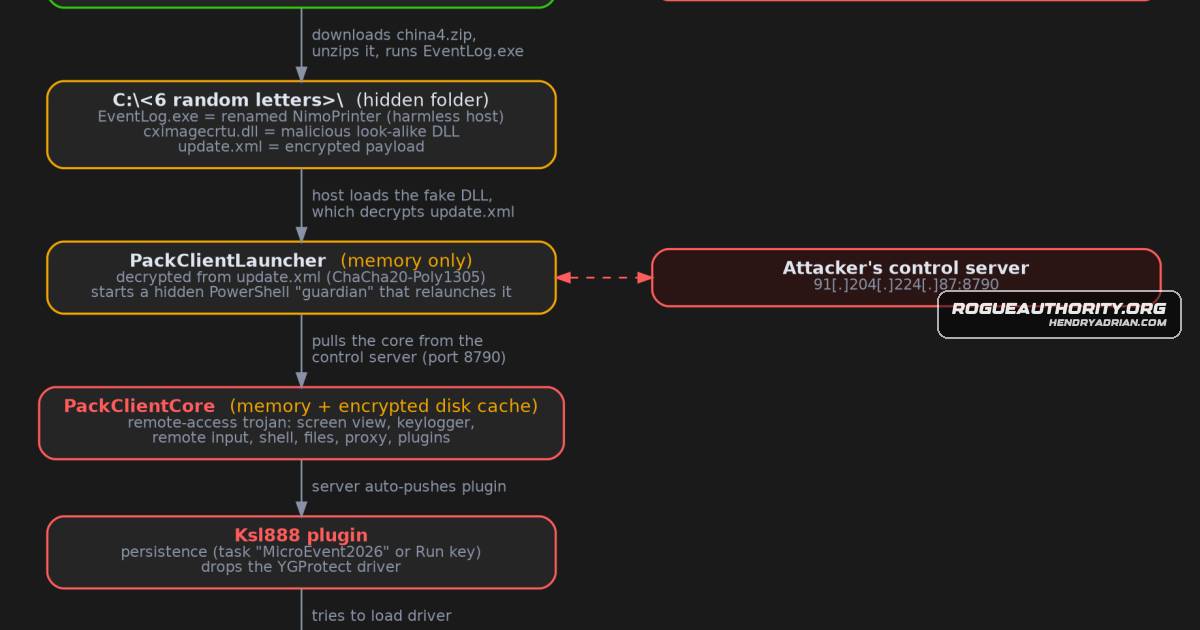
- The archive includes a renamed printer program that loads a malicious DLL; the DLL decrypts and runs the PackClient launcher in memory.
- PackClient RAT can capture screens, log keystrokes and clipboard contents, control the device, run commands, transfer files, and hijack copied text.
- The server pushed a plugin that establishes persistence and installs a signed kernel driver designed to terminate security products and protect the malware’s files and processes.
- The driver failed to load in all three sandbox runs of this sample. A sibling dropper’s artifacts suggest it loaded in a separate VirusTotal sandbox, but the article does not establish that it works on all systems.
- The investigation links the sample to the PackClient family but cannot identify who operated this campaign; named optional plugins were not observed in the analyzed sessions.
- Defenders are advised to look for MicroEvent2026 tasks, the YgProtect service, and PackMonitorClient files and registry entries.
Article Details
- Attack Vectors
- SilentSetup.exe checks for a hard-coded date and time before continuing, then downloads china4.zip and unpacks it into a hidden, system-marked folder under C:\.
- The dropped EventLog.exe, a renamed NimoPrinter program, loads a malicious cximagecrtu.dll placed beside it through DLL sideloading.
- The malicious DLL decrypts update.xml and loads PackClientLauncher directly into memory; the launcher downloads and loads PackClientCore.dll from its control server.
- PackClient RAT can capture screens, log keystrokes and clipboard contents, control the victim's system, transfer files, run commands, and route attacker traffic through the victim's PC.
- The server pushed PackExtraPlugin.Ksl888.dll, which attempts persistence through scheduled tasks or a Run key and uses the YGProtect driver to disable security products and protect the trojan's files and processes.
- In the three sandbox runs described, the driver failed to load; the article reports that a sibling dropper's driver may have loaded in a VirusTotal sandbox.
- Defensive Notes
- Treat an unexpected hidden folder with a random six-letter name under C:\ containing EventLog.exe and update.xml as a compromise indicator.
- Hunt for scheduled tasks named MicroEvent2026 or MicroEvent2026Maint, the YgProtect service, and ygp.dat in System32\drivers or Windows\Temp.
- Look for %LOCALAPPDATA%\PackMonitorClient\, HKCU\Software\PackMonitorClient\, and HKCU\Software\PackClientConsole\.
- Alert on hidden PowerShell launched with -File …\pack_proc_guard.ps1 -WatchPid.
- Block the listed download and control-server indicators, and use Emerging Threats rules for PackClient RAT as an additional network detection.
- Avoid routine use of administrator accounts and keep Secure Boot enabled; the article notes that the driver failed in the reported runs and that Secure Boot makes unsigned-by-Microsoft drivers harder to load.
- Verify the destination address after copying cryptocurrency addresses, because the RAT can replace clipboard contents matching an operator-defined pattern.
- Do not treat a valid code-signing signature as proof that an installer is safe.
Indicators of compromise
| Type | Indicator | Context |
|---|---|---|
| IPV4 | 156[.]251[.]16[.]214 | Control-server IP used by a sibling zip with the same DLL; the article reports port 8790. |
| IPV4 | 161[.]248[.]14[.]20 | Control-server IP used by the sibling dropper NexifySetup.exe; the article reports port 8790. |
| IPV4 | 91[.]204[.]224[.]87 | PackClient control-server IP; the article reports the server answering on port 8790. |
| SHA256 | 0efc2c7224d1662602fe6494f8d1834178ee5906a2270f33d7b2990bee79c7c9 | SHA-256 of the YGProtect driver, identified as ygp.dat. |
| SHA256 | 4b1b874c662418773f3166a621e01a3863e0df7f87e7a0a02dc8038f2cb0fc35 | SHA-256 of an older YGProtect driver build. |
| SHA256 | 82edd622a5d008d3918b663a141a5aa3b0941801d61ff5717c6d52cf67bbdc9f | SHA-256 of china4.zip, the archive downloaded by SilentSetup.exe. |
| SHA256 | 8bad5b867e640ef2a5d9909cde11788f78c45c9c40bea6c901cc0b9cf65bf91f | SHA-256 of PackClientCore.dll, the PackClient RAT core downloaded from the control server. |
| SHA256 | 93dfab86959d88de5c01186bfa92f52f91f8242045d274ef632f660bd7e41d51 | SHA-256 of PackClientLauncher, the malware launcher recovered from the sample. |
| SHA256 | af5062786294b67d1befa07b6a43e4f22cec72a887fe2e94e937688e15c53cc3 | SHA-256 of cximagecrtu.dll, the malicious sideloaded loader. |
| SHA256 | cba381dcd6b1ed6ddb494d35dc4f6be7dca832f040ef81cc4225e292c70e3dc1 | SHA-256 of update.xml, the encrypted payload file containing the program loaded by the malicious DLL. |
| SHA256 | dc27bb3c16f98f11a2cdb88be7c4d3edf8348ce5b1a9334f5bd2e569f3cbf050 | SHA-256 of SilentSetup.exe, the signed installer in the reported malware chain. |
| SHA256 | e7f671e57206d2ce764bae5a8e9424224c4e0992bdc0093cece5f5ca49bcffd0 | SHA-256 of NexifySetup.exe, a sibling dropper signed with the same installer certificate and reported to drop the same driver and helper DLLs. |
| SHA256 | ff66f97a671ca22a6ba00027b1ed7320322a03ba9652d314edfaa707bfa02b14 | SHA-256 of PackExtraPlugin.Ksl888.dll, the server-pushed plugin that attempts persistence and driver-based security-product interference. |
| URL | hxxp[:]//108[.]187[.]43[.]139:8080/china4[.]zip | Payload-download URL used by SilentSetup.exe to retrieve china4.zip. |
MITRE ATT&CK
T1027 · Obfuscated Files or InformationThe installer XOR-scrambles its download address, and the sideloaded DLL decrypts the EPK1-marked update.xml payload.T1041 · Exfiltration Over C2 ChannelThe article reports that PackClient sent captured screen thumbnails back to its control server during sandbox runs.T1053.005 · Scheduled TaskWith administrator rights, the plugin creates scheduled tasks named MicroEvent2026 or MicroEvent2026Maint for persistence.T1056.001 · KeyloggingPackClientCore's capabilities include logging keystrokes.T1059.001 · PowerShellThe launcher writes and starts a hidden PowerShell script, pack_proc_guard.ps1, to monitor and restart the trojan.T1090 · ProxyThe RAT can act as a proxy by routing attacker traffic through the victim's PC.T1105 · Ingress Tool TransferSilentSetup.exe downloads china4.zip, and PackClientLauncher downloads PackClientCore.dll from the control server.T1113 · Screen CapturePackClientCore can capture screen thumbnails, which the article says were sent to the server during sandbox runs.T1115 · Clipboard DataPackClientCore logs clipboard contents and can replace clipboard text matching an operator-defined pattern.T1497.003 · Time Based ChecksSilentSetup.exe exits before a hard-coded local date and time, delaying execution until 11 October 2026 at 20:00.T1543.003 · Windows ServiceThe plugin attempts to install the YGProtect kernel driver through a driver service; the reported sandbox runs did not confirm successful loading.T1547.001 · Registry Run Keys / Startup FolderWithout administrator rights, the plugin adds MicroEvent2026Maint to the user's Run key.T1562.001 · Disable or Modify ToolsThe plugin is built to use YGProtect to forcibly close security products including 360 Total Security, Huorong, and Microsoft Defender.T1574.002 · DLL Side-LoadingThe dropped EventLog.exe loads a malicious cximagecrtu.dll placed beside the legitimate NimoPrinter program.T1620 · Reflective Code LoadingThe sideloaded DLL decrypts the program in update.xml and loads it directly into memory rather than writing it as a normal file.
Threat Actors
Malware
Vendors
Huorong Network TechnologyThe kill list is mostly Qihoo 360 and Huorong security products, plus Microsoft Defender.MicrosoftThe kill list is mostly Qihoo 360 and Huorong security products, plus Microsoft Defender.Qihoo 360The kill list is mostly Qihoo 360 and Huorong security products, plus Microsoft Defender.
Products
360 Total Securityforcibly close security products: 360 Total Security and its many components, Huorong, and Microsoft Defender / Windows SecurityMicrosoft Defender Antimalware PlatformThe kill list is mostly Qihoo 360 and Huorong security products, plus Microsoft Defender.NimoPrinterMost of them are real: an old 2018 printing tool called NimoPrinter (renamed here to EventLog.exe to sound like part of Windows), its picture-processing and PDF libraries, and genuine Microsoft runtime files.PackMonitorClientThe whole toolkit calls itself "PackMonitorClient", and the operator side is PackMonitorServer.exe.Windows Securityforcibly close security products: 360 Total Security and its many components, Huorong, and Microsoft Defender / Windows Security
Tools
ANY.RUNTools used: Malcat, ILSpy, capa, capstone, unicorn, tshark, Recorded Future Triage and ANY.RUN.capaTools used: Malcat, ILSpy, capa, capstone, unicorn, tshark, Recorded Future Triage and ANY.RUN.CapstoneTools used: Malcat, ILSpy, capa, capstone, unicorn, tshark, Recorded Future Triage and ANY.RUN.ILSpyTools used: Malcat, ILSpy, capa, capstone, unicorn, tshark, Recorded Future Triage and ANY.RUN.MalcatTools used: Malcat, ILSpy, capa, capstone, unicorn, tshark, Recorded Future Triage and ANY.RUN.PackMonitorServer.exeThe whole toolkit calls itself "PackMonitorClient", and the operator side is PackMonitorServer.exe.Recorded Future TriageTools used: Malcat, ILSpy, capa, capstone, unicorn, tshark, Recorded Future Triage and ANY.RUN.tsharkTools used: Malcat, ILSpy, capa, capstone, unicorn, tshark, Recorded Future Triage and ANY.RUN.unicornTools used: Malcat, ILSpy, capa, capstone, unicorn, tshark, Recorded Future Triage and ANY.RUN.
Countries
ChinaProofpoint described PackClient in 2026: a RAT sold on Telegram and used by a group it tracks as TA4922 against China and India with tax-themed lures.IndiaProofpoint described PackClient in 2026: a RAT sold on Telegram and used by a group it tracks as TA4922 against China and India with tax-themed lures.