ClickFix Attack Spreads Potemkin, RMMProject and EtherRAT Across 11 Hosts
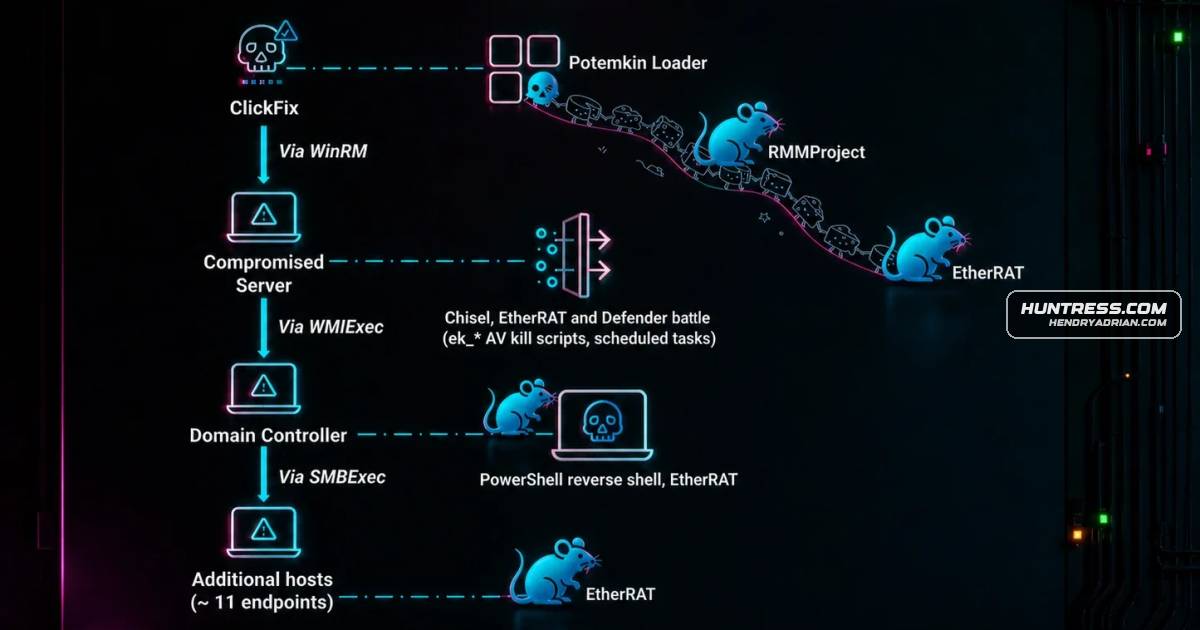
Summary
A ClickFix infection on an unmonitored endpoint led to Potemkin and RMMProject deployment, EtherRAT persistence and hands-on lateral movement across more than 11 hosts. Huntress says monitoring began after the intrusion was underway.
Key points
- A user was tricked into running a command that fetched an HTA payload and silently installed an MSI containing the Potemkin loader.
- Potemkin used a deterministic DGA and reflective loading to deliver RMMProject, a Lua-scriptable RAT with browser credential theft, remote control and module-loading capabilities.
- RMMProject bypassed Chrome App-Bound Encryption by injecting a helper DLL into a spawned browser process to recover keys for credential and cookie theft.
- The attackers deployed EtherRAT, which resolves its command-and-control address through the Ethereum blockchain, and used a Cloudflare tunnel for remote access.
- The operator attempted to disable Windows Defender, used Chisel tunnels and reverse shells, and moved laterally with WMIExec and SMBExec across more than 11 hosts.
- Huntress reports its agent was installed after the intrusion was underway; the SOC then contained the systems and began remediation. The article recommends monitoring all endpoints and alerting on cloudflared executions.
Article Details
- Attack Vectors
- A compromised website presented ClickFix instructions that induced a user to paste a command into the Windows Run dialog.
- The pasted command proxied remote HTA execution through legitimate Windows utilities, leading to a silently installed MSI and an in-memory follow-on implant.
- Compromised domain credentials enabled remote execution through WMI, WinRM, and SMB, including access to the domain controller.
- The operator distributed an MSI from an attacker-controlled administrative share during bulk lateral movement. Researchers could not retrieve that MSI, so its exact internal execution chain remains unconfirmed.
- Run keys, scheduled tasks, reconnecting reverse shells, reverse SOCKS tunnels, and an externally accessible tunnel provided persistence and remote access.
- Defensive Notes
- Audit endpoint-agent coverage across workstations, servers, and other network-connected machines; the initial unmonitored endpoint allowed substantial activity before visibility became available.
- The article recommends disabling the Windows Run dialog and Win+R through Group Policy to interrupt the observed initial execution path.
- Enable tamper protection where available and alert on security-service stops, service-disable commands, antivirus policy overrides, and exclusion-path additions.
- Alert on tunnel-client execution, including copies renamed to resemble Windows processes.
- For the observed JavaScript loader, terminate the Node processes, delete all three loader artifacts, and remove the persistence Run key; removing the key alone is insufficient because the loader rewrites it on startup.
- Sweep every affected host and user context for persistence because installation directories, payload filenames, and Run-key values vary.
- The loader's fixed-seed domain-generation sequence is finite and precomputable, allowing candidate-domain blocklisting.
Indicators of compromise
| Type | Indicator | Context |
|---|---|---|
| DOMAIN | anus-staylard[.]xyz | Live Potemkin C2 observed in a packet capture and listed as C2 for Potemkin and RMMProject. |
| DOMAIN | cl[.]distritovagas[.]com | ClickFix HTA delivery domain listed in the article's IOC table. |
| DOMAIN | fair-bath-fond[.]xyz | Potemkin DGA candidate observed in the captured infection; registration or live C2 status is not established. |
| DOMAIN | pestrear-lamp[.]xyz | Potemkin DGA candidate observed in the captured infection; registration or live C2 status is not established. |
| DOMAIN | resumeacceptable[.]com | EtherRAT C2 domain resolved through the Ethereum blockchain. |
| DOMAIN | rule-bead-dust[.]xyz | Potemkin DGA candidate observed in the captured infection; registration or live C2 status is not established. |
| DOMAIN | sonra[.]eutialyson[.]com | Attacker-controlled domain distributing the Potemkin MSI. |
| DOMAIN | uglyshop-mare[.]xyz | Potemkin DGA candidate observed in the captured infection; registration or live C2 status is not established. |
| IPV4 | 213[.]165[.]41[.]26 | Attacker Chisel reverse SOCKS server contacted on port 22603. |
| IPV4 | 77[.]110[.]122[.]58 | Attacker C2 and staging server hosting payloads, reverse-shell listeners, a Chisel endpoint, and an MSI administrative share. |
| SHA256 | 2abe5dd3a057fdef935722e50e9251c272d29fd26113187b853a1f9a9cb89d9b | RunSearch.exe Potemkin loader hash. |
| SHA256 | 2ada24dd6e517f37942b749c2bd57ddd97445e9853002cee70a0bc30d0b0ce3a | cons_1.0.1.msi installer identified as delivering EtherRAT. |
| SHA256 | 3b7ae925e2d64522b4f69b56285b05aeca8c5aab5ab46a9c02c4fafb69d881ce | RMMProject DLL served as avast_update.bin by the C2. |
| SHA256 | 79f7b67ce8b39070f3e1c2b90fce0ce84134782a7dedcccc1edac197ee9e089b | inst24.msi installer that drops Potemkin. |
| SHA256 | cd4e5e2c65b1660470d3446539ee68adf5faeece3eaeb46583623be9911ee145 | Embedded RMMProject helper DLL injected into a browser to recover App-Bound Encryption keys. |
| URL | hxxp[:]//77[.]110[.]122[.]58:23205/cons_1[.]0[.]1[.]msi | EtherRAT installer retrieved through scheduled-task and hands-on execution. |
| URL | hxxp[:]//77[.]110[.]122[.]58:23205/lQhEQui9a4lZ[.]exe | Attacker-hosted Chisel client downloaded repeatedly during attempts to evade Defender. |
| URL | hxxp[:]//77[.]110[.]122[.]58:44479/bjxxUmG8K3uy[.]ps1 | Attacker-hosted PowerShell script retrieved and executed for second-wave activity. |
| URL | hxxps[:]//cl[.]distritovagas[.]com/hte[.]hta | Remote HTA payload executed by the initial ClickFix command. |
| URL | hxxps[:]//resumeacceptable[.]com | Live EtherRAT C2 URL returned by its Ethereum contract at analysis time. |
MITRE ATT&CK
T1021.002 · SMB/Windows Admin SharesSMBExec performed bulk lateral execution, with payload installation from an attacker-hosted ADMIN$ share and output redirected through C$ shares.T1021.006 · Windows Remote ManagementWinRM Event ID 91 recorded an interactive cmd shell created with the compromised domain Administrator account.T1027 · Obfuscated Files or InformationPotemkin encrypted communication constants and its DGA dictionary; the EtherRAT loader stored an encrypted JavaScript payload.T1033 · System Owner/User DiscoveryThe operator ran whoami through SMBExec to verify the remote execution context.T1036.005 · Match Legitimate Resource Name or LocationThe attacker renamed cloudflared to svchost.exe and used WindowsHost and EdgeUpdate persistence names to resemble legitimate components.T1041 · Exfiltration Over C2 ChannelRMMProject serialized browser theft results, compressed them with zlib, and POSTed the task results to C2.T1047 · Windows Management InstrumentationWMIExec was used for reconnaissance and remote execution, including delivery of PowerShell loaders to the domain controller.T1053.005 · Scheduled TaskThe attacker created msiInstall2 to retrieve and execute an MSI and ekShell2 to launch a PowerShell reverse shell.T1055.001 · Dynamic-link Library InjectionRMMProject used VirtualAllocEx, WriteProcessMemory, and CreateRemoteThread with LoadLibraryW to inject its ABE helper DLL into a spawned browser.T1059.001 · PowerShellPowerShell scripts disabled defenses, retrieved payloads, loaded assemblies, and implemented reconnecting reverse shells.T1059.003 · Windows Command ShellThe operator used cmd.exe for remote execution and SMBExec wrappers that created, executed, and deleted batch files.T1059.007 · JavaScriptA signed Node.js runtime executed the JavaScript loader and decrypted EtherRAT payload.T1069.001 · Local GroupsAn early remote command ran whoami /groups and filtered the output for admin.T1070.004 · File DeletionSMBExec command chains immediately deleted their temporary batch files after execution.T1071.001 · Web ProtocolsPotemkin used HTTP GET and POST tasking endpoints; EtherRAT disguised polling URLs as image and stylesheet requests.T1078.002 · Domain AccountsRemote sessions used compromised domain credentials, including DOMAIN\Administrator.T1082 · System Information DiscoveryThe operator queried InstalledUICulture, Win32_VideoController, and computer domain-membership properties.T1090 · ProxyThe operator repeatedly deployed Chisel clients to establish reverse SOCKS proxy access.T1105 · Ingress Tool TransferThe intrusion downloaded HTA, MSI, DLL, executable, and PowerShell payloads from attacker infrastructure.T1112 · Modify RegistryAttack scripts wrote multiple Defender policy values to disable scanning and protection features.T1113 · Screen CaptureRMMProject supported ordinary desktop screenshots and streamed captures of a hidden desktop to its operator.T1134.001 · Token Impersonation/TheftRMMProject duplicated and impersonated the logged-on user's token to access browser profiles and launch processes under that user's context.T1140 · Deobfuscate/Decode Files or InformationThe loaders decrypted embedded strings and payloads, and RMMProject decoded its XOR-encoded helper DLL and base64 module payloads.T1204.004 · Malicious Copy and PasteA ClickFix page instructed the user to paste and run a command in the Windows Run dialog.T1218.005 · MshtaThe initial command invoked mshta.exe through pcalua.exe to execute a remotely hosted HTA.T1218.007 · MsiexecThe HTA and later intrusion commands used msiexec to silently install attacker-delivered MSI packages.T1518 · Software DiscoveryThe operator queried installed products while looking for ScreenConnect or ConnectWise installations.T1518.001 · Security Software DiscoveryReconnaissance queried SecurityCenter2 AntivirusProduct and checked Defender's RealTimeProtectionEnabled status.T1539 · Steal Web Session CookieRMMProject collected and decrypted browser cookies, including through a Chrome App-Bound Encryption bypass.T1547.001 · Registry Run Keys / Startup FolderPotemkin persisted through the RunSearch Run value; EtherRAT loaders used WindowsHost and EdgeUpdate Run values.T1555.003 · Credentials from Web BrowsersRMMProject read browser credential databases and decrypted saved credentials from Chrome, Firefox, and Edge.T1562.001 · Disable or Modify ToolsThe operator patched AMSI, changed Defender policies and preferences, added an exclusion path, and stopped or disabled security services.T1564.003 · Hidden WindowThe intrusion hid HTA, PowerShell, browser, and Node.js execution using hidden-window settings and conhost --headless.T1568.002 · Domain Generation AlgorithmsPotemkin and RMMProject generated candidate C2 domains using an embedded dictionary and deterministic XorShift32-based algorithm.T1572 · Protocol TunnelingA renamed cloudflared client exposed an internal service through a public quick tunnel, while Chisel provided reverse SOCKS tunnels.T1620 · Reflective Code LoadingPotemkin manually mapped the RMMProject DLL in memory, and RMMProject could reflectively map additional PE modules.
People
Malware
Vendors
Cloudflarea known Node.js backdoor that resolves its C2 address from the Ethereum blockchain, along with a Cloudflare tunnel for persistent access.HuntressHuntress previously documented a ClickFix case in February involving lateral movement and the delivery of malware-as-a-service loader Matanbuchus and a novel custom implant called AstarionRAT. In a new case in May 2026
Products
Edgescripting engine and consists of 15 task types, browser credential and cookie theft across Chrome/Firefox/Edge (including a Chrome App-Bound Encryption bypass via embedded DLL injection into a spawned browserGoogle Chromea LuaJIT scripting engine and consists of 15 task types, browser credential and cookie theft across Chrome/Firefox/Edge (including a Chrome App-Bound Encryption bypass via embedded DLL injection into a spawnedHuntress agentand spray EtherRAT across over 11 hosts. The intrusion was already well underway by the time the Huntress agent was installed on the affected endpoints.Microsoft Windowsfootholds established, the operator moved to hands-on-keyboard activity - fighting a running battle with Windows Defender, deploying Chisel reverse SOCKS tunnels, and spreading laterally via WMIExec and SMBExec toMozilla FirefoxLuaJIT scripting engine and consists of 15 task types, browser credential and cookie theft across Chrome/Firefox/Edge (including a Chrome App-Bound Encryption bypass via embedded DLL injection into a spawned browserNode.jsremote control module, and 15 distinct task types. Separately, the attacker deployed EtherRAT, a known Node.js backdoor that resolves its C2 address from the Ethereum blockchain, along with a Cloudflare tunnel forWindows Defenderestablished, the operator moved to hands-on-keyboard activity - fighting a running battle with Windows Defender, deploying Chisel reverse SOCKS tunnels, and spreading laterally via WMIExec and SMBExec to
Tools
Chiseloperator moved to hands-on-keyboard activity - fighting a running battle with Windows Defender, deploying Chisel reverse SOCKS tunnels, and spreading laterally via WMIExec and SMBExec to ultimately reach the domainCloudflaredEtherRAT was established, the threat actor used it to deliver a Cloudflare tunnel. The Cloudflare cloudflared client, renamed to svchost.exe to pose as a Windows process, opens a Cloudflare quick tunnel thatImpacket| findstr /i admin 1> \Windows\Temp\DqNtxC 2>&1 carries the redirect signature commonly associated with Impacket, where output is written to \Windows\Temp\<8 chars>. Alongside this, the attacker leveraged WMI and SMBsmbexecwith Windows Defender, deploying Chisel reverse SOCKS tunnels, and spreading laterally via WMIExec and SMBExec to ultimately reach the domain controller and spray EtherRAT across over 11 hosts. The intrusion waswmiexecbattle with Windows Defender, deploying Chisel reverse SOCKS tunnels, and spreading laterally via WMIExec and SMBExec to ultimately reach the domain controller and spray EtherRAT across over 11 hosts. The