
Fake DBeaver Installer Uses Azure Relay to Hide a myagent RAT
Summary
Researchers analyzed a fake DBeaver installer that sideloads the myagent RAT through a signed Realtek program and uses a generated list of Azure Relay addresses. Lab testing confirmed its remote-control capabilities; operator activity remains unknown.
Key points
- The ZIP pairs a genuine, Realtek-signed InstallShield executable with a malicious, unsigned ISSetup.dll and the genuine DBeaver installer as a decoy.
- The DLL sideloads through the Realtek executable, copies files under C:\ProgramData\, and creates an ISSetup logon task to run the RAT.
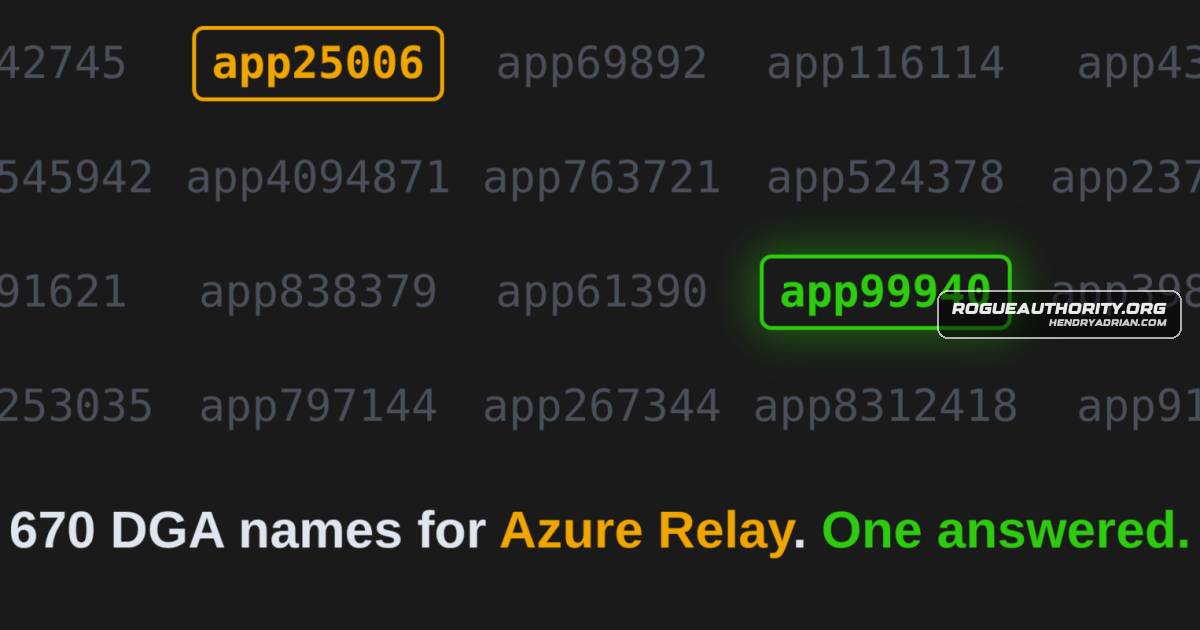
- The myagent RAT generates a fixed list of 670 Azure Relay names and attempts WebSocket connections to app-numbered namespaces under servicebus[.]windows[.]net.
- A sandbox listener accepted a connection but closed it after the initial handshake; researchers observed no operator commands, so actual use of the RAT is unknown.
- In an isolated lab, researchers confirmed remote shell access, file operations, screenshots, network tunneling, in-memory execution, plugin loading, and full-screen Edge pages.
- The article recommends checking for the ISSetup scheduled task, the HKCU\Software\myagent registry key, and suspicious Azure Relay WebSocket traffic.
Article Details
- Attack Vectors
- A fake DBeaver ZIP bundles a genuine Realtek-signed InstallShield setup program, a malicious ISSetup.dll, and the genuine DBeaver installer as a decoy.
- The trusted setup program loads the malicious ISSetup.dll from its own folder through DLL sideloading.
- The malware copies its folder to C:\ProgramData\dbeaver-ce-26.2.4-windows-x86_64\, launches the genuine installer as a decoy, and creates an ISSetup scheduled task that runs at logon.
- The RAT generates Azure Relay namespace names and uses WebSocket connections to seek a listener; app99940[.]servicebus[.]windows[.]net accepted a connection during testing.
- The RAT supports remote shell commands, file browsing and transfer, screenshots, network tunnelling, and running programs or DLLs from memory.
- Defensive Notes
- Download DBeaver only from dbeaver.io or its official GitHub releases; the article says the genuine Windows installer is a single signed executable, not a ZIP containing a CAB, INI, and DLL.
- Do not treat a valid signature on an executable as validation of files it loads from the same directory.
- Look for an ISSetup logon task running rundll32.exe with ISSetup.dll, the registry key HKCU\Software\myagent, and InstallShield-related files under C:\ProgramData\.
- Alert on WebSocket traffic to app<digits>.servicebus.windows.net using /$hc/test2/api/, particularly from machines with no expected Azure Relay use.
- Investigate rundll32.exe making outbound HTTPS connections.
Indicators of compromise
| Type | Indicator | Context |
|---|---|---|
| DOMAIN | app99940[.]servicebus[.]windows[.]net | Azure Relay namespace where a listener accepted the RAT's connection during sandbox testing; the listener's operator was not identified. |
| SHA256 | 0b080b0a96311a04355eaa2a5304d120ace39a5cf0545b8f7fdf40b6aeac9418 | SHA-256 of the malicious ISSetup.dll identified as the myagent RAT. |
| SHA256 | 550ca84d2879598bc4c41784b211fffad233e767db8eb6745fcfd92353a641cd | SHA-256 of the malicious ZIP bundle containing the sideloaded RAT. |
| SHA256 | a8f3c80936700a8996dc5acf16139531530a60c630cda9081dd1507e4757bd50 | SHA-256 of the setup.ini included in the malicious bundle, with the added SSID=dbeaver line. |
MITRE ATT&CK
T1016 · System Network Configuration DiscoveryThe DLL looks up the machine's public IP address using api.ipify.org and icanhazip.com.T1053.005 · Scheduled TaskThe DLL creates an ISSetup scheduled task configured to run at every logon.T1057 · Process DiscoveryThe RAT's ps command lists running programs.T1059.003 · Windows Command ShellThe RAT supports an interactive command shell and running individual commands through its cmd command.T1071.001 · Web ProtocolsThe RAT communicates with Azure Relay over WebSocket connections using HTTPS.T1083 · File and Directory DiscoveryThe RAT's ls command browses directories and returns directory listings.T1105 · Ingress Tool TransferThe RAT's get and put commands support downloading and uploading files, and it can run extra programs or DLLs from memory.T1113 · Screen CaptureThe RAT's screen command captures screenshots.T1568.002 · Domain Generation AlgorithmsThe RAT uses a fixed formula to generate a list of 670 Azure Relay namespace names and tries them until one responds.T1572 · Protocol TunnelingThe RAT's sock messages can tunnel network connections through the infected victim.T1573.001 · Symmetric CryptographyThe RAT scrambles JSON messages with XOR using a hard-coded key combined with the victim ID.T1574.002 · DLL Side-LoadingThe genuine InstallShield setup.exe loads the malicious ISSetup.dll placed alongside it.
Malware
Vendors
DBeaver CorpNot a cab file at all. It is the genuine DBeaver installer, validly signed by DBeaver CorpMicrosoftInstead it connects through Azure Relay, a Microsoft cloud service, picking the address from a list it generates itself.Realtek Semiconductor CorpA genuine InstallShield setup.exe, signed by Realtek Semiconductor Corp. in 2018, renamed
Products
Azure RelayInstead it connects through Azure Relay, a Microsoft cloud service, picking the address from a list it generates itself.DBeaverA zip named dbeaver-ce-26.2.4-windows-x86_64.zip looks like the installer for DBeaver, a popular free database tool.InstallShieldA genuine InstallShield setup.exe, signed by Realtek Semiconductor Corp. in 2018, renamedMicrosoft Edgeopen a page in Microsoft Edge full-screen kiosk mode, with no address bar or close button
Tools
capaTools used: Malcat, capa, FLOSS, KesaKode, a sandboxed Wine setup, Recorded Future Triage, tshark and a few short Python scripts.FLOSSTools used: Malcat, capa, FLOSS, KesaKode, a sandboxed Wine setup, Recorded Future Triage, tshark and a few short Python scripts.KesaKodeTools used: Malcat, capa, FLOSS, KesaKode, a sandboxed Wine setup, Recorded Future Triage, tshark and a few short Python scripts.MalcatTools used: Malcat, capa, FLOSS, KesaKode, a sandboxed Wine setup, Recorded Future Triage, tshark and a few short Python scripts.Recorded Future TriageTools used: Malcat, capa, FLOSS, KesaKode, a sandboxed Wine setup, Recorded Future Triage, tshark and a few short Python scripts.tsharkTools used: Malcat, capa, FLOSS, KesaKode, a sandboxed Wine setup, Recorded Future Triage, tshark and a few short Python scripts.