
Signed QuaTouchCtrl Loader Uses Mutual TLS to Reach Its Command Server
Summary
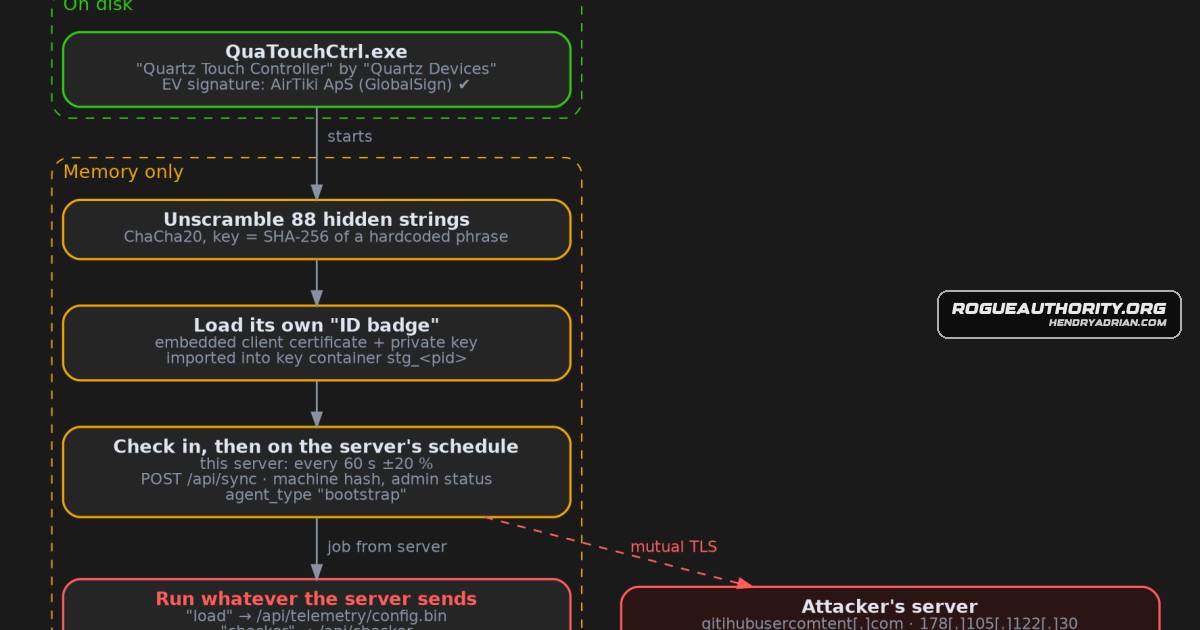
Analysis identifies QuaTouchCtrl.exe as a signed loader with encrypted strings and an embedded client certificate for mutual TLS. It can run server-provided modules in memory; the observed server replied with no jobs.
Key points
- QuaTouchCtrl.exe disguises itself as a Quartz touch-controller utility and carries a valid EV signature attributed to AirTiki ApS, which the article says is unrelated to the claimed product.
- The loader decrypts 88 strings with ChaCha20, including its configuration, server details, and embedded client certificate and private key.
- It uses a client certificate issued by private CA ca-arch for mutual TLS; the malware disables validation of the server certificate.
- The loader checks in to gitihubusercomtent[.]com at 178[.]105[.]122[.]30 and can run server-provided modules in memory without writing them to disk.
- In a sandbox capture, the live server accepted the client certificate and replied with a 60-second interval and no jobs; the researchers did not retrieve the unavailable modules.
- The article reports testing job handling against a researcher-controlled fake server using junk payloads, so no real modules were loaded during those tests.
- The analysis recommends hunting for the ca-arch and srv-arch.internal certificate identifiers, the listed domain and IP, and an unusual WinHTTP user-agent string.
Article Details
- Attack Vectors
- QuaTouchCtrl.exe disguises itself as the signed “Quartz Touch Controller” driver helper from “Quartz Devices”; the article does not establish how it reaches victims.
- The loader checks in with its C2 server over HTTPS using a built-in client certificate for mutual TLS.
- The loader can download server-assigned programs and map and run them from memory without writing them to disk.
- Its strings are encrypted with ChaCha20 and decrypted at startup.
- Defensive Notes
- Block and hunt for gitihubusercomtent[.]com and 178[.]105[.]122[.]30.
- Look for TLS servers presenting CN=srv-arch.internal with issuer CN=ca-arch; the article identifies these certificates as fingerprints of the operation.
- Investigate unusual WinHTTP traffic using the truncated user agent Mozilla/5.0 (Windows NT 10.0; Win64; x64) AppleWebKit/537.36.
- On suspect hosts, investigate an unfamiliar driver process that created an orphaned crypto key container under %APPDATA%\Microsoft\Crypto\RSA\<SID>\.
- Do not treat a valid code-signing signature as proof that a program is safe; obtain drivers and device utilities from the PC or device maker.
Indicators of compromise
| Type | Indicator | Context |
|---|---|---|
| DOMAIN | gitihubusercomtent[.]com | C2 domain contacted by the loader. |
| IPV4 | 178[.]105[.]122[.]30 | IP address of the loader's C2 server. |
| SHA256 | a967b46481f77ce9bdd6e57afe858943dd5c03e8810a95e3223c9b2ccec06ec6 | SHA-256 hash of the QuaTouchCtrl.exe loader. |
| SHA256 | bfe114ef9835d9d0ac996a19f25d2ae4c4d4e7d50185bd72e82d48ccea9db893 | SHA-256 fingerprint of the client certificate embedded in the loader and used for mutual TLS. |
| SHA256 | ef54a9c2cab7fbcc2cca17dd1e5ca6dc207b06e80bd44f44689af7bb3527de39 | SHA-256 fingerprint of the C2 server certificate. |
MITRE ATT&CK
T1027 · Obfuscated Files or InformationThe loader encrypts all 88 text strings with ChaCha20 and decrypts them at runtime.T1036 · MasqueradingThe loader presents itself as a signed “Quartz Touch Controller” driver helper from “Quartz Devices.”T1069.001 · Local GroupsThe loader reports whether it is running as an administrator, as SYSTEM, or as a member of the Administrators group.T1071.001 · Web ProtocolsThe loader checks in to its C2 server using HTTPS POST requests and JSON messages.T1082 · System Information DiscoveryThe check-in includes a machine fingerprint derived from the Windows machine GUID, computer name, and C: drive serial number.T1105 · Ingress Tool TransferThe loader can download the server-assigned module and checker programs.T1140 · Deobfuscate/Decode Files or InformationAt startup, the loader decrypts its embedded strings, including its server details and message templates.T1573 · Encrypted ChannelThe loader communicates with its C2 server over TLS using a built-in client certificate for mutual TLS.T1620 · Reflective Code LoadingThe loader manually maps downloaded programs into memory and runs them without writing them to disk.
Malware
Products
Microsoft WindowsCode signing is a digital seal that tells Windows which company published a program and that nobody has changed it since.Quartz Touch ControllerQuaTouchCtrl.exe calls itself the "Quartz Touch Controller" from "Quartz Devices", a driver helper that "processes touch controller interrupts".
Tools
ANY.RUNTools used: Malcat, capa, FLOSS, pefile/capstone, OpenSSL, tshark, Wine (sandboxed) and ANY.RUN.capaTools used: Malcat, capa, FLOSS, pefile/capstone, OpenSSL, tshark, Wine (sandboxed) and ANY.RUN.FLOSSTools used: Malcat, capa, FLOSS, pefile/capstone, OpenSSL, tshark, Wine (sandboxed) and ANY.RUN.MalcatTools used: Malcat, capa, FLOSS, pefile/capstone, OpenSSL, tshark, Wine (sandboxed) and ANY.RUN.OpenSSLTools used: Malcat, capa, FLOSS, pefile/capstone, OpenSSL, tshark, Wine (sandboxed) and ANY.RUN.pefile/capstoneTools used: Malcat, capa, FLOSS, pefile/capstone, OpenSSL, tshark, Wine (sandboxed) and ANY.RUN.tsharkTools used: Malcat, capa, FLOSS, pefile/capstone, OpenSSL, tshark, Wine (sandboxed) and ANY.RUN.WineTools used: Malcat, capa, FLOSS, pefile/capstone, OpenSSL, tshark, Wine (sandboxed) and ANY.RUN.