BlackCrypt Malware Uses Signed RMM Agent to Hide Phishing Lures
Summary
Sandbox analysis found that BlackCrypt’s signed Windows agent installs as a service, enables remote control and searches for fake DocuSign, Adobe and other installers to hide them. The report identifies blackcryptknight[.]com as a C2 domain.
Key points
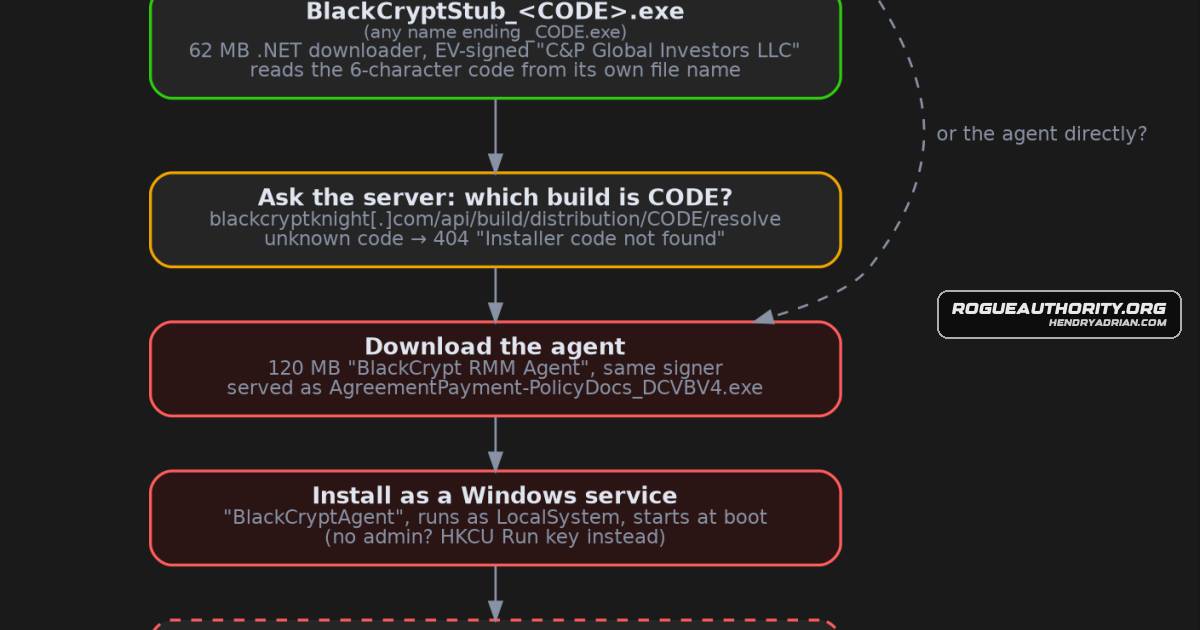
- A small downloader retrieves a BlackCrypt agent using a six-character code in the downloader’s filename; without the code, it stops.
- The agent installs as a Windows service running as LocalSystem, or uses a per-user autostart entry, and supports remote commands, shells and screenshots.
- Both programs are EV-signed by C&P Global Investors LLC but branded as BlackCrypt Labs Inc.; the report says both certificates were reported to their issuing CAs.
- In a sandbox, the server sent automatic scripts within seconds of enrollment to search for and hide fake DocuSign, Adobe, HSA and payment-document installers.
- The lure installers were not recovered, and the analysis did not establish who operates BlackCrypt or what happens after initial onboarding.
- The report identifies BlackCryptAgent, related file paths, a mutex and scheduled-task names as defender search leads, and recommends allowing only approved RMM tools.
Article Details
- Attack Vectors
- A downloader requires a six-character code appended to its filename, queries blackcryptknight[.]com for the corresponding build, downloads the Agent, and runs it.
- The article reports that the operator's scripts search user folders for fake DocuSign, Adobe, HSA, and payment-document installers and move matching files to a temporary folder where they are hidden.
- The Agent installs as a Windows service running as LocalSystem when elevated, or uses a per-user Run registry entry without admin rights; it maintains a WebSocket connection for remote commands.
- The Agent supports PowerShell, cmd, and batch execution, including execution as SYSTEM through a scheduled task, remote terminal sessions, and screenshot capture.
- Defensive Notes
- Look for the BlackCryptAgent service, the folders C:\Program Files\BlackCrypt Labs\ and C:\ProgramData\BlackCrypt\, the Global\BlackCryptRmmAgentSingleton mutex, processes launched with --session-task, and scheduled tasks named BlackCrypt-System-<id> or BlackCryptSessionTask_<id>.
- Alert on executables named *_XXXXXX.exe (six letters or digits) signed by C&P Global Investors LLC, and block the reported C2 domains and IP address.
- Use an allow-list for RMM software and investigate any RMM agent not deployed by the IT team.
- Advise users not to run installers presented as document readers or updates from unexpected email attachments or download links.
Indicators of compromise
| Type | Indicator | Context |
|---|---|---|
| DOMAIN | apinetsolworkspace[.]network | Domain listed in the article as BlackCrypt C2 infrastructure. |
| DOMAIN | blackcryptknight[.]com | BlackCrypt C2 domain used to resolve downloader build codes and host the operator panel. |
| DOMAIN | devicehubcloud[.]com | Domain listed in the article as BlackCrypt C2 infrastructure. |
| DOMAIN | ws[.]blackcryptknight[.]com | Reported C2 domain used as the Agent's WebSocket host. |
| IPV4 | 89[.]117[.]54[.]201 | Reported WebSocket C2 IP address. |
| SHA256 | 7206a66435b45db34e7772297b192d296e3206bedf0a854f1593717f6545285b | SHA-256 hash identified in the article as BlackCrypt Agent 4.2.1.36. |
| SHA256 | 971492297864b72dbfbede769f1ea6472ad80d911404636d14d4fa5babdc68c4 | SHA-256 hash identified in the article as the September 2026 BlackCrypt Stub. |
| SHA256 | bb5c49eaa94615f7d75cfa80afb8e79b12da2defc47d9b9c53d7602e7171b668 | SHA-256 hash identified in the article as BlackCrypt Agent 4.2.1.35. |
| SHA256 | f58b67e61ee947afd2e9e45f7ecd392d5fedc8f6b29a3d2ec5a323e38aba253c | SHA-256 hash identified in the article as the new BlackCrypt Stub. |
MITRE ATT&CK
T1053.005 · Scheduled TaskFor requested SYSTEM execution, the Agent uses a throwaway scheduled task.T1059.001 · PowerShellThe Agent accepts and runs PowerShell commands and scripts sent by the server.T1059.003 · Windows Command ShellThe Agent supports remote cmd commands and terminal sessions.T1071.001 · Web ProtocolsThe Agent maintains a live WebSocket connection for server-pushed orders.T1113 · Screen CaptureThe Agent captures the logged-in user's desktop and uploads screenshots.T1543.003 · Windows ServiceWith admin rights, the Agent registers and starts the BlackCryptAgent Windows service, running as LocalSystem.T1547.001 · Registry Run Keys / Startup FolderWithout admin rights, the Agent establishes persistence using a per-user HKCU Run registry entry.T1564.001 · Hidden Files and DirectoriesOperator-supplied scripts move lure installers into a temporary folder and mark them hidden.
Malware
Vendors
Products
BlackCrypt RMM AgentA small downloader fetches a “BlackCrypt RMM Agent”, which installs itself as a Windows service and gives a remote operator full control of the PC.Microsoft WindowsA small downloader fetches a “BlackCrypt RMM Agent”, which installs itself as a Windows service and gives a remote operator full control of the PC.
Tools
capaTools used: Malcat, ILSpy, a small custom .NET bundle extractor, capa, YARA, osslsigncode and OpenSSL, tshark, and the Hatching Triage sandbox.Hatching TriageTools used: Malcat, ILSpy, a small custom .NET bundle extractor, capa, YARA, osslsigncode and OpenSSL, tshark, and the Hatching Triage sandbox.ILSpyTools used: Malcat, ILSpy, a small custom .NET bundle extractor, capa, YARA, osslsigncode and OpenSSL, tshark, and the Hatching Triage sandbox.MalcatTools used: Malcat, ILSpy, a small custom .NET bundle extractor, capa, YARA, osslsigncode and OpenSSL, tshark, and the Hatching Triage sandbox.OpenSSLTools used: Malcat, ILSpy, a small custom .NET bundle extractor, capa, YARA, osslsigncode and OpenSSL, tshark, and the Hatching Triage sandbox.osslsigncodeTools used: Malcat, ILSpy, a small custom .NET bundle extractor, capa, YARA, osslsigncode and OpenSSL, tshark, and the Hatching Triage sandbox.REMnuxThis analysis and write-up were produced by Claude (Opus 5.5), working as an agent in Claude Code on a REMnux analysis VM.tsharkTools used: Malcat, ILSpy, a small custom .NET bundle extractor, capa, YARA, osslsigncode and OpenSSL, tshark, and the Hatching Triage sandbox.YARATools used: Malcat, ILSpy, a small custom .NET bundle extractor, capa, YARA, osslsigncode and OpenSSL, tshark, and the Hatching Triage sandbox.