
LevelBlue Details YellowKey BitLocker Bypass and Windows Privilege-Escalation Techniques
Summary
LevelBlue’s technical analysis explains how the YellowKey PoC abuses WinRE TxF replay to bypass BitLocker on TPM-only systems, and examines GreenPlasma and MiniPlasma privilege-escalation techniques, detection signals and Microsoft mitigation guidance.
Key points
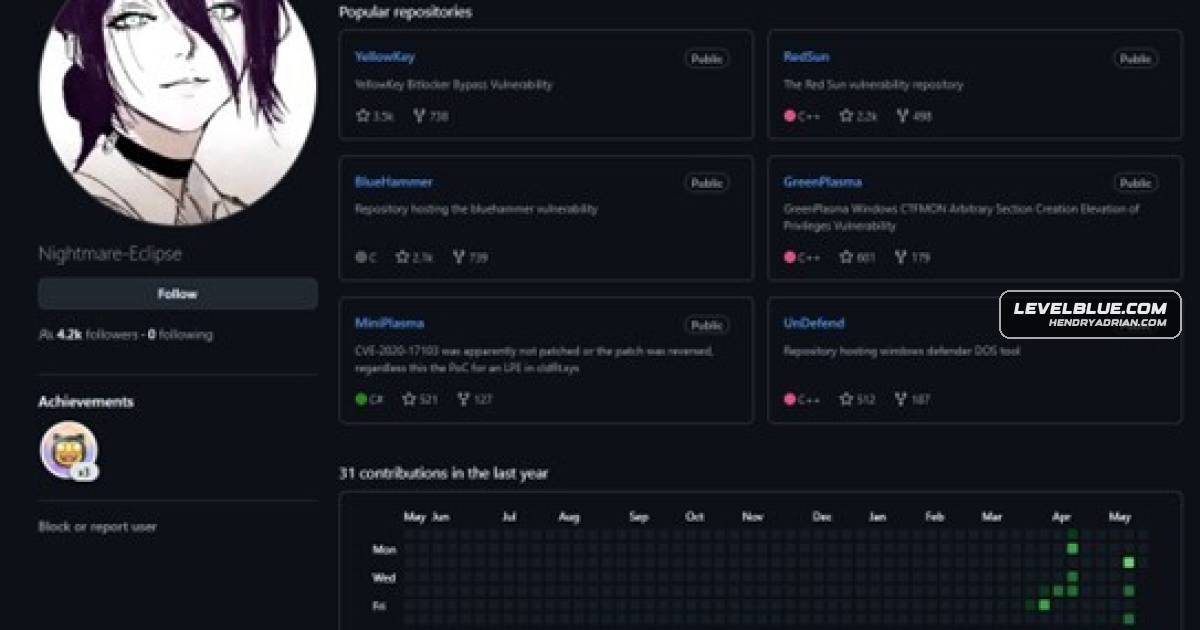
- LevelBlue attributes the public YellowKey, GreenPlasma and MiniPlasma disclosures to the actor using the names Chaotic Eclipse and Nightmare Eclipse.
- YellowKey uses crafted CLFS/TxF logs processed during WinRE startup to replace winpeshl.ini, causing a command shell to launch after TPM-only BitLocker has unlocked the volume.
- The described YellowKey PoC requires brief physical access and can stage payload data on USB media or the EFI System Partition; the article says Windows 11, Windows Server 2022 and Windows Server 2025 are affected.
- Microsoft assigned YellowKey CVE-2026-45585 and issued WinRE mitigation guidance; the article says TPM+PIN configurations are not vulnerable and a security update is pending.
- GreenPlasma demonstrates arbitrary section-object placement through Windows object-manager behavior. MiniPlasma targets a cldflt.sys race condition; the actor claims the previously patched CVE-2020-17103 code path remains exploitable on current builds.
- The article recommends correlating WinRE activity, TxF/CLFS artifacts, registry changes, scheduled-task execution and unusual process behavior for detection.
Article Details
- Attack Vectors
- YellowKey uses brief physical access and a USB device, or staging on the EFI System Partition, to place crafted TxF/CLFS data where WinRE can process it during early boot.
- YellowKey exploits WinRE transaction replay to overwrite winpeshl.ini, causing the recovery shell to fall back to cmd.exe after the TPM has unlocked a BitLocker volume. The report identifies TPM-only configurations as vulnerable; Microsoft says TPM+PIN configurations are not vulnerable.
- MiniPlasma exploits a race condition in cldflt.sys by interrupting Cloud Files hydration with CfAbortOperation while changing thread impersonation state, enabling registry access-check bypass and local privilege escalation to SYSTEM.
- MiniPlasma redirects a registry path and the windir environment variable, then uses the Windows Error Reporting QueueReporting scheduled task to run an attacker-controlled wermgr.exe under SYSTEM.
- GreenPlasma uses Windows object manager symbolic links and CTF-related namespaces to create an attacker-controlled section object in a protected location.
- Defensive Notes
- Microsoft's guidance for CVE-2026-45585 is to remove autofstx.exe from the BootExecute registry value in the WinRE image; the article says a security update was pending.
- Microsoft confirms that TPM+PIN configurations are not vulnerable to YellowKey. The disclosure actor's contrary claim about TPM+PIN is unsupported by a released PoC and conflicts with Microsoft's guidance.
- Restrict external boot and protect UEFI/BIOS settings to reduce USB-based staging risk. The article notes these controls do not fully prevent offline modification of the EFI System Partition.
- Correlate TxF/CLFS filesystem artifacts, WinRE entry and duration, BootExecute contents in the WinRE offline SYSTEM hive, and recovery-session behavior. The report identifies VMware OUI values in TxF GUIDs as a high-confidence forensic marker on physical endpoints, but says the marker is not guaranteed across variants.
- Monitor for MiniPlasma-related registry symbolic links and windir changes, unexpected QueueReporting task execution, wermgr.exe launched from a non-standard path, and the MiniPlasmaWERPipe named pipe.
- The article recommends auditing CloudFiles policy-key and Volatile Environment registry changes, and considering restrictions on manual triggering of Windows Error Reporting scheduled tasks where not operationally required.
Indicators of compromise
| Type | Indicator | Context |
|---|---|---|
| SHA256 | 6ac1febd94d0582c259ef5e89b1059bf307d5cddbb7bf935ef23b9700f8e2067 | Hash identified in the article as a YellowKey PoC artifact associated with the TxF/CLFS payload. |
MITRE ATT&CK
T1053.005 · Scheduled TaskMiniPlasma triggers the Windows Error Reporting QueueReporting scheduled task to run attacker-controlled wermgr.exe under SYSTEM.T1059.003 · Windows Command ShellYellowKey causes WinRE to fall back to cmd.exe, providing a SYSTEM-level command shell after transaction replay.T1068 · Exploitation for Privilege EscalationMiniPlasma exploits a race condition in cldflt.sys to achieve local privilege escalation to SYSTEM.T1112 · Modify RegistryMiniPlasma modifies registry paths, replaces a key with a symbolic link, and changes the windir value to redirect execution.T1134.001 · Token Impersonation/TheftMiniPlasma duplicates a SYSTEM token and assigns it to the current user session to obtain an interactive SYSTEM shell.T1565.001 · Stored Data ManipulationYellowKey replays a crafted TxF transaction that overwrites WinRE's winpeshl.ini with the contents of win.ini.
CVE
CVE-2020-17103The vulnerability was originally identified by James Forshaw of Google Project Zero and assigned CVE-2020-17103.CVE-2026-45585Microsoft assigned CVE-2026-45585 to the YellowKey BitLocker bypass and released mitigation guidance, while the report details PoC mechanics, detection opportunities, and attacker artifacts tied to the disclosed
People
Vendors
Products
BitLockerNightmare Eclipse, including YellowKey, GreenPlasma, and MiniPlasma, affecting Windows security, WinRE, BitLocker, and privilege escalation paths.Microsoft OneDrive[API name] MiniPlasma exploit behavior – CfAbortOperation invoked by a non-OneDrive process, cldapi.dllWindows 11The YellowKey PoC targets Windows 11, Windows Server 2022, and Windows Server 2025, requiring only brief physical access and a USB device.Windows Server 2022The YellowKey PoC targets Windows 11, Windows Server 2022, and Windows Server 2025, requiring only brief physical access and a USB device.Windows Server 2025The YellowKey PoC targets Windows 11, Windows Server 2022, and Windows Server 2025, requiring only brief physical access and a USB device.