Zalmoxis Stealer Hides Behind Signed Loader and Name-Based Execution
Summary
Researchers analyzed a signed loader that activates only under specific filenames, installs persistence, and retrieves the Zalmoxis stealer. The malware targets browser data, crypto wallets, and Chrome’s App-Bound Encryption key.
Key points
- The loader exits when run as File.exe but installs or retrieves its payload when named CrashHandler.exe or Updater.exe, a behavior that can evade automated sandbox analysis.
- Two builds were signed with different GlobalSign EV certificates issued to companies in Croatia and Poland; the researchers reported both certificates.
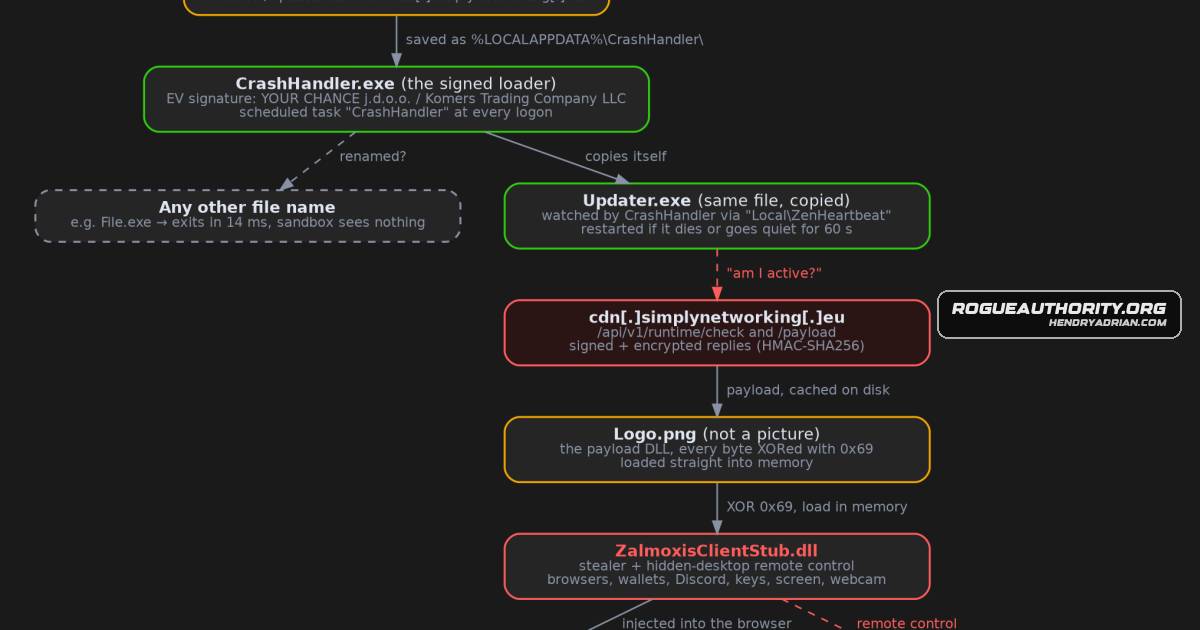
- CrashHandler establishes logon persistence through a scheduled task or Startup-folder shortcut, then supervises an Updater copy using shared memory.
- The loader retrieves payloads from cdn[.]simplynetworking[.]eu using signed and encrypted server replies; researchers recreated the protocol and tested it with a harmless payload in an isolated environment.
- The Zalmoxis payload steals browser credentials, cookies, crypto wallets, and account tokens, and supports keylogging, screenshots, webcam access, and hidden-desktop remote control.
- A bundled DLL injects into a Chromium browser process to obtain Chrome’s App-Bound Encryption key; the article says researchers did not contact the live servers or verify what they currently serve.
- Defenders can look for the CrashHandler task, CrashHandler.exe, Updater.exe, Logo.png, and the Local\ZenHeartbeat shared-memory name.
Article Details
- Attack Vectors
- The loader changes behavior according to its filename: as CrashHandler.exe it installs itself, while as Updater.exe it contacts its server and loads a payload; under other names it exits.
- Downloaders including tea.exe and updsvc.exe fetched /Updater.exe and saved it as %LOCALAPPDATA%\CrashHandler\CrashHandler.exe.
- The loader establishes logon persistence with a scheduled task named CrashHandler, falling back to a Startup-folder shortcut if task creation fails.
- The loader downloads an XOR-obfuscated DLL as Logo.png, unscrambles it in memory, and loads it without writing a conventional DLL file to disk.
- The Zalmoxis payload steals browser credentials, cookies, crypto-wallet data, and account tokens; it also includes keylogging, clipboard access, screenshots, webcam access, and hidden-desktop remote control.
- Zalmoxis places ChromiumPayloadABE.dll into a Chromium browser process to obtain Chrome's App-Bound Encryption cookie key.
- Defensive Notes
- Be wary of unexpected updaters or crash handlers, particularly files appearing under %LOCALAPPDATA%\CrashHandler\.
- Hunt for the \CrashHandler scheduled task; CrashHandler.exe, Updater.exe, and Logo.png in the same folder; and the shared-memory name Local\ZenHeartbeat.
- A Logo.png file that lacks a PNG header but becomes an MZ-format file after XOR with 0x69 is a strong signal.
- The loader uses the unusual, truncated user agent Mozilla/5.0 (Windows NT 10.0; Win64; x64) AppleWebKit/537.36.
- If a signed sample appears inactive, test it under the filenames CrashHandler.exe and Updater.exe.
- If infection is suspected, assume browser passwords, sessions, and wallets may be compromised; change passwords from a clean device, sign out of sessions, and move crypto funds to a new wallet.
Indicators of compromise
| Type | Indicator | Context |
|---|---|---|
| DOMAIN | cdn[.]simplynetworking[.]eu | Loader server used for check-in and payload requests. |
| IPV4 | 45[.]152[.]149[.]66 | Hard-coded Zalmoxis server address found in the payload code; the researchers did not observe traffic to it. |
| SHA256 | 4ee019bed7bc98e908b164c6c0ea6ecb3a9ea9a5ddeabea8fe9ae77d639548d5 | Hash of the ZalmoxisClientStub.dll payload. |
| SHA256 | 57eec1d0ac09c29ccfba43fcd44b04d8cdccea5e5b7653278a4fa2994233861c | Hash of Logo.png, which contains the scrambled payload. |
| SHA256 | 8bfc78bf454a49f4a0d0a09f1d53a59bccfe47cf4405acd1557391f778dcd3ee | Hash of ChromiumPayloadABE.dll, the embedded DLL used to obtain Chrome's cookie-protection key. |
| SHA256 | ad0d08d54c9bbe2309bb7a8ae92def8a04297d0238f2799764d93929b57cbd5f | Hash of the File.exe loader signed with the YOUR CHANCE j.d.o.o. certificate. |
| SHA256 | e518987c6e2678fa89da4755adab11d9d01f1331b763766146b1a467522be13c | Hash of an earlier loader build signed with the Komers Trading Company LLC certificate. |
MITRE ATT&CK
T1027 · Obfuscated Files or InformationThe Logo.png payload is concealed by XORing every byte with 0x69, and the embedded Chromium DLL is encrypted with ChaCha20.T1036.005 · Match Legitimate Resource Name or LocationThe loader changes behavior based on its filename, requiring names such as CrashHandler.exe or Updater.exe, and disguises a DLL payload as Logo.png.T1053.005 · Scheduled TaskThe loader creates a scheduled task named CrashHandler to run at every logon.T1055 · Process InjectionZalmoxis places ChromiumPayloadABE.dll into a Chromium browser process to request Chrome's cookie key.T1056.001 · KeyloggingThe Zalmoxis payload includes a keylogger.T1105 · Ingress Tool TransferThe Updater copy requests and downloads a payload from the server, and downloaders fetch /Updater.exe.T1113 · Screen CaptureThe Zalmoxis payload can capture screenshots.T1115 · Clipboard DataThe Zalmoxis payload can read and write clipboard contents.T1125 · Video CaptureThe Zalmoxis payload includes webcam access.T1140 · Deobfuscate/Decode Files or InformationThe loader XOR-decodes Logo.png in memory before loading the resulting DLL.T1539 · Steal Web Session CookieZalmoxis steals browser cookies and includes a component that obtains Chrome's App-Bound Encryption cookie key.T1547.001 · Registry Run Keys / Startup FolderIf scheduled-task creation fails, the loader falls back to a shortcut in the Startup folder.T1555.003 · Credentials from Web BrowsersZalmoxis is described as stealing saved passwords from Chrome, Edge, Brave, Avast Browser, and Firefox.