
Analysis Links Remote AI Agent to Domain Hosting an RDP Password-Spraying Panel
Summary
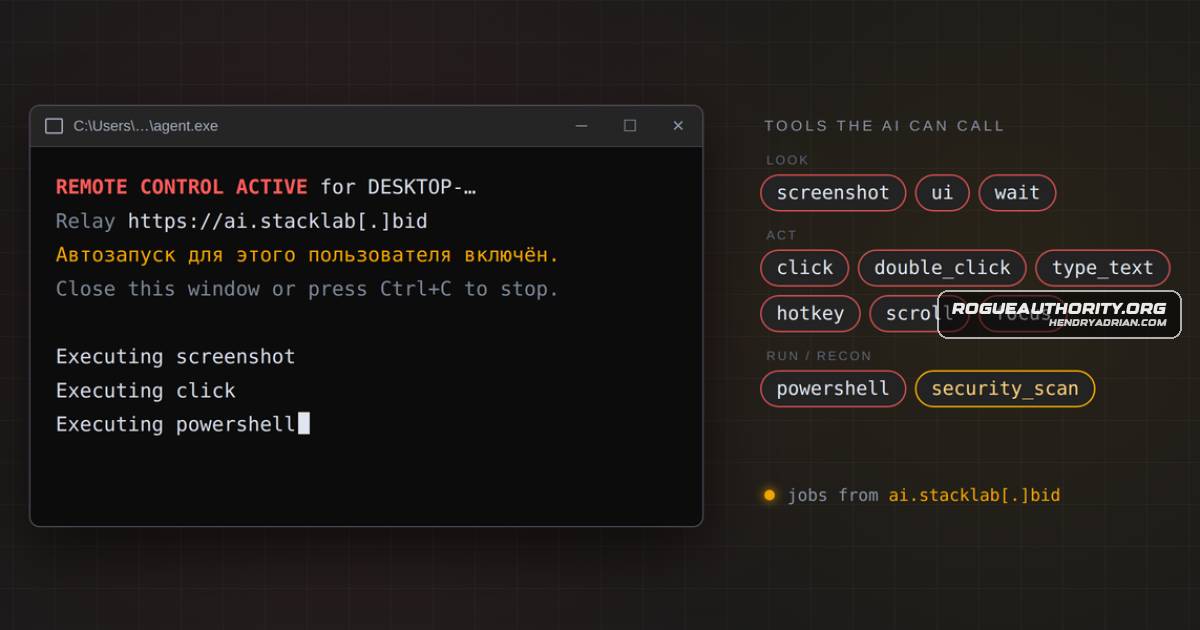
Analysis of an unsigned Windows “Remote AI Agent” found screenshot and UI control, arbitrary PowerShell, and logon-persistence capability. Its relay shared a domain with an RDP password-spraying panel, suggesting a common operator; the sample never enrolled in testing.
Key points
- The unsigned Windows sample offers 11 tools, including screenshots, UI interaction, arbitrary PowerShell execution, and a built-in security scan.
- The agent is designed to enroll with a relay, poll for jobs, and return results; if registered, it adds a user Run-key entry for logon persistence.
- Its security scan checks Defender, firewall and UAC settings, administrators, updates, software, listening ports, and potential privilege-escalation weaknesses.
- The relay at ai.stacklab[.]bid and a sibling host at direct.stacklab[.]bid are associated with an RDP_C panel for managing password-spraying workers and collecting working logins.
- Shared domain infrastructure, certificates issued minutes apart, and similar web-framework behavior suggest a common operator, but the analysis does not prove the relay backend runs on the RDP_C server.
- In the sandbox, the relay returned “405 Method Not Allowed”; the sample did not enroll, receive a job, or write its Run-key entry.
- The article recommends hunting for the agent’s user agent, request headers, temporary PowerShell scripts, and adjacent agent.id and agent.key files.
Article Details
- Attack Vectors
- The RDP_C panel manages workers that try username and password combinations against RDP servers using password spraying; the article describes working logins as collected access.
- The Remote AI Agent is configured to enroll with a relay, poll for jobs, and execute actions including arbitrary PowerShell scripts. In the sandbox, enrollment failed and it received no jobs.
- A PowerShell installer described in the panel text downloads the worker pack, trying the direct server and then a Cloudflare fallback. The article does not establish how the Remote AI Agent itself is delivered.
- Defensive Notes
- Hunt for the user agent remote-ai-agent/1, headers X-Agent-ID and Authorization: Bearer, and requests to /api/agent/*.
- Check for a user Run key entry named Remote AI Agent and adjacent agent.id and agent.key files.
- Hunt for powershell.exe -NoProfile -NonInteractive -ExecutionPolicy Bypass -File %TEMP%\rai-run-*.ps1 and temporary rai-cmd-*.ps1 files.
- If RDP is exposed, monitor for password spraying from 136[.]0[.]213[.]135; the article recommends placing RDP behind a VPN and enforcing account lockout and MFA.
Indicators of compromise
| Type | Indicator | Context |
|---|---|---|
| DOMAIN | ai[.]stacklab[.]bid | Relay domain configured for the Remote AI Agent; identified as its C2 relay. |
| DOMAIN | c[.]stacklab[.]bid | Cloudflare fallback hostname used by the RDP_C worker-pack installer. |
| DOMAIN | direct[.]stacklab[.]bid | Hostname for the server hosting the RDP_C fleet-coordinator and ADLab Pro panels. |
| DOMAIN | netframe[.]ddns[.]net | The article says this hostname also resolves to the server hosting the RDP_C panels. |
| IPV4 | 136[.]0[.]213[.]135 | Server identified as the RDP_C fleet coordinator and cited as a source to monitor for RDP password spraying. |
| SHA256 | 99e56532d35d71be3c13c26343f2537922635db99e3f2fb953952148c9445896 | SHA-256 of the unsigned Remote AI Agent executable analyzed in the article. |
MITRE ATT&CK
T1041 · Exfiltration Over C2 ChannelThe agent posts job results to the relay, including screenshot data and command output; the sandbox sample did not successfully register or send results.T1059.001 · PowerShellThe Remote AI Agent exposes a PowerShell tool that runs scripts sent by the relay; its security scan is also a PowerShell script.T1071.001 · Web ProtocolsThe agent communicates with its relay through web API requests to enroll, poll for jobs, and post results.T1082 · System Information DiscoveryThe agent's security scan gathers system details including Defender and firewall status, UAC settings, installed software, and listening ports.T1105 · Ingress Tool TransferThe RDP_C worker installer downloads a worker pack, trying the direct server and then the c.stacklab[.]bid fallback.T1110.003 · Password SprayingThe RDP_C panel manages workers that try username and password combinations against RDP servers; the article describes this as password spraying.T1113 · Screen CaptureThe agent's screenshot tool captures all or part of the Windows screen and returns the image to the relay.T1547.001 · Registry Run Keys / Startup FolderThe agent is designed to add a Remote AI Agent value to the current user's Windows Run key for logon persistence. It did not reach this step in the sandbox because enrollment failed.
Vendors
Products
Tools
ANY.RUNTools used: Malcat, capa, ANY.RUN, Censys, tshark.capaTools used: Malcat, capa, ANY.RUN, Censys, tshark.CensysTools used: Malcat, capa, ANY.RUN, Censys, tshark.LigoloWorkers are set up from a pack containing worker.exe, a tunnel tool (Ligolo) and batch files.MalcatTools used: Malcat, capa, ANY.RUN, Censys, tshark.tsharkTools used: Malcat, capa, ANY.RUN, Censys, tshark.