
Linux Sentinel Backdoor Uses GitHub Dead Drops to Find Its Command Server
Summary
Analysis of the Linux backdoor Sentinel 1.3.7 describes five persistence methods, a command server address retrieved from GitHub dead drops that could encode an IP in a poem, and remote shell and payload-management capabilities.
Key points
- The analyzed 64-bit Linux executable, named fzw9oq.exe, calls itself Sentinel and exits unless launched with a payload list; it also exits when it detects a debugger.
- It copies itself under a name resembling a running process and uses five persistence methods: a systemd service, cron jobs, Python script modification, injection into running Python processes, and immutable files.
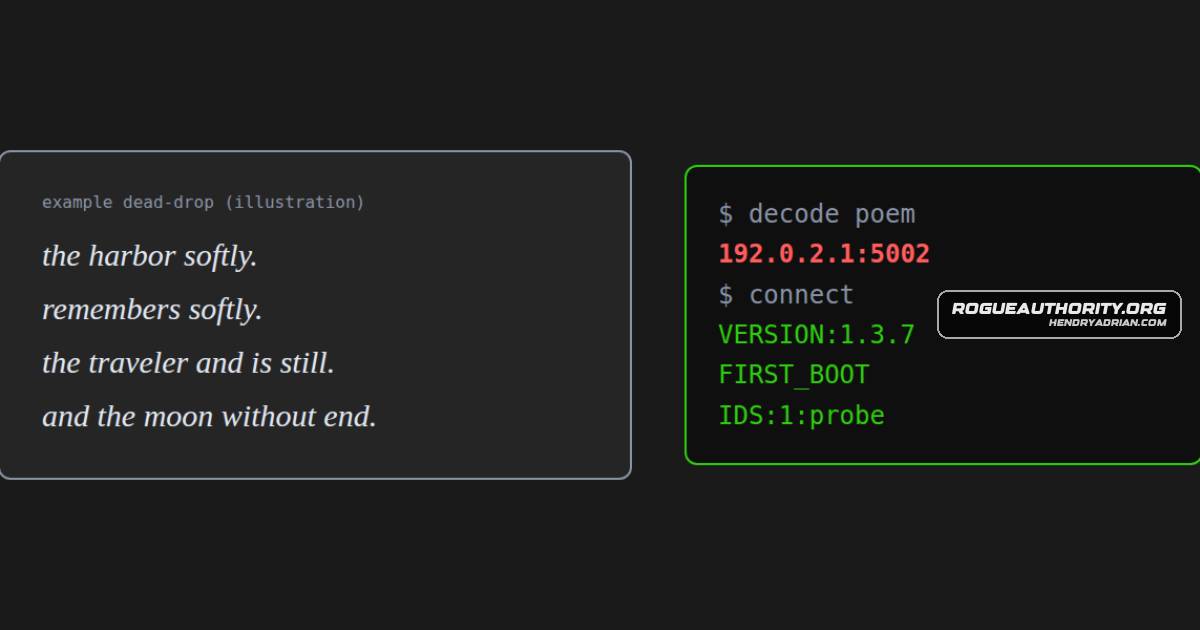
- The backdoor retrieves its command server address from .readme files in three GitHub repositories, directly or through public-looking proxies; the address can be encoded as a four-line poem.
- The repositories and accounts were unavailable during the analysis, so researchers could not recover the server address or determine which payloads this sample was meant to supervise.
- In an isolated test with a researcher-operated fake server, it responded to commands for shell execution, receiving and starting files, payload management, updates, and trace removal; this does not establish how it behaved with its real server.
- The article identifies defensive checks including a systemd configuration pattern, a shared-memory state file, distinctive filenames, modified Python scripts, and outbound traffic on ports 1458 and 5002.
Article Details
- Attack Vectors
- The article describes fzw9oq.exe as a Linux backdoor and second-stage payload that exits unless started with a --id argument listing programs to supervise; the parent stage that installs and starts it was not available.
- The backdoor copies itself to a system- or user-looking directory, adopts a name resembling a running process, and deletes the file it was started from.
- It establishes persistence through a restarting systemd service, cron jobs, modifications to the user's Python scripts, injection into running Python processes as root, and immutable files.
- It retrieves server addresses from .readme dead drops in GitHub repositories, directly or through public-looking web proxies, and can communicate with the server over TCP port 5002 using RC4-encrypted traffic.
- Its supported commands include running shell commands, receiving and launching programs, updating the backdoor, managing supervised payloads, changing server addresses, and removing traces.
- Defensive Notes
- Check for systemd units containing both KillSignal=SIGCONT and SendSIGKILL=no, especially when the command line ends in --no-kill.
- Inspect crontabs, user .py files, running Python processes, and file attributes for signs of the described persistence methods; check lsattr flags before deleting suspected files.
- Look for /dev/shm/.i2c_36589256 and files named .snt, .snt.lck, or .snt_upd.
- Review outbound requests to port 1458 matching /get?url=https://raw.githubusercontent.com/...readme and outbound TCP connections to port 5002.
- The article says the three GitHub accounts and repositories were no longer available, so the real server address and supervised payloads could not be recovered.
Indicators of compromise
| Type | Indicator | Context |
|---|---|---|
| IPV4 | 104[.]152[.]186[.]146 | Listed as a fetch proxy the backdoor can use to retrieve dead drops; ownership is unconfirmed. |
| IPV4 | 152[.]89[.]29[.]79 | Listed as a fetch proxy the backdoor can use to retrieve dead drops; ownership is unconfirmed. |
| IPV4 | 159[.]223[.]42[.]40 | Listed as an allOrigins fetch proxy the backdoor can use to retrieve dead drops; ownership is unconfirmed. |
| IPV4 | 202[.]61[.]246[.]49 | Listed as a fetch proxy the backdoor can use to retrieve dead drops; ownership is unconfirmed. |
| IPV4 | 45[.]10[.]26[.]95 | Listed as an allOrigins fetch proxy the backdoor can use to retrieve dead drops; ownership is unconfirmed. |
| SHA256 | 695be80a55df587f79508546c166276d345ffc3453f8da7beb256c38d4ded7bd | SHA-256 hash of the fzw9oq.exe Linux backdoor, identified as sentinel 1.3.7. |
| URL | hxxps[:]//raw[.]githubusercontent[.]com/alessio756/deepin-wine-ubuntu/refs/heads/master/deepin-wine-plugin-virtual_1[.]0deepin1_all/DEBIAN/control[.]readme | Dead-drop resource used by the backdoor to retrieve a server address; the article reports it returned 404. |
| URL | hxxps[:]//raw[.]githubusercontent[.]com/franchgamer34/discord[.]js/refs/heads/main/packages/api-extractor-model/src/items/NewAPi[.]readme | Dead-drop resource used by the backdoor to retrieve a server address; the article reports it returned 404. |
| URL | hxxps[:]//raw[.]githubusercontent[.]com/francoryt3/umbrel/refs/heads/master/packages/umbreld/source/modules/blacklist-uas/blacklist-uas[.]readme | Dead-drop resource used by the backdoor to retrieve a server address; the article reports it returned 404. |
MITRE ATT&CK
T1036 · MasqueradingThe backdoor copies itself into system- or user-looking directories and gives its copy a name resembling a process already running on the host.T1053.003 · CronIt creates cron jobs that run at reboot and check every five minutes to restart it if missing.T1055.008 · Ptrace System CallsWhen running as root, it uses ptrace to make a running python3 process execute a line that starts the backdoor.T1059.004 · Unix ShellThe operator can issue shell commands through the backdoor, which returns their output.T1070.004 · File DeletionAfter copying itself, the backdoor deletes the file from which it was started.T1090.002 · External ProxyIt can fetch dead-drop files through public-looking web proxies; the article says proxy ownership is unconfirmed.T1102.001 · Dead Drop ResolverIt retrieves its server address from .readme files in GitHub repositories used as dead drops.T1105 · Ingress Tool TransferThe server can send programs that the backdoor saves, launches, and supervises.T1222.002 · Linux and Mac PermissionsIt uses chattr +i to make files immutable, complicating their removal.T1543.002 · Systemd ServiceIt installs a systemd service configured to restart the backdoor and resist stop requests.T1573.001 · Symmetric CryptographyAfter exchanging random bytes with its server, the backdoor derives directional RC4 keys and encrypts subsequent messages.T1622 · Debugger EvasionAt startup, the backdoor checks TracerPid in /proc/self/status and exits if a debugger is attached.
Malware
Tools
capaTools used: Malcat, capa, objdump, Python, a bubblewrap sandbox with a home-made fake command server, Censys and Triage.CensysTools used: Malcat, capa, objdump, Python, a bubblewrap sandbox with a home-made fake command server, Censys and Triage.MalcatTools used: Malcat, capa, objdump, Python, a bubblewrap sandbox with a home-made fake command server, Censys and Triage.objdumpTools used: Malcat, capa, objdump, Python, a bubblewrap sandbox with a home-made fake command server, Censys and Triage.TriageTools used: Malcat, capa, objdump, Python, a bubblewrap sandbox with a home-made fake command server, Censys and Triage.