
Brazilian Browser-Hijacking Kit Uses Microsoft- and Mozilla-Signed Components
Summary
Analysis of HardwareInfo.msi found a Brazilian-targeted kit that sideloads a signed DLL, installs browser extensions, steals saved credentials and cookies, and prepares a hidden remotely controlled Chrome session. Live server activity was not observed.
Key points
- The per-user HardwareInfo.msi installer hides its installation and launches a renamed, genuine Windows BdeUISrv.exe as ChromeUpdate.exe.
- That program sideloads a malicious wtsapi32.dll, signed with a short-lived Microsoft Trusted Signing certificate issued to Technoservice B.V., to load the kit’s Python payload.
- The kit installs the “Documentos Online” extension in Chromium browsers and “pulsardrift” in Firefox, enabling access to cookies and site storage, web requests, tabs, and input on on-screen bank keypads.
- Its stealer targets saved passwords, cookies, autofill, history, bookmarks, and extension lists across several browsers. The code also describes using Chrome’s own decryption service to access protected cookies.
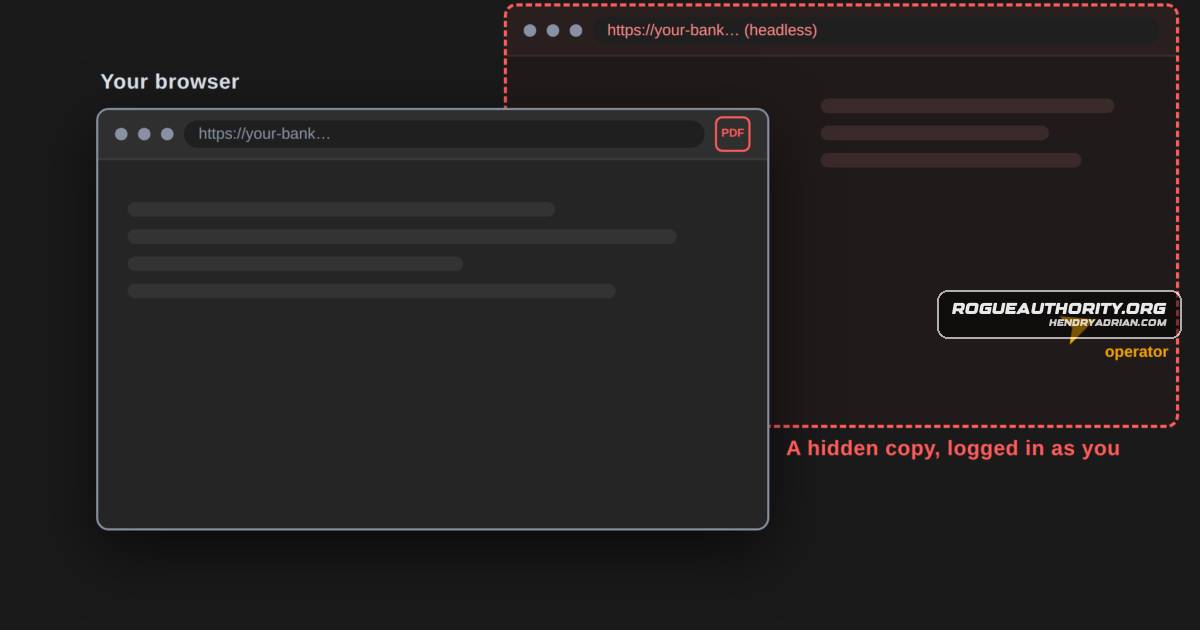
- A hidden Chrome instance is designed to use the victim’s profile and stolen credentials for remote operator control; the article says this behavior was not observed live.
- Persistence mechanisms include scheduled tasks, a Startup-folder batch file, and watchdog processes. The article also provides paths, task names, and other indicators for defenders to hunt.
- In the sandbox, the kit reached its dead-drop websites but did not obtain working server addresses, so live commands and connections were not captured.
Article Details
- Attack Vectors
- A silent, per-user MSI installer deploys a renamed copy of the genuine Windows BdeUISrv.exe alongside a malicious wtsapi32.dll, which is loaded through DLL side-loading.
- The installer closes browsers and silently installs extensions by modifying Chromium Secure Preferences or Firefox startup files.
- The kit collects saved browser passwords, cookies, autofill entries, history, bookmarks, and extension lists. Its remote-browser role loads the victim’s profile, reuses stolen credentials and cookies, and lets an operator control the browser remotely.
- The kit retrieves server addresses from encoded text files hosted on six domains, using a machine-specific subdomain; it can also receive an encrypted ZIP update.
- Persistence uses scheduled tasks, a Startup-folder batch file, and watchdog processes.
- Defensive Notes
- Do not run unexpected installers claiming to be hardware tools, document viewers, or tax apps.
- Check browser extensions for Documentos Online, pulsardrift, Intel Drivers, or Intel Graphic Drivers; remove unrecognized extensions and change passwords from a clean device.
- Treat an unexpected Developer mode setting in Chrome or Edge as a warning sign.
- Hunt for ChromeUpdate.exe running from %LOCALAPPDATA%\Microsoft\Cache\<8 hex>\, especially with arguments _primereach, _topaznode, _boot, or _edge.
- Alert on wtsapi32.dll loaded from outside System32 and on python.exe -B …\copperrack\gausstwist.py.
- Look for scheduled tasks ChromeUpdSvc and ShellUpdateTask, Startup\ChromeUpdSvc.bat, writes to Chromium Secure Preferences by non-browser processes, and Firefox add-on ID {df9b5af8-37e1-47cf-9438-85ec86c970cc}.
- Block or monitor the six reported dead-drop URLs and their subdomains.
Indicators of compromise
| Type | Indicator | Context |
|---|---|---|
| SHA256 | 04f8d9f2b357c5861c5f60e76a10c57559b4d7f6b744fd686b2343aa43663f40 | SHA-256 hash of hexacase, the compressed configuration containing both malicious extensions. |
| SHA256 | 1d0f1d845e9a942547dc84e222f2ca559a8fe6587a8e56d6669e2a61145aeb70 | SHA-256 hash of the kit’s _entry.py loader script. |
| SHA256 | 47b8030db237d54041fb2006c67a6c80938dd1d070ff69d1e487c339b8f82022 | SHA-256 hash of the malicious pulsardrift Firefox add-on. |
| SHA256 | 8924cdc34450007e1a31a34ac7a11f1f358c2535ca995d11e60344d17eadb2d2 | SHA-256 hash of the malicious HardwareInfo.msi installer. |
| SHA256 | 98e3bbaced5719581f12aaf603eb9c08519b8a988c202cf085b2c6cd4a36276f | SHA-256 hash of the malicious side-loaded wtsapi32.dll. |
| SHA256 | edd98ca9eefab4ebc1d5c474aabb5f776f40214923857ae94777827fdef0a80e | SHA-256 hash of duskwall.pyd, the kit’s main compiled module. |
| URL | hxxps[:]//bestnews4u[.]com/bs/fl6c844fb620[.]txt | Installer dead-drop URL used to retrieve the current server list. |
| URL | hxxps[:]//carlosmarket[.]com/sw/fl0fcb1cb536[.]txt | Dead-drop URL used by the Firefox add-on to retrieve server addresses. |
| URL | hxxps[:]//dvacontabil[.]com/di/flc2bf0028dc[.]txt | Dead-drop URL used by the Chromium extension to retrieve server addresses. |
| URL | hxxps[:]//grupoathos[.]com/jm/fl60e12b8178[.]txt | Dead-drop URL used by the Firefox add-on to retrieve server addresses. |
| URL | hxxps[:]//niagentech[.]com/nt/fl5dd4b8c073[.]txt | Dead-drop URL used by the Chromium extension to retrieve server addresses. |
| URL | hxxps[:]//nyxservicos[.]com/xl/fl9f03a24b21[.]txt | Installer dead-drop URL used to retrieve the current server list. |
MITRE ATT&CK
T1027 · Obfuscated Files or InformationThe loader runs a base64-encoded script, and the kit’s dead-drop text files contain server lists scrambled with a one-byte XOR key.T1036 · MasqueradingThe kit renames genuine BdeUISrv.exe to ChromeUpdate.exe to make it resemble a browser updater.T1053.005 · Scheduled TaskThe kit creates the ChromeUpdSvc and ShellUpdateTask scheduled tasks for persistence.T1055 · Process InjectionThe kit injects shellcode into a paused Chrome process to obtain a cookie-decryption key through Chrome’s own service.T1056.003 · Web Portal CaptureThe malicious extension can capture input entered on Brazilian banks’ on-screen numeric keypads.T1059.006 · Python_entry.py decodes and runs a Python script that dispatches the kit’s roles.T1071.001 · Web ProtocolsThe kit retrieves dead-drop text files over HTTPS and the extension connects to its server.T1105 · Ingress Tool TransferThe kit can receive an encrypted ZIP from its server to update itself.T1176 · Software ExtensionsThe kit silently installs the Documentos Online Chromium extension and the pulsardrift Firefox add-on.T1185 · Browser Session HijackingThe operator can remotely drive a hidden Chrome instance using the victim’s profile and stolen cookies.T1539 · Steal Web Session CookieThe kit copies browser cookies and reuses them in a hidden browser loaded with the victim’s profile.T1547.001 · Registry Run Keys / Startup FolderThe kit places ChromeUpdSvc.bat in the user’s Startup folder for persistence.T1555.003 · Credentials from Web BrowsersThe stealer copies saved passwords from the supported browsers’ stored credentials.T1574.002 · DLL Side-LoadingThe kit places a malicious wtsapi32.dll beside the renamed BdeUISrv.exe so the genuine program loads the malicious library.
Vendors
Products
BraveWhat it takes: saved passwords, cookies, autofill, history, bookmarks and the list of installed extensions, from Chrome, Edge, Brave, Opera, Vivaldi and Firefox.Documentos OnlineWhat it plants: an extension called “Documentos Online” (Chromium) or “pulsardrift” (Firefox) that can read cookies and site storage, watch web requests, redirect tabs and capture input on banks’ on-screen keypads.EdgeThat module closes your browsers, plants a malicious extension in Chrome, Edge and Firefox, and copies your saved passwords and cookies.Google ChromeThat module closes your browsers, plants a malicious extension in Chrome, Edge and Firefox, and copies your saved passwords and cookies.Microsoft WindowsHardwareInfo.msi is a Windows installer that quietly sets up a browser-hijacking kit aimed at Brazilian users.Mozilla FirefoxThat module closes your browsers, plants a malicious extension in Chrome, Edge and Firefox, and copies your saved passwords and cookies.OperaWhat it takes: saved passwords, cookies, autofill, history, bookmarks and the list of installed extensions, from Chrome, Edge, Brave, Opera, Vivaldi and Firefox.Opera GXThe kit’s stealer copies saved passwords, cookies, autofill entries, history, bookmarks and the extension list from Chrome, Edge, Brave, Opera, Opera GX, Vivaldi and Firefox.pulsardriftWhat it plants: an extension called “Documentos Online” (Chromium) or “pulsardrift” (Firefox) that can read cookies and site storage, watch web requests, redirect tabs and capture input on banks’ on-screen keypads.VivaldiWhat it takes: saved passwords, cookies, autofill, history, bookmarks and the list of installed extensions, from Chrome, Edge, Brave, Opera, Vivaldi and Firefox.
Tools
ANY.RUNTools used: msitools, Malcat, a sandboxed Wine/Python environment, osslsigncode/OpenSSL, Censys and ANY.RUN.CensysTools used: msitools, Malcat, a sandboxed Wine/Python environment, osslsigncode/OpenSSL, Censys and ANY.RUN.MalcatTools used: msitools, Malcat, a sandboxed Wine/Python environment, osslsigncode/OpenSSL, Censys and ANY.RUN.msitoolsTools used: msitools, Malcat, a sandboxed Wine/Python environment, osslsigncode/OpenSSL, Censys and ANY.RUN.OpenSSLTools used: msitools, Malcat, a sandboxed Wine/Python environment, osslsigncode/OpenSSL, Censys and ANY.RUN.osslsigncodeTools used: msitools, Malcat, a sandboxed Wine/Python environment, osslsigncode/OpenSSL, Censys and ANY.RUN.REMnuxThis analysis and write-up were produced by Claude (Opus 5.5), working as an agent in Claude Code on a REMnux analysis VM.