
Operation HumanitarianBait Uses Aid-Themed Lures to Deploy a Python Infostealer
Summary
Cyble describes a campaign using Russian-language humanitarian-aid lures and malicious LNK files to deploy a persistent Python implant. Analysis found credential and data theft, surveillance, and covert remote-access capabilities; attribution remains inconclusive.
Key points
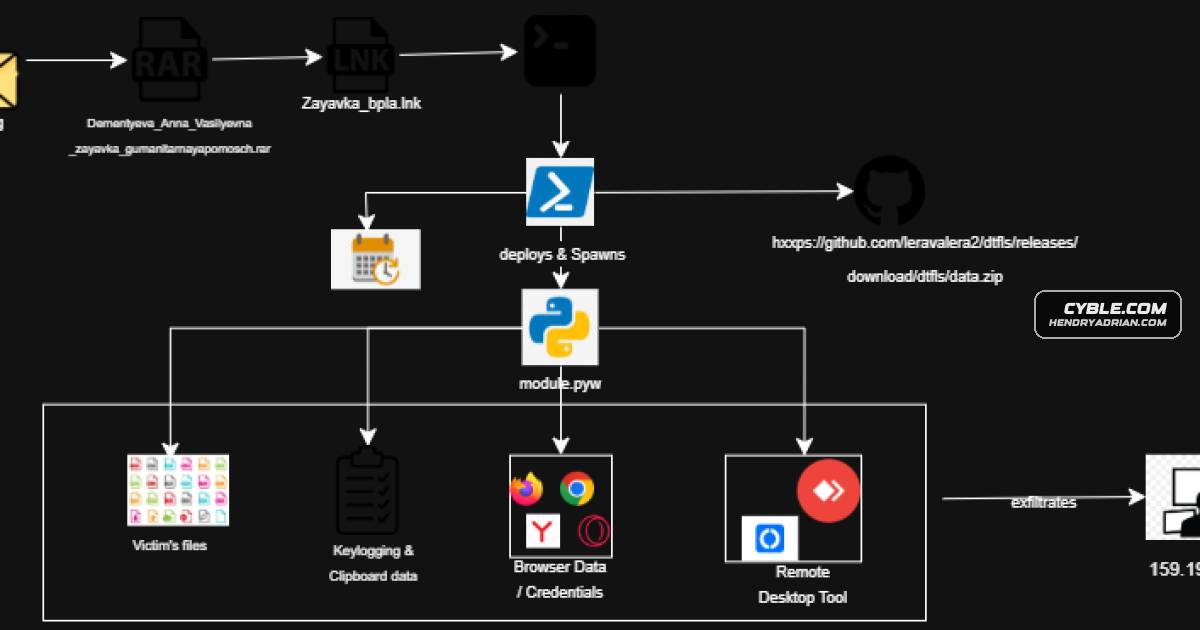
- Phishing emails deliver a malicious LNK inside a RAR archive using Russian-language humanitarian-aid and survey lures; opening the shortcut starts the infection chain.
- PowerShell extracts obfuscated content from the LNK and executes it in memory while a decoy document is shown to the victim.
- The Python payload is protected with PyArmor and downloaded from GitHub Releases; a scheduled task and silent VBScript launchers maintain persistence.
- Cyble's analysis found collection of browser passwords and cookies, keystrokes, clipboard contents, screenshots, Telegram session data, and selected files.
- The implant can silently install RustDesk or AnyDesk for remote access and send collected data to a custom command-and-control server.
- Cyble reports the campaign's command-and-control server was live as of May 2026. Attribution is inconclusive; Russian-language lures suggest Russian-speaking targets.
Article Details
- Attack Vectors
- Phishing emails deliver a malicious LNK file inside a RAR archive, using Russian-language humanitarian-aid and survey lures.
- Opening the LNK triggers PowerShell to extract and execute obfuscated content in memory; a decoy PDF is shown while the Python implant is deployed.
- The payload is downloaded from a GitHub Releases resource and obfuscated with PyArmor.
- The implant establishes persistence with a recurring Windows Scheduled Task and silent VBScript launchers.
- The implant collects browser credentials and cookies, keystrokes, clipboard contents, screenshots, Telegram session data, and selected local files, then uploads data to the C2 server.
- The payload can silently install RustDesk or AnyDesk for remote desktop access.
- Defensive Notes
- Treat unsolicited archives and shortcut files with caution, and verify senders through a separate trusted channel before opening attachments.
- Enable file extension visibility in Windows and audit Scheduled Tasks for unexpected tasks running at short intervals.
- Monitor user-writable directories for self-contained scripting environments, obfuscated scripts, and non-administrative silent installation of remote desktop tools.
- Monitor scripting interpreter activity and outbound HTTP connections from user-space processes; block traffic to known malicious infrastructure.
- Alert on payload downloads from newly registered or low-reputation code-sharing accounts and maintain visibility into scheduled-task creation.
Indicators of compromise
| Type | Indicator | Context |
|---|---|---|
| IPV4 | 159[.]198[.]41[.]140 | Attacker-controlled C2 server used to host the login panel and receive collected data. |
| SHA256 | 8a100cbdf79231e70cee2364ebd9a4433fda6b4de4929d705f26f7b68d6aeb79 | SHA-256 of the malicious initial LNK dropper. |
| SHA256 | 9be61c95056fd6b63565cf51a196f2615f5360c0a42e616b2a618473e9d60a21 | SHA-256 of the malicious RAR archive delivered to victims. |
| SHA256 | a5b782901829861a6f458db404e8ec1a99c65a48393525e681742bb2a5db454d | SHA-256 of module.pyw, identified as the packed Python stealer/RAT. |
| URL | hxxp[:]//159[.]198[.]41[.]140/static/builder/lnk_uploads/invo[.]pdf | C2-hosted humanitarian-aid lure PDF downloaded to the victim. |
| URL | hxxp[:]//159[.]198[.]41[.]140/test/index.php?r=survey/index&sid=936926&newtest=Y&lang=ru%22 | Survey-based lure URL observed in the campaign. |
| URL | hxxps[:]//github[.]com/leravalera2/dtfls/releases/download/dtfls/data.zip | Specific GitHub Releases resource identified as the malicious payload download. |
MITRE ATT&CK
T1005 · Data from Local SystemThe implant recursively scans user directories for documents, configuration files, and credential stores.T1027.002 · Software PackingThe Python payload is protected with PyArmor v9.2 Pro to resist static analysis and decompilation.T1041 · Exfiltration Over C2 ChannelCollected data is sent in batches to the attacker-controlled C2 server.T1053.005 · Scheduled TaskA recurring Windows Scheduled Task named WindowsHelper runs the implant and persists across reboots.T1056.001 · KeyloggingThe keyboard library continuously captures keystrokes, which are stored and periodically uploaded.T1059.001 · PowerShellPowerShell extracts obfuscated content embedded at a specific offset in the LNK file and executes it in memory.T1059.005 · Visual Basicrun.vbs and launch_module.vbs silently launch the Python payload through pythonw.exe.T1059.006 · PythonThe surveillance implant is written in Python and runs through pythonw.exe.T1071.001 · Web ProtocolsCollected data is uploaded to the C2 server over HTTP.T1105 · Ingress Tool TransferThe payload data.zip is downloaded at runtime from a GitHub Releases resource.T1113 · Screen CaptureThe mss library captures desktop screenshots, archives them, and uploads them periodically.T1115 · Clipboard DataThe implant uses pyperclip to monitor and collect clipboard contents in real time.T1219 · Remote Access ToolsThe payload can silently install RustDesk or AnyDesk for covert interactive remote desktop access.T1555.003 · Credentials from Web BrowsersThe implant extracts stored passwords from Chrome, Edge, Brave, Opera, Yandex Browser, and Firefox.T1566.001 · Spearphishing AttachmentPhishing emails deliver a malicious LNK file inside a RAR archive using Russian-language humanitarian-aid lures.
Vendors
Products
Bravecookies are extracted from multiple browsers (‘Collects stored passwords and cookies from Chrome, Edge, Brave, Opera, Yandex Browser, and Firefox’).Edgeand cookies are extracted from multiple browsers (‘Collects stored passwords and cookies from Chrome, Edge, Brave, Opera, Yandex Browser, and Firefox’).GitHub Releasesdeliver a fileless Python-based infostealer through malicious LNK files and trusted platforms like GitHub Releases.Google Chromepasswords and cookies are extracted from multiple browsers (‘Collects stored passwords and cookies from Chrome, Edge, Brave, Opera, Yandex Browser, and Firefox’).Microsoft Windowskeystrokes, clipboard data, screenshots, Telegram sessions, and files while maintaining persistence via Windows Scheduled Tasks and enabling silent remote access through RustDesk or AnyDesk.Mozilla Firefoxbrowsers (‘Collects stored passwords and cookies from Chrome, Edge, Brave, Opera, Yandex Browser, and Firefox’).Operaare extracted from multiple browsers (‘Collects stored passwords and cookies from Chrome, Edge, Brave, Opera, Yandex Browser, and Firefox’).Pythona covert espionage campaign that uses Russian-language humanitarian aid lures to deliver a fileless Python-based infostealer through malicious LNK files and trusted platforms like GitHub Releases.TelegramThe malware collects browser credentials, cookies, keystrokes, clipboard data, screenshots, Telegram sessions, and files while maintaining persistence via Windows Scheduled Tasks and enabling silent remote accessYandex Browserfrom multiple browsers (‘Collects stored passwords and cookies from Chrome, Edge, Brave, Opera, Yandex Browser, and Firefox’).