Stadia RAT Revives StealC Operation After Europol Takedown
Summary
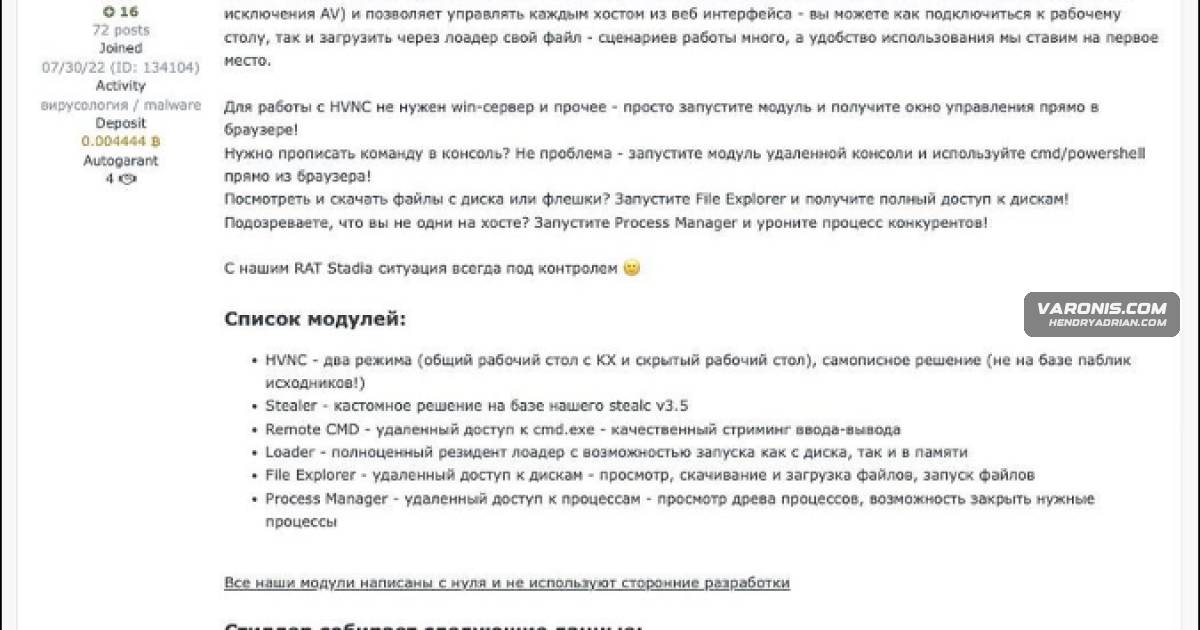
Varonis Threat Labs reverse-engineered Stadia, a remote-access trojan from the StealC seller. The sample combines StealC 3.5 credential theft with remote-control modules and uses hidden scheduled-task persistence and encrypted-over-HTTP command traffic.
Key points
- Varonis says Stadia appeared four months after Operation Endgame disrupted StealC; the seller offered former StealC customers a free month on Stadia's Pro tier.
- The analyzed Stadia sample includes a 26,112-byte Chromium App-Bound Encryption helper identical byte-for-byte to one in StealC v3.5 builds.
- Stadia combines StealC credential theft with hidden desktop control, remote command execution, file browsing, process management and disk or in-memory loading.
- The agent installs under a randomized folder in C:\ProgramData\, creates a hidden scheduled task that runs every 15 minutes, and can add a Windows Defender exclusion when elevated.
- C2 traffic uses HTTP POST requests whose bodies are RC4-encrypted and Base64-encoded despite a Content-Type header claiming JSON.
- Varonis recommends hunting for suspicious browser-process injection from unsigned executables in C:\ProgramData\, transient GUID-named text files, and the hidden scheduled-task pattern.
Article Details
- Attack Vectors
- The Stadia agent installs under a randomized directory in C:\ProgramData\ and uses a filename selected from names that impersonate legitimate updaters.
- It establishes persistence with a hidden scheduled task that runs at logon and every 15 minutes.
- When elevated, it uses PowerShell Add-MpPreference to add its install directory to the Windows Defender exclusion list.
- The agent communicates with hard-coded C2 addresses over HTTP POST. It sends RC4-encrypted, Base64-encoded message bodies while declaring Content-Type: application/json.
- The stealer collects browser credentials, cookies, wallet data, and other application data. The analyzed build also injects code into suspended Chrome, Edge, or Brave processes to access browser-protected data.
- The RAT provides remote command execution, file browsing and transfer, process management, desktop control, and a loader that can run files from disk or memory.
- Defensive Notes
- Monitor for unsigned processes running from C:\ProgramData\ that create suspended Chrome, Edge, or Brave processes and write a 26 KB code block into them.
- Look for a GUID-named .txt file in C:\ProgramData\ containing a 64-character hexadecimal string that is subsequently deleted.
- Hunt for new executables in randomized C:\ProgramData\ folders, hidden scheduled tasks with a 15-minute interval and 3,650-day duration, and Windows Defender exclusions added through PowerShell.
- The article says the analyzed build's C2 addresses can be blocked, but notes that these addresses change between builds.
- The article recommends starting behavioral rules in alert mode and tuning them against local telemetry before blocking.
Indicators of compromise
| Type | Indicator | Context |
|---|---|---|
| DOMAIN | stadiadev[.]cc | Domain identified in the article as the Stadia operator panel. |
| IPV4 | 193[.]148[.]56[.]97 | Third hard-coded C2 address in the analyzed build's failover order. |
| IPV4 | 91[.]92[.]43[.]45 | Second hard-coded C2 address in the analyzed build's failover order. |
| IPV4 | 93[.]152[.]213[.]215 | Primary hard-coded C2 address used by the analyzed Stadia build. |
| MD5 | 7739a8d0d101ca82b93bbd0acdb6d9af | MD5 of the analyzed Stadia agent sample. |
| SHA1 | 1ba76d2029744cc6e2f7209c96a696b32962b1f1 | SHA-1 of the analyzed Stadia agent sample. |
| SHA256 | 0e5337a4cc8ebc772bc50f6e79befd1e8efad3410022e050d08d5269733c4ea4 | SHA-256 of the App-Bound Encryption helper blob embedded in Stadia and reported as byte-identical to the helper in StealC v3.5 builds. |
| SHA256 | ea928494fd30d88b98141d39a502a4324889fb732e74b44bfee12c72137dd73e | SHA-256 of the analyzed Stadia agent executable, stadia_x32.exe. |
MITRE ATT&CK
T1027 · Obfuscated Files or InformationThe sample stores meaningful strings, module names, and C2 configuration using Base64 and RC4 encoding.T1036.005 · Match Legitimate Resource Name or LocationThe agent selects install filenames from a list of names that impersonate legitimate updater or system processes.T1053.005 · Scheduled TaskThe agent creates a hidden scheduled task configured to run at logon and every 15 minutes.T1055 · Process InjectionThe analyzed build writes a 26 KB code block into suspended Chrome, Edge, or Brave processes during browser credential theft.T1057 · Process DiscoveryThe RAT's process manager displays a process tree and allows operators to kill processes.T1059.001 · PowerShellThe agent uses PowerShell to add its install directory to the Windows Defender exclusion list.T1059.003 · Windows Command ShellThe RAT offers a remote command module with cmd.exe access and streamed input and output.T1071.001 · Web ProtocolsThe agent uses HTTP POST requests to its C2 addresses, with traffic sent to the root path.T1083 · File and Directory DiscoveryThe file explorer module supports browsing remote disks and listing, reading, writing, downloading, and uploading files.T1105 · Ingress Tool TransferThe panel's loader lets operators deploy files to selected hosts and execute them from disk or memory.T1113 · Screen CaptureThe agent can capture desktop screenshots and transmit JPEG frames from remote desktop sessions.T1555.003 · Credentials from Web BrowsersThe stealer targets browser credentials and cookies, including by accessing data protected by the browser's App-Bound Encryption.T1562.001 · Disable or Modify ToolsWhen elevated, the agent uses PowerShell Add-MpPreference to exclude its install directory from Windows Defender.T1573.001 · Symmetric CryptographyThe agent encrypts C2 messages with RC4 before Base64-encoding them for transmission.
Threat Actors
Malware
Products
BraveAn unsigned process running from C:\ProgramData\ starts a genuine Chrome, Edge or Brave process in a suspended state and writes a 26 KB block of code into it.EdgeAn unsigned process running from C:\ProgramData\ starts a genuine Chrome, Edge or Brave process in a suspended state and writes a 26 KB block of code into it.Google ChromeThe sidebar organizes stolen data by type: passwords, credit cards, messengers, software, session tokens for Chrome, Discord, Steam, Roblox, and Azure, and a crypto section for seed phrases.Microsoft WindowsThe HVNC screenshot is a live remote-desktop session on an infected Windows 11 machine, with a Spanish-language runtime error dialog sitting on the victim's desktop.Windows Defendera random folder under C:\ProgramData\, a hidden scheduled task that repeats every 15 minutes, and a Windows Defender exclusion added for that folder through PowerShell's Add-MpPreference command.