
Analysis Tracks Grixba’s Evolution Across Four Play Ransomware Samples
Summary
The analysis tracks four Grixba samples from 2022–2024, describing shifts from a .NET infostealer to modular reconnaissance and a smaller staged loader, while WMI/WinRM enumeration and an RDP drop path remain detection opportunities.
Key points
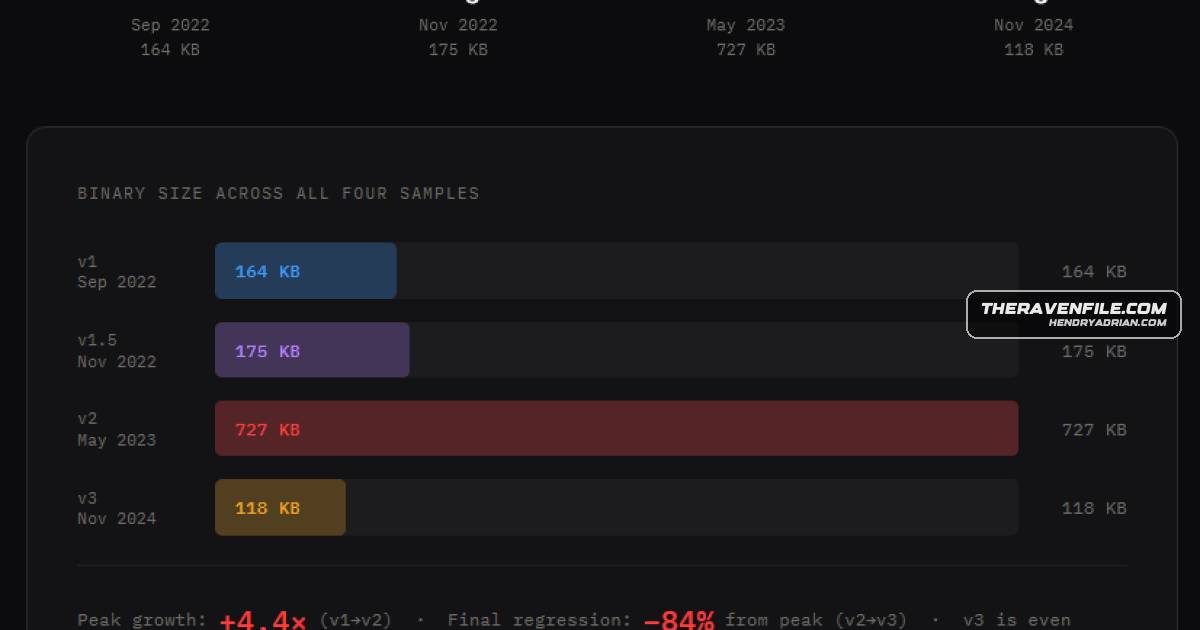
- The analysis compares four samples spanning 2022–2024; their reported sizes grew from 164 KB to 727 KB before shrinking to 118 KB.
- The v1.5 sample added active host scanning and browser-history path enumeration over SMB; the article says CISA Snort rules detect the listed paths.
- In v2, scanning logic moved into an XOR-encrypted inf_g.dll delivered in data.dat; the tool also adopted SQLite output, forged SentinelOne metadata, and a PIA VPN endpoint.
- The v3 account describes removal of the bundled SQLite engine and externalized staged payload delivery; the article notes these architectural conclusions are partly inferred and that the specific hash lacked a full public technical analysis.
- The analysis reports WMI/WinRM enumeration and writes to C:UsersPublicMusic via RDP as behaviors retained across all four versions.
- The samples also reportedly modify ntdll.dll memory protection; the article recommends behavior-based detections rather than relying on version-specific file sizes or artifacts.
Article Details
- Attack Vectors
- Play Ransomware used Grixba to enumerate hosts, software, users, security products, backup systems, and remote-management tools before encryption.
- Grixba used WMI and WinRM for network enumeration; version 1.5 also scanned IP ranges for reachable hosts and services.
- Version 1.5 accessed browser-history paths over SMB.
- The tool was delivered via RDP to C:\Users\Public\Music.
- Version 2 communicated with 84.239.41.12, identified in the article as a PIA VPN exit node used as a C2 and exfiltration channel.
- Version 3 used a separately delivered scanning payload; the article says scanning depended on that second stage succeeding.
- Grixba modified ntdll.dll memory protection to unhook EDR instrumentation and cleared Windows event logs.
- Defensive Notes
- Monitor executable writes to C:\Users\Public\Music from RDP sessions.
- Detect rapid WMI and WinRM connections from one host to multiple targets, especially when used for software and security-product enumeration.
- Correlate ntdll.dll memory-protection changes, VEH registration, RWX memory creation, and the en-US locale registry check as the article's cross-version behavior pattern.
- Watch for connections to 84.239.41.12, which the article identifies as a PIA VPN exit node used by Grixba as a C2 endpoint.
- Do not rely only on version 2 file-size, filename, or artifact signatures; the article reports that later versions changed packaging and payload delivery.
- Look for Windows event-log clearing behavior and password-protected data.zip archives.
Indicators of compromise
| Type | Indicator | Context |
|---|---|---|
| IPV4 | 84[.]239[.]41[.]12 | PIA VPN exit-node IP that the article reports Grixba v2 used as a C2 and exfiltration endpoint; the article does not claim the VPN provider owns or controls the malicious activity. |
| SHA256 | 3621468d188d4c3e2c6dfe3e9ddcfe3894701666bad918bc195aba0c44e46e94 | SHA-256 hash of one of the Grixba samples analyzed in the article. |
| SHA256 | 453257c3494addafb39cb6815862403e827947a1e7737eb8168cd10522465deb | SHA-256 hash of one of the Grixba samples analyzed in the article. |
| SHA256 | c59f3c8d61d940b56436c14bc148c1fe98862921b8f7bad97fbc96b31d71193c | SHA-256 hash of the November 2022 Grixba v1.5 sample, identified in the article as a Play network scanner. |
| SHA256 | f8810179ab033a9b79cd7006c1a74fbcde6ed0451c92fbb8c7ce15b52499353a | SHA-256 hash of one of the Grixba samples analyzed in the article. |
MITRE ATT&CK
T1005 · Data from Local SystemThe article says Grixba collected local information including credentials, cryptocurrency wallets, messaging-app data, and software data.T1018 · Remote System DiscoveryGrixba v1.5 scanned IP ranges to discover reachable hosts.T1021.001 · Remote Desktop ProtocolThe article reports that Grixba samples were delivered to target Windows servers via RDP.T1021.006 · Windows Remote ManagementGrixba used WinRM for remote host and software enumeration.T1027 · Obfuscated Files or InformationVersion 2 stored inf_g.dll XOR-encrypted inside data.dat.T1036 · MasqueradingVersion 2 forged PE version information to make GT_NET.exe appear to be a SentinelOne Compatibility Wizard.T1039 · Data from Network Shared DriveGrixba v1.5 accessed browser-history database paths over SMB.T1041 · Exfiltration Over C2 ChannelThe article identifies Grixba v2's communication with 84.239.41.12 as a C2 and exfiltration channel.T1046 · Network Service DiscoveryGrixba v1.5 scanned for reachable hosts and services across IP ranges.T1047 · Windows Management InstrumentationGrixba used WMI to enumerate systems and installed software on reachable hosts.T1070.001 · Clear Windows Event LogsGrixba's Clr mode used Windows Event Log APIs, including EvtOpenLog and EvtClearLog, to clear logs.T1105 · Ingress Tool TransferThe article describes version 3 as pulling or receiving its scanning payload as a separate stage.T1140 · Deobfuscate/Decode Files or InformationVersion 2 decoded data.dat at runtime with an embedded base64 XOR key to recover inf_g.dll.T1518 · Software DiscoveryGrixba collected installed-software and remote-management-tool information.T1518.001 · Security Software DiscoveryGrixba enumerated AV and EDR products, including SentinelOne and CrowdStrike.T1560.001 · Archive via UtilityGrixba compressed collected reconnaissance output into ZIP archives, using WinRAR for the earlier export.zip output.T1562.001 · Disable or Modify ToolsAll four versions reportedly changed ntdll.dll memory protection to unhook EDR instrumentation; earlier versions also showed behavior the article says strongly indicated attempts to bypass AMSI and WLDP.
Threat Actors
AndarielThe article identifies Andariel as an alternative name for Jumpy Pisces and reports that the group operated alongside Play as an initial access broker.Play RansomwareThe article identifies Play Ransomware as the group that developed and used Grixba for reconnaissance and information collection before encryption.
Malware
Vendors
MicrosoftCore targetsâ—âCrowdStrike, SentinelOne, Microsoft Defender, Veeam, TeamViewer, AnyDeskâ—âare retained as the highest-ROI detections for the operators.Private Internet Accessv2 was observed communicating with 84.239.41.12, a Private Internet Access (PIA) VPN exit node.SentinelOne#PlayRansomware
Products
Microsoft Defender Antimalware PlatformCore targetsâ—âCrowdStrike, SentinelOne, Microsoft Defender, Veeam, TeamViewer, AnyDeskâ—âare retained as the highest-ROI detections for the operators.Microsoft WindowsThe Log-Clearing mode using the Windows Event Log APIs and WMI activity log wipe has been present in every version.SentinelOne#PlayRansomware
Tools
Countries
Industries
BusinessManufacturing, Business and Technology are the major sectors disrupted by Play Ransomware Group.ManufacturingManufacturing, Business and Technology are the major sectors disrupted by Play Ransomware Group.TechnologyManufacturing, Business and Technology are the major sectors disrupted by Play Ransomware Group.