
Cyber Threat Daily Report
2026-11-13- Reporting period
- 13 November 2026 (UTC)
- Publication date
- Eligible Articles
- 30
- Distinct Publishers
- 12
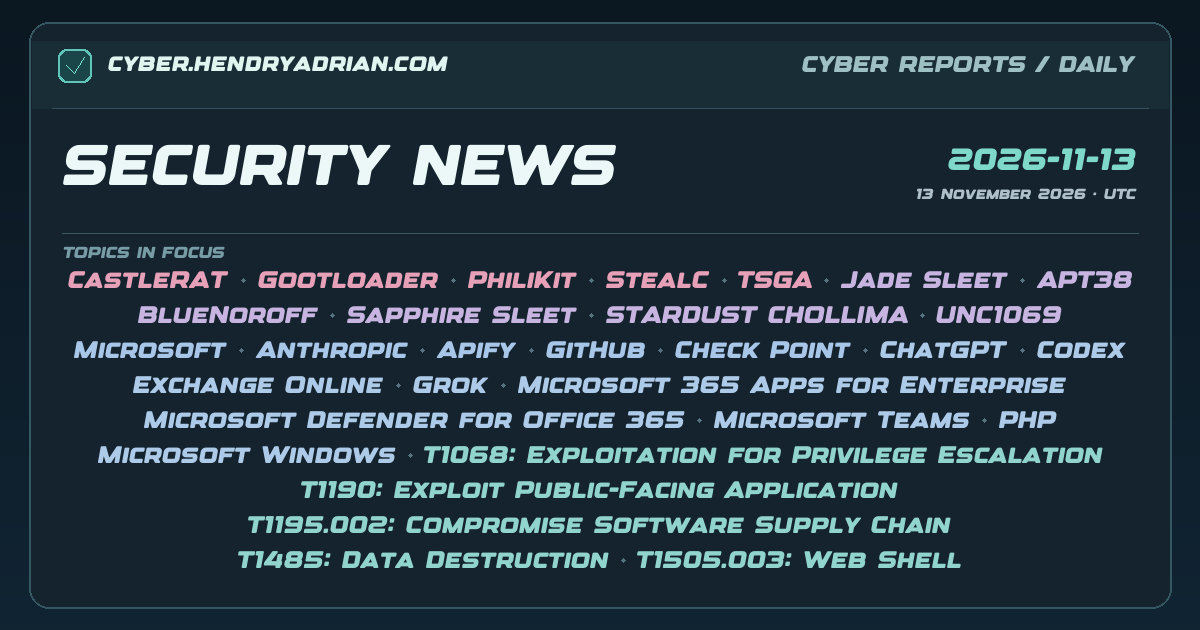
Daily Report (13 November 2026), Highlighted News/Report : Attackers exploit Check Point gateways in destructive attacks, Binance theft involved malicious wallet authorizations; U.S. obtains seizure order
Highlighted News
The day’s leading storiesAttackers exploit Check Point gateways in destructive attacks
Check Point reports two waves of attacks exploiting PHP2Shell flaws in its gateways. The first targeted Israeli organizations and deployed an ESXi wiper; the second reached organizations in multiple countries, with no destructive activity observed. Attribution remains uncertain.
Security Significance: Attackers reportedly used CVE-2026-109618 and CVE-2026-109619 for initial access and CVE-2026-123039 for privilege escalation, then installed web shells and a backdoor.
Binance theft involved malicious wallet authorizations; U.S. obtains seizure order
Attackers transferred about $6.34 billion from Binance wallets after compromising developer systems and gaining signing privileges, according to reporting on Binance’s post-mortem. The Justice Department obtained court authorization to seize or restrain more than $1.2 billion in funds reported stolen.
Security Significance: A malicious EIP-7702 authorization allowed sweeper code to move funds from a treasury wallet and later deposits; suspending withdrawals did not revoke the authorization. The FBI previously attributed the theft to North Korea’s TraderTraitor group.
Daily News Digest
Additional developmentsThreat Research SilentAir intercepts calls and texts through mobile-operator nodes
Enea reports that SilentAir uses hijacked mobile-operator nodes to intercept calls and SMS, mainly targeting Taiwan. The nodes belong to operators in at least six Asian countries.
Security Significance: The activity mostly uses SS7 and sometimes Diameter. Enea assesses with high confidence that SilentAir is a new state-level actor, but has low confidence in a possible China alignment.
Incident Quantum Systems confirms cyberattack amid reports of compromised software update
Quantum Systems confirmed an active cyberattack detected in late October. Media reports say attackers compromised a QBase update server and distributed a malicious update; German forces reportedly grounded the company’s drones as a precaution.
Security Significance: QBase is ground-control and mission-planning software. The number of customers who installed the reported malicious update is unknown, and the company did not identify the attackers.
Incident FBI disrupts FaceStealer campaign linked to cryptocurrency theft
The FBI says North Korea-linked actors stole more than $400 million in cryptocurrency over 18 months through FaceStealer. Authorities seized campaign cloud infrastructure and more than 900 victim webcam recordings.
Security Significance: The campaign used compromised accounts and prerecorded or deepfake video to build trust before directing targets to malware through a fake technical-error lure. Operators remain at large.
Incident Trezor finds recovery-phrase-stealing implants in three wallets
Trezor confirmed that three Safe 5 wallets sold by CryptoBilis contained implants capable of capturing recovery phrases and passphrases and transmitting them over mobile networks. No owners have reported lost funds.
Security Significance: Trezor says firmware 2.13.1 blocks the identified implants, but previously captured phrases may remain at risk.
Incident Apify confirms attacker accessed customer accounts and data
Apify says an attacker used a compromised credential to obtain additional credentials and access related accounts on November 9–10. Some customer personal information or stored data was accessed, including salted password hashes and authentication tokens.
Security Significance: Apify says it cut off access, rotated credentials and secrets, and notified affected customers. It has not disclosed the number of affected accounts.
Other Operation Endgame disrupts infrastructure for three malware operations
Authorities say an international operation seized 235 servers and 257 domains associated with Gootloader, CastleRAT and StealC. Europol reports that 6.4 million victim credentials were recovered.
Security Significance: Authorities also report cleaning malware from 681 infected websites. Gootloader has been used to deliver other malware, including ransomware.
Threat Research ArcticRAT adds Android remote control and AI-assisted data analysis
Zimperium reports that ArcticRAT has evolved from a cryptocurrency stealer into an Android remote-access trojan that uses the xAI Grok API to identify potentially valuable financial data in stolen messages.
Security Significance: Reported capabilities include abusing Accessibility Services, stealing keystrokes and messages, capturing screens, monitoring microphone audio and changing screen-lock credentials.
Advisory Chrome update fixes 83 security issues
Google’s Chrome Stable update for Windows, Mac and Linux fixes 83 security issues, including five critical use-after-free flaws.
Security Significance: The update is rolling out over days and weeks; users can check for it manually.
Incident TSMC confirms employee data appeared on external website
TSMC says current and former employee data appeared on an external website and matched records held by an unnamed cloud provider. It found no evidence that its own systems were compromised.
Security Significance: A seller’s claim to have about 46,000 records remains unverified.
Threat Research Researchers analyze DownTheDRAIN macOS infostealer
A SANS diary analyzes a DownTheDRAIN sample delivered through a fake CAPTCHA and ClickFix instructions. The diary author says macOS blocked the sample before sensitive data could be exfiltrated.
Security Significance: Huntress identified a function in a sample that can identify cryptocurrency wallet addresses and redirect their contents to an attacker-controlled wallet.
Other Microsoft cloud outage disrupts collaboration and some security functions
A widespread Microsoft outage disrupted services including Exchange Online, Teams and SharePoint. Defender services and some password-reset, MFA and single-sign-on functions were also affected.
Security Significance: Microsoft said it had no indication of a cyberattack and was investigating the cause; full recovery had not been confirmed in the reporting.
Incident Baker Tilly notifies clients of service-provider data theft
Baker Tilly is notifying clients that hackers stole personal information, including Social Security numbers, from a service provider’s platform. Texas filings indicate more than 10,000 affected people.
Security Significance: The reported theft involves sensitive personal information held by a third-party provider.
Daily Threat Intelligence
Six Top 7 rankingsRanked by distinct supporting articles. Open Related Evidence for saved source contexts and CVE details.
Top 7 CVEs
- 1CVE-2026-109618 · PHP Group PHP
- 2CVE-2026-109619 · PHP Group PHP
- 3CVE-2026-123039 · checkpoint Quantum Security Gateway
Top 7 MITRE ATT&CK Techniques
Top 7 Malware
- 5TSGA
Top 7 Threat Actors
- 7BYOD
Top 7 Mentioned Countries
Top 7 Mentioned Industries
Other Articles (9)
-
New York City Council Passes Bill to Ban Surveillance Pricing
malwarebytes.com · Publisher date:
-
GuardSix Updates Free Academy With Role-Based SIEM Training
guardsix.com · Publisher date:
-
OpenAI Announces Daybreak AI Tools for Security Testing and Patching
securityweek.com · Publisher date:
-
Microsoft Warns November 2026 Security Updates May Break Printing
bleepingcomputer.com · Publisher date:
-
Microsoft Confirms Windows Activation Failures After November Updates
bleepingcomputer.com · Publisher date:
-
Operation TorNado Leads to 354 Arrests in Dark Web Crackdown
bleepingcomputer.com · Publisher date:
-
Pall Mall Process Finalizes Voluntary Guidelines for Commercial Cyber Intrusion Tools
cyberscoop.com · Publisher date:
-
IBM Buys AuthMind to Monitor AI Agent Identity and Access
databreachtoday.com · Publisher date:
-
Anthropic CEO Predicts AI Agent Swarms Could Patch Vulnerabilities Within a Year
databreachtoday.com · Publisher date:
METHODOLOGY AND LIMITATIONS
Reporting period and eligibility
Article selection uses the original publisher publication date within the saved reporting period. Articles without that date are excluded; discovery dates and Cyber publication dates do not substitute for it. Counts include articles meeting public eligibility rules after the saved Daily Report SCOPE exclusions were applied.
Daily scope includes only Security News and Cyber Attack & Data Breach. Each report covers one completed UTC calendar day, with an exclusive ending boundary. AI groups saved article evidence independently of PHP diagnostic event clusters.
Highlighted News and Daily News Digest selection
Daily editorial selection considers Security Impact & Scale, Urgency & Operational Relevance, Evidence Quality & Confidence, and Technical Novelty & Topic Diversity. Security impact and urgency receive the strongest consideration: actual incidents, breaches, disruption, active exploitation and immediate defensive needs. Confirmed impact is distinguished from potential impact; credible reporting and verified findings are distinguished from unverified claims.
Highlighted News aims to select two distinct, significant, well-supported developments when available. Different wording, publishers or PHP diagnostic clusters may describe the same underlying development and can be grouped together; shared entities alone do not establish SAME_EVENT. Separate incidents remain separate, and conflicting facts and uncertainty are retained.
Highlighted News contains up to two items. The Daily News Digest aims for twelve additional distinct, valuable developments, excluding developments already highlighted and duplicate coverage of the same event. These are upper bounds and editorial targets, never minimum counts: shorter or empty sections are valid when evidence is insufficient. No filler is added. Article frequency or the number of publishers alone does not establish security significance or independent verification.
Selection uses the supplied, budget-bounded saved article evidence. Unsupported claims, including unsupported severity assessments, predictions and quantitative facts, are omitted. These criteria describe the current editorial policy; historical reports retain their saved analysis.
Ranked lists and evidence
Ranked lists show up to seven saved, validated canonical entities per category, ordered by the number of distinct supporting articles. Each article counts once per entity. These are article references, not unique incident counts; multiple articles and publishers may cover the same event.
Related Evidence displays saved entity-specific contexts with publisher identity, publication dates and article links. Missing context is identified explicitly and does not mean a supporting article is missing: the article remains linked and counted. Article summaries are not substituted for unavailable entity context.
Entity mentions do not confirm attribution, infection, exploitation, attacker origin, victim location, targeting or industry compromise. Country and industry contexts retain the original research wording.
Saved CVE details
CVSS, severity, EPSS and CISA KEV details are available inside each CVE's Related Evidence, using saved snapshot enrichment only; unavailable values are Unknown. EPSS estimates exploitation probability, not vulnerability severity or confirmed exploitation. Absence from KEV does not establish absence of exploitation. CVE rankings depend on supporting articles, not scores or KEV status.
Historical and AI limitations
This report uses a saved historical evidence snapshot. Source edits, later enrichment and subsequent reporting do not automatically update it. AI analysis uses bounded editorial selections of summaries, key points and validated relationships; it cannot establish complete coverage of global threat activity. Historical completeness: Saved daily scope.
Ransomware operator claims and leak-site listings are unverified allegations, not confirmed attacks. Repetition by another publisher does not independently verify compromise, data theft or actor involvement.
Evidence panels provide ten articles per page, with every saved reference accessible. Without JavaScript, all references are displayed. Related entity metadata does not increase the supporting article count. Links use saved identities; their availability may change.
Supporting evidence
2 saved supporting articles
- Attackers Exploit PHP2Shell in Check Point Gateways to Deploy VMware ESXi Wiperbleepingcomputer.com · Publisher date:
- PHP2Shell Exploited in Destructive Attacks on Check Point Gatewayssecurityweek.com · Publisher date:
- CVE-2026-109618PHP Group · PHP; Siemens · AMIS TS; +105 more
- CVE-2026-109619PHP Group · PHP; Siemens · AMIS TS; +106 more
- CVE-2026-123039checkpoint · Quantum Security Gateway; checkpoint · Quantum Security Management
- TSGA
- TSProxy
- destroy_v6
- VMware ESXi
- Check Point
Supporting evidence
2 saved supporting articles
- Attackers Used EIP-7702 Authorizations to Move Cryptocurrency From Binance Walletsdarkreading.com · Publisher date:
- U.S. Gets Court Authorization to Seize $1.2 Billion in Crypto Stolen From Binancesecurityweek.com · Publisher date:
Supporting evidence
1 saved supporting article
- Enea Details SilentAir Activity Intercepting Calls and SMS Through Compromised Mobile Networkssecurityweek.com · Publisher date:
Supporting evidence
1 saved supporting article
Supporting evidence
2 saved supporting articles
- FBI Says North Korea-Linked Actors Stole Over $400 Million Through FaceStealerthehackernews.com · Publisher date:
- FBI Disrupts FaceStealer Campaign Using Fake Video Calls to Target Crypto Userssocradar.io · Publisher date:
Supporting evidence
2 saved supporting articles
- Trezor Finds Hidden Recovery-Phrase-Capturing Implants in Three CryptoBilis-Sold Walletsthehackernews.com · Publisher date:
- Trezor Confirms Crypto-Stealing Implants in Three Safe 5 Wallets, Releases Fixbleepingcomputer.com · Publisher date:
Supporting evidence
2 saved supporting articles
- Apify Confirms Customer Data Accessed in Cyberattacksecurityweek.com · Publisher date:
- Apify Says Attacker Accessed Customer Accounts and Dataprivacyaffairs.com · Publisher date:
Supporting evidence
2 saved supporting articles
- Law Enforcement Disrupts Gootloader, CastleRAT and StealC Infrastructuresecurityweek.com · Publisher date:
- Operation Endgame Disrupts Gootloader, CastleRAT and StealC Infrastructurethehackernews.com · Publisher date:
Supporting evidence
1 saved supporting article
- Zimperium Reports ArcticRAT Uses AI to Identify Financial Data on Android Devicesdarkreading.com · Publisher date:
Supporting evidence
1 saved supporting article
- Google Issues Second Chrome Update This Week, Fixing 83 Security Flawsmalwarebytes.com · Publisher date:
Supporting evidence
1 saved supporting article
- TSMC Confirms Employee Data Appeared on External Website; Cloud Provider Under Investigationsecurityonline.info · Publisher date:
Supporting evidence
1 saved supporting article
Supporting evidence
2 saved supporting articles
- Microsoft 365 Outage Disrupts Outlook, Teams and SharePoint; Defender Services May Be Affectedmalwarebytes.com · Publisher date:
- Microsoft Cloud Outage Disrupts Services and Some Sign-In Functions Globallydatabreachtoday.com · Publisher date:
Supporting evidence
1 saved supporting article
- Security Roundup Covers AI-Agent Abuse, Cloud Credential Theft and Connected-Car Flawssecurityweek.com · Publisher date:
Related Evidence
2 saved supporting articles
Entity: CVE-2026-109618
PHP Group · PHP; Siemens · AMIS TS; +105 more
- CVSS
- 9.2 · CRITICAL
- EPSS
- 100.00%
- KEV
- Unknown
Supporting articles
PHP2Shell, tracked as CVE-2026-109618 and CVE-2026-109619, refers to two critical vulnerabilities leading to remote code execution (RCE) and affecting all PHP versions from PHP 5 onwards.
Publisher: securityweek.com · Publisher date: VIEW ARTICLEPHP2Shell is the name for two critical PHP flaws, tracked as CVE-2026-109618 and CVE-2026-109619, that allow unauthenticated remote code execution on vulnerable systems.
Publisher: bleepingcomputer.com · Publisher date: VIEW ARTICLE
Related Evidence
2 saved supporting articles
Entity: CVE-2026-109619
PHP Group · PHP; Siemens · AMIS TS; +106 more
- CVSS
- 9.2 · CRITICAL
- EPSS
- 100.00%
- KEV
- Unknown
Supporting articles
PHP2Shell, tracked as CVE-2026-109618 and CVE-2026-109619, refers to two critical vulnerabilities leading to remote code execution (RCE) and affecting all PHP versions from PHP 5 onwards.
Publisher: securityweek.com · Publisher date: VIEW ARTICLEPHP2Shell is the name for two critical PHP flaws, tracked as CVE-2026-109618 and CVE-2026-109619, that allow unauthenticated remote code execution on vulnerable systems.
Publisher: bleepingcomputer.com · Publisher date: VIEW ARTICLE
Related Evidence
2 saved supporting articles
Entity: CVE-2026-123039
checkpoint · Quantum Security Gateway; checkpoint · Quantum Security Management
- CVSS
- 7.8 · HIGH
- EPSS
- Unknown
- KEV
- Unknown
Supporting articles
of the Check Point campaign, the attackers exploited PHP2Shell for initial access, then targeted CVE-2026-123039, a local privilege escalation in the DynamicCLI process, to gain root access and deploy PHP webshells
Publisher: securityweek.com · Publisher date: VIEW ARTICLEThe attacker used PHP2Shell to gain access through the gateways’ Mobile Access portal, then exploited a newly disclosed zero-day vulnerability tracked as CVE-2026-123039 to gain root privileges.
Publisher: bleepingcomputer.com · Publisher date: VIEW ARTICLE
Related Evidence
2 saved supporting articles
Attackers exploited CVE-2026-123039 for local privilege escalation to gain root access.
Publisher: securityweek.com · Publisher date: VIEW ARTICLEThe attackers exploited a newly disclosed zero-day to gain root privileges.
Publisher: bleepingcomputer.com · Publisher date: VIEW ARTICLE
Related Evidence
2 saved supporting articles
Attackers exploited PHP2Shell vulnerabilities on Check Point Gateway appliances for initial access.
Publisher: securityweek.com · Publisher date: VIEW ARTICLEThe attackers exploited PHP2Shell vulnerabilities on internet-facing Check Point gateways to gain initial access.
Publisher: bleepingcomputer.com · Publisher date: VIEW ARTICLE
Related Evidence
2 saved supporting articles
A Binance developer downloaded a compromised version of Homebrew, which the article identifies as one of the initial compromises enabling the attack.
Publisher: darkreading.com · Publisher date: VIEW ARTICLEReports citing internal sources said the compromise involved a malicious QBase update file delivered through Quantum Systems' update distribution server, consistent with a software supply chain compromise.
Publisher: bleepingcomputer.com · Publisher date: VIEW ARTICLE
Related Evidence
2 saved supporting articles
Attackers deployed and executed a wiper on a VMware ESXi host during the first wave.
Publisher: securityweek.com · Publisher date: VIEW ARTICLEThe destroy_v6 wiper recursively deletes data and can overwrite it to make recovery harder.
Publisher: bleepingcomputer.com · Publisher date: VIEW ARTICLE
Related Evidence
2 saved supporting articles
Attackers deployed PHP webshells on gateways for command execution and persistence.
Publisher: securityweek.com · Publisher date: VIEW ARTICLEThe attackers installed PHP webshells on compromised gateways.
Publisher: bleepingcomputer.com · Publisher date: VIEW ARTICLE
Related Evidence
1 saved supporting article
The article describes unauthorized SSH activity from gateways to internal VMware ESXi hosts as a sign of breach.
Publisher: bleepingcomputer.com · Publisher date: VIEW ARTICLE
Related Evidence
1 saved supporting article
The article describes keyloggers as part of the reported malware toolkit.
Publisher: socradar.io · Publisher date: VIEW ARTICLE
Related Evidence
2 saved supporting articles
Law enforcement agencies in the US, Europe, Australia, and Canada have seized infrastructure behind the notorious Gootloader, CastleRAT, and StealC malware.
Publisher: securityweek.com · Publisher date: VIEW ARTICLEAn international police operation took down servers behind Gootloader, CastleRAT and StealC this week. Criminals used the three malware tools to gain access to computers, steal passwords, and launch ransomware attacks.
Publisher: thehackernews.com · Publisher date: VIEW ARTICLE
Related Evidence
2 saved supporting articles
Next, they deployed TSGA and TSProxy, variants of the malware framework PhiliKit previously seen (PDF) in China-linked UNC5221’s hacking into Ivanti products, for backdoor access and network function interception.
Publisher: securityweek.com · Publisher date: VIEW ARTICLECheck Point tentatively linked TSGA and TSProxy to PhiliKit, a malware framework previously seen in attacks on Ivanti appliances and which ESET associated with the Chinese threat cluster UNC5221.
Publisher: bleepingcomputer.com · Publisher date: VIEW ARTICLE
Related Evidence
2 saved supporting articles
Law enforcement agencies in the US, Europe, Australia, and Canada have seized infrastructure behind the notorious Gootloader, CastleRAT, and StealC malware.
Publisher: securityweek.com · Publisher date: VIEW ARTICLEAn international police operation took down servers behind Gootloader, CastleRAT and StealC this week. Criminals used the three malware tools to gain access to computers, steal passwords, and launch ransomware attacks.
Publisher: thehackernews.com · Publisher date: VIEW ARTICLE
Related Evidence
2 saved supporting articles
Next, they deployed TSGA and TSProxy, variants of the malware framework PhiliKit previously seen (PDF) in China-linked UNC5221’s hacking into Ivanti products, for backdoor access and network function interception.
Publisher: securityweek.com · Publisher date: VIEW ARTICLEThen they abused the privileges to install PHP webshells and the TSGA backdoor, which embeds a networking component called TSProxy to listen for attacker commands concealed within regular traffic.
Publisher: bleepingcomputer.com · Publisher date: VIEW ARTICLE
Related Evidence
1 saved supporting article
Android cryptocurrency stealer ArcticRAT has evolved into a sophisticated remote access Trojan (RAT) capable of taking control of victim devices, harvesting sensitive information, and using AI to identify valuable
Publisher: darkreading.com · Publisher date: VIEW ARTICLE
Related Evidence
1 saved supporting article
The payload in question is BeaverTail, a JavaScript loader that's used to deliver a Python backdoor referred to as InvisibleFerret. Both malware families are attributed to Contagious Interview.
Publisher: thehackernews.com · Publisher date: VIEW ARTICLE
Related Evidence
4 saved supporting articles
The FBI previously attributed the Binance theft to the North Korean hacking group known as TraderTraitor.
Publisher: securityweek.com · Publisher date: VIEW ARTICLEThe article describes TraderTraitor as North Korea-linked actors associated with the hack of Binance and cryptocurrency theft; the DOJ announced seizure and restraint of assets recently stolen by them.
Publisher: thehackernews.com · Publisher date: VIEW ARTICLEThe article identifies TraderTraitor as the moniker for the group behind the attacks and reports that the FBI placed blame on North Korean cybercriminal operators, publishing cryptocurrency addresses linked to the group.
Publisher: darkreading.com · Publisher date: VIEW ARTICLEFederal authorities attribute the separate Binance theft to TraderTraitor, which the DOJ links to North Korea’s military. North Korea denies the allegations; the FBI says it is unclear whether the attackers used FaceStealer’s methods to breach Binance.
Publisher: socradar.io · Publisher date: VIEW ARTICLE
Related Evidence
2 saved supporting articles
The article explicitly lists APT38 as a cryptonym for BlueNoroff, which it links to the FaceStealer campaign.
Publisher: thehackernews.com · Publisher date: VIEW ARTICLEThe DOJ names APT38 among the groups associated with FaceStealer, and an FBI official separately told reporters the scheme was attributed to APT38. The article says these designations refer to overlapping, financially motivated North Korean activity.
Publisher: socradar.io · Publisher date: VIEW ARTICLE
Related Evidence
2 saved supporting articles
The article links this North Korea-associated financially motivated threat cluster to FaceStealer and describes its targeting of cryptocurrency and Web3 workers, developers, and maintainers.
Publisher: thehackernews.com · Publisher date: VIEW ARTICLEThe DOJ attributes FaceStealer to North Korean hackers tracked under this name; the article says these designations are used by different organizations for overlapping, financially motivated North Korean activity.
Publisher: socradar.io · Publisher date: VIEW ARTICLE
Related Evidence
2 saved supporting articles
The article explicitly lists CryptoCore as a cryptonym for BlueNoroff, which it links to the FaceStealer campaign.
Publisher: thehackernews.com · Publisher date: VIEW ARTICLEThe DOJ attributes FaceStealer to North Korean hackers tracked under this name; the article says these designations are used by different organizations for overlapping, financially motivated North Korean activity.
Publisher: socradar.io · Publisher date: VIEW ARTICLE
Related Evidence
2 saved supporting articles
The article explicitly lists Stardust Chollima as a cryptonym for BlueNoroff, which it links to the FaceStealer campaign.
Publisher: thehackernews.com · Publisher date: VIEW ARTICLEThe DOJ attributes FaceStealer to North Korean hackers tracked under this name; the article says these designations are used by different organizations for overlapping, financially motivated North Korean activity.
Publisher: socradar.io · Publisher date: VIEW ARTICLE
Related Evidence
2 saved supporting articles
The article explicitly lists UNC1069 as a cryptonym for BlueNoroff, which it links to the FaceStealer campaign.
Publisher: thehackernews.com · Publisher date: VIEW ARTICLEThe DOJ attributes FaceStealer to North Korean hackers tracked under this name; the article says these designations are used by different organizations for overlapping, financially motivated North Korean activity.
Publisher: socradar.io · Publisher date: VIEW ARTICLE
Related Evidence
1 saved supporting article
The group claimed credit for the cyberattack under investigation at Vanderbilt University; the university advised its community to power down devices and disconnect from campus Wi-Fi.
Publisher: securityweek.com · Publisher date: VIEW ARTICLE
Related Evidence
9 saved supporting articles
Typically in those situations, the U.S. government will file a claim of forfeiture with a judge, who will then determine who has a legitimate claim to the recovered funds.
Publisher: securityweek.com · Publisher date: VIEW ARTICLELaw enforcement authorities also seized more than 4.8 metric tonnes of illicit drugs, 152 firearms, and over €150 million ($166 million) in the United States.
Publisher: bleepingcomputer.com · Publisher date: VIEW ARTICLELaw enforcement agencies in the US, Europe, Australia, and Canada have seized infrastructure behind the notorious Gootloader, CastleRAT, and StealC malware.
Publisher: securityweek.com · Publisher date: VIEW ARTICLEThe disruption began at 16:17 UTC on Thursday, or 11:17 a.m. East Coast Time in the United States, according to Microsoft's Exchange Online portal.
Publisher: databreachtoday.com · Publisher date: VIEW ARTICLEThe U.S. Federal Bureau of Investigation (FBI) has established that threat actors tied to the Democratic People's Republic of Korea (DPRK aka North Korea) have stolen more than $400 million worth of cryptocurrency as
Publisher: thehackernews.com · Publisher date: VIEW ARTICLEGootloader has infected at least 25,000 computers worldwide since 2018, the U.S. Justice Department said. Its operators used those computers to infect more computers, then sold access to the new ones to ransomware
Publisher: thehackernews.com · Publisher date: VIEW ARTICLEUS-based Vanderbilt University this week told everyone in its community to shut down university devices and disconnect from campus Wi-Fi as its IT team worked on an active cybersecurity incident that it said could
Publisher: securityweek.com · Publisher date: VIEW ARTICLEThe United States this week signed on to an international set of industry standards for commercial offensive cyber tools that human rights groups and other advocates wish had been stronger.
Publisher: cyberscoop.com · Publisher date: VIEW ARTICLEThe FBI and the U.S.
Publisher: socradar.io · Publisher date: VIEW ARTICLE
Related Evidence
4 saved supporting articles
CNN reports impacts on businesses, schools, and government services, including in Australia.
Publisher: malwarebytes.com · Publisher date: VIEW ARTICLELaw enforcement agencies in the US, Europe, Australia, and Canada have seized infrastructure behind the notorious Gootloader, CastleRAT, and StealC malware.
Publisher: securityweek.com · Publisher date: VIEW ARTICLEjoint cybersecurity advisory published by cybersecurity and intelligence agencies from Japan, the U.S., Australia, and Germany in late September 2026, the long-running campaign is estimated to have compromised at least
Publisher: thehackernews.com · Publisher date: VIEW ARTICLEIn July, another drone manufacturer, the Australian CubePilot, which also openly supports Ukraine, was targeted by a DNS hijacking attack that caused severe operational disruption.
Publisher: bleepingcomputer.com · Publisher date: VIEW ARTICLE
Related Evidence
4 saved supporting articles
[ Read: North Korea Launches Missiles Toward the Sea to Protest Binance Hack Claims ]
Publisher: securityweek.com · Publisher date: VIEW ARTICLE(FBI) has established that threat actors tied to the Democratic People's Republic of Korea (DPRK aka North Korea) have stolen more than $400 million worth of cryptocurrency as part of a social engineering scheme
Publisher: thehackernews.com · Publisher date: VIEW ARTICLELike that incident, the FBI placed blame directly on North Korean cybercriminal operators, releasing a list of more than 600 Ethereum addresses, 19 Bitcoin addresses, and 1 SOL address linked to TraderTraitor, a moniker
Publisher: darkreading.com · Publisher date: VIEW ARTICLEFederal authorities attribute the Binance attack to a different threat actor, TraderTraitor, which the DOJ links to North Korea’s military.
Publisher: socradar.io · Publisher date: VIEW ARTICLE
Related Evidence
3 saved supporting articles
Next, they deployed TSGA and TSProxy, variants of the malware framework PhiliKit previously seen (PDF) in China-linked UNC5221’s hacking into Ivanti products, for backdoor access and network function interception.
Publisher: securityweek.com · Publisher date: VIEW ARTICLEEnea’s researchers also believe, with low confidence, that SilentAir’s activity is aligned with China-nexus operations.
Publisher: securityweek.com · Publisher date: VIEW ARTICLECheck Point tentatively linked TSGA and TSProxy to PhiliKit, a malware framework previously seen in attacks on Ivanti appliances and which ESET associated with the Chinese threat cluster UNC5221.
Publisher: bleepingcomputer.com · Publisher date: VIEW ARTICLE
Related Evidence
3 saved supporting articles
advisory published by cybersecurity and intelligence agencies from Japan, the U.S., Australia, and Germany in late September 2026, the long-running campaign is estimated to have compromised at least 30,000
Publisher: thehackernews.com · Publisher date: VIEW ARTICLEPolice also seized about 6.4 million stolen logins belonging to more than 40,000 victims, according to Germany's Federal Criminal Police Office (BKA).
Publisher: thehackernews.com · Publisher date: VIEW ARTICLEIts drones are in service with Germany’s military, and in October Germany announced funding to build tens of thousands of Quantum Systems interceptor drones in Ukraine for Ukrainian forces.
Publisher: bleepingcomputer.com · Publisher date: VIEW ARTICLE
Related Evidence
2 saved supporting articles
An initial, destructive round started on October 30 and targeted Israeli organizations, and a second one started on November 2, targeting organizations across multiple countries.
Publisher: securityweek.com · Publisher date: VIEW ARTICLEThe attacks started on October 30, initially against Israeli organizations, and were conducted by an actor that ran the entire campaign, from initial access to lateral movement and launching PHP webshells.
Publisher: bleepingcomputer.com · Publisher date: VIEW ARTICLE
Related Evidence
2 saved supporting articles
Taiwan Semiconductor Manufacturing Company (TSMC)
Publisher: securityonline.info · Publisher date: VIEW ARTICLEthat intercepts phone calls and text messages through compromised mobile operator infrastructure, with Taiwan as its main target.
Publisher: securityweek.com · Publisher date: VIEW ARTICLE
Related Evidence
4 saved supporting articles
The FBI said Thursday that it had seized more than $1.2 billion of cryptocurrency reported stolen last month from Binance, the world’s largest crypto exchange.
Publisher: securityweek.com · Publisher date: VIEW ARTICLEattacks can be stopped — or at least blunted — by a combination of controls. Any company processing cryptocurrency transactions in real time should use simulations to detect malicious rules, enforce policies on the
Publisher: darkreading.com · Publisher date: VIEW ARTICLECryptocurrency hardware wallet maker Trezor has confirmed that three Safe 5 devices sold by Southeast Asian reseller CryptoBilis contained malicious hardware implants designed to steal wallet recovery phrases and send
Publisher: bleepingcomputer.com · Publisher date: VIEW ARTICLEhijacked accounts, replayed webcam footage and fake video calls to steal more than $400 million in cryptocurrency over the past 18 months.
Publisher: socradar.io · Publisher date: VIEW ARTICLE
Related Evidence
2 saved supporting articles
OpenAI has introduced two new Daybreak cybersecurity products that use AI agents to test web applications for vulnerabilities and help security teams develop fixes.
Publisher: securityweek.com · Publisher date: VIEW ARTICLECEO Jamie Dimon, Anthropic CEO Dario Amodei said the next spaces agents will transform include cybersecurity, and enterprises can expect more from agents in securing their systems.
Publisher: databreachtoday.com · Publisher date: VIEW ARTICLE
Related Evidence
2 saved supporting articles
CNN reports impacts on businesses, schools, and government services, including in Australia.
Publisher: malwarebytes.com · Publisher date: VIEW ARTICLEBanks, hospitals, courts, schools, government cybersecurity agencies, emergency services and others reported being disrupted by the outage.
Publisher: databreachtoday.com · Publisher date: VIEW ARTICLE
Related Evidence
2 saved supporting articles
Web scraping and automation company Apify has confirmed that customer data was accessed in a cyberattack that compromised internal systems and customer accounts.
Publisher: securityweek.com · Publisher date: VIEW ARTICLETheir results land in the customer’s account, in datasets that, in Apify’s own words, store “results from web scraping”.
Publisher: privacyaffairs.com · Publisher date: VIEW ARTICLE
Related Evidence
1 saved supporting article
US accounting giant Baker Tilly is informing clients that hackers stole personal information, including Social Security numbers, from a platform operated by one of its service providers.
Publisher: securityweek.com · Publisher date: VIEW ARTICLE
Related Evidence
1 saved supporting article
Artificial Intelligence & Machine Learning
Publisher: databreachtoday.com · Publisher date: VIEW ARTICLE
Related Evidence
1 saved supporting article
Gayatri Khandhadai, head of technology and human rights at the Business and Human Rights Centre, said the real potential of the Pall Mall Process is in governing commercial spyware through cooperation between nations.
Publisher: cyberscoop.com · Publisher date: VIEW ARTICLE