React2Shell Exploited to Gain RCE on Production Next.js App
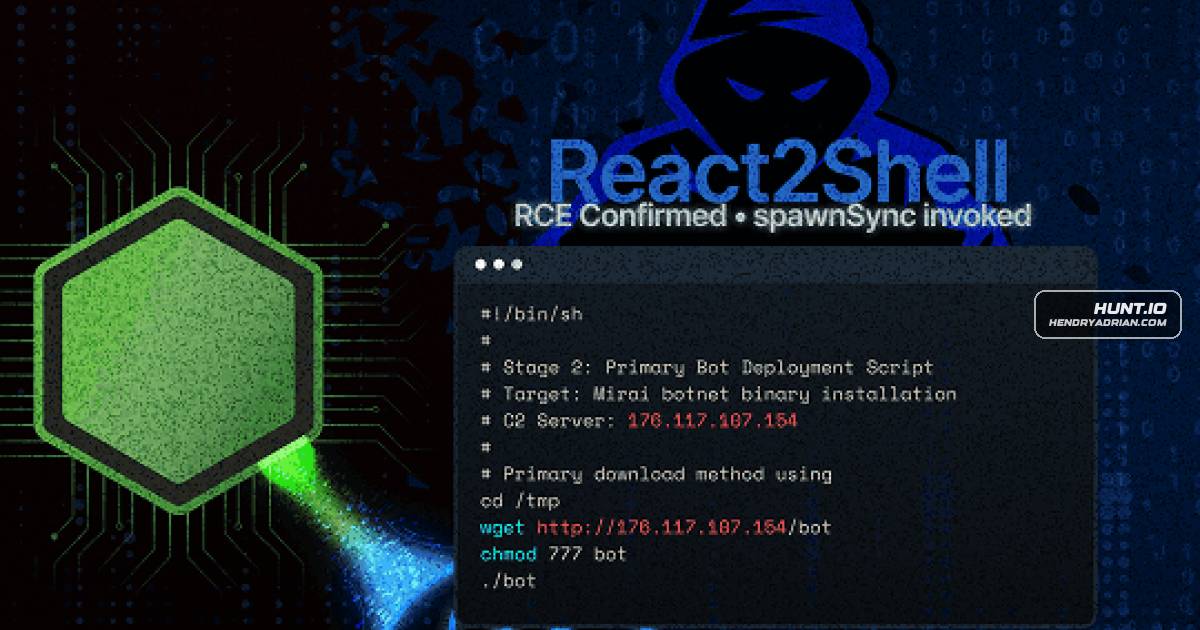
Summary
A Hunt IO investigation found attackers exploited React2Shell (CVE-2025-55182) on a production Next.js app, confirmed command execution, and attempted to deploy malware and persistence. Container restrictions blocked much of the activity, but logs showed integrity alert
Key points
- Logs from a production Next.js application confirmed successful exploitation of CVE-2025-55182, with attackers executing shell commands through Node.js child_process.spawnSync().
- The attackers attempted to deploy Mirai and other IoT-style payloads, run obfuscated scripts, and establish persistence using four C2 servers.
- A restricted container environment—including missing bash, curl, and sudo, plus process timeouts—blocked or limited several payload and persistence attempts.
- The investigation recorded 330 file-integrity alerts involving /app/logs/app.log; the article notes these may partly reflect logging of the attack itself.
- A JWT for a user account appeared in application logs, creating potential session-impersonation risk; the article recommends invalidating sessions and reviewing log redaction.
- The report advises organizations using React Server Components to patch and review logging, filtering, and container security controls.
Article Details
- Victim Organization
- Not disclosed
- Victim Domain
- avangenio.com
- Incident Type
- CVE-2025-55182 remote code execution, followed by attempted malware deployment and persistence, file integrity violations, and exposure of a JWT in application logs
- Data Types Exposed
- Email address
- Username
- JWT authentication token
- Affected Records
- One user's JWT and account identifier were present in the logs; unauthorized use is not confirmed.
- Affected Data Size
- Not disclosed
- Operational Impact
- Remote code execution on the application server was confirmed. Attempts to deploy and execute payloads and establish persistence were blocked or failed in the restricted container. File integrity monitoring recorded 330 violations on /app/logs/app.log, and a user's JWT was logged in plaintext.
- Ransom Or Extortion
- None reported
- Claim Status
- confirmed
Indicators of compromise
| Type | Indicator | Context |
|---|---|---|
| IPV4 | 128[.]199[.]194[.]97 | C2 server used to distribute persistence scripts on port 9001. |
| IPV4 | 176[.]117[.]107[.]154 | C2 server used to distribute the Mirai bot binary. |
| IPV4 | 193[.]34[.]213[.]150 | Primary Mirai campaign C2; the article reports 544 connection attempts. |
| IPV4 | 193[.]34[.]213[.]152 | Additional infrastructure linked to the primary C2 by a shared SSH key fingerprint; the article attributes it to the same threat actor's infrastructure. |
| IPV4 | 193[.]34[.]213[.]153 | Additional infrastructure linked to the primary C2 by a different SSH key fingerprint; identified by the article as associated infrastructure. |
| IPV4 | 193[.]34[.]213[.]157 | Additional infrastructure linked to the primary C2 by a shared SSH key fingerprint; the article attributes it to the same threat actor's infrastructure. |
| IPV4 | 193[.]34[.]213[.]159 | Additional infrastructure linked to the primary C2 by a shared SSH key fingerprint; the article attributes it to the same threat actor's infrastructure. |
| IPV4 | 78[.]153[.]140[.]16 | Hidden C2 address embedded in the base64 payload. |
| URL | hxxp[:]//128[.]199[.]194[.]97:9001/setup2[.]sh | Persistence-dropper URL used by the attack script. |
| URL | hxxp[:]//176[.]117[.]107[.]154/bot | Payload-download URL used to retrieve the Mirai bot binary from the C2 server. |
| URL | hxxp[:]//193[.]34[.]213[.]150/nuts/ | Malicious file repository directory on the campaign C2, identified as serving IoT malware. |
| URL | hxxp[:]//193[.]34[.]213[.]150/nuts/bolts | Payload URL used to retrieve the shell dropper from the campaign C2. |
| URL | hxxp[:]//193[.]34[.]213[.]150/nuts/x86 | Payload URL used to download the x86 IoT binary from the campaign C2. |
| URL | hxxp[:]//78[.]153[.]140[.]16/re[.]sh | Payload URL retrieved from the hidden C2 by the decoded malicious script. |
MITRE ATT&CK
T1027 · Obfuscated Files or InformationThe article maps the base64-encoded payload and custom socket-based HTTP client to this technique.T1037 · Boot or Logon Initialization ScriptsThe article maps attempted execution of persistence scripts to this technique.T1059.004 · Unix ShellThe article maps shell command execution through /bin/sh to this technique.T1071.001 · Web ProtocolsThe article maps HTTP-based C2 communications to this technique.T1105 · Ingress Tool TransferThe article maps payload downloads using wget, curl, and busybox to this technique.T1190 · Exploit Public-Facing ApplicationThe article maps exploitation of CVE-2025-55182 against the public-facing application to this technique.T1548.003 · Sudo and Sudo CachingThe article maps failed sudo privilege-escalation attempts to this technique.T1565.001 · Stored Data ManipulationThe article maps observed application-log integrity violations to this technique.
CVE
People
Malware
Vendors
Products
Next.jsThis report analyzes a live exploitation of CVE-2025-55182 - “React2Shell” - against a production Next.js application using React Server Components (RSC). Though the vulnerability lies in the RSC Flight protocol, theNode.jsComponents (RSC). Though the vulnerability lies in the RSC Flight protocol, the exploit executes within Node.js - meaning attackers can call Node APIs directly.Reacta live exploitation of CVE-2025-55182 - “React2Shell” - against a production Next.js application using React Server Components (RSC). Though the vulnerability lies in the RSC Flight protocol, the exploit executes
Tools
Countries
PolandThe screenshot below shows the detailed intelligence profile for this IP address. Key observations include the server's hosting on MEVSPACE sp. z o.o. infrastructure in Warsaw, Poland, operating under ASN AS201814.SingaporeOur dashboard reveals extensive information about this Singapore-based DigitalOcean droplet. Operating under ASN AS14061, it carries a Warning indicator tied to a recent Next.js RCE IOC, highlighting its involvement inSloveniathis campaign served as the primary distribution point for the Mirai bot binary. Located in Ljubljana, Slovenia, this server delivered the 3,595 KB bot executable to compromised targets. Our platform providesUnited Kingdom78.153.140[.]16 80 Hidden C2 (base64) Encoded in payload United Kingdom