
Huntress Explains How to Turn Windows Event Logs Into Intrusion Insights
Summary
Huntress outlines practical methods for analyzing Windows authentication, credential-access and RDP logs to investigate suspicious activity, including approaches that work without a SIEM.
Key points
- Compare failed logins’ status and substatus codes to distinguish nonexistent usernames from incorrect passwords; weigh unfamiliar activity against historical patterns.
- Assess successful 4624 logins using authentication protocol, workstation name and account history; coordinated logins across hosts can reveal suspicious activity.
- Use logon IDs to connect related events, including 5145 file-share activity that may help investigate registry credential dumping.
- Registry credential dumping can use remote access and yield credential material without uploading files to the victim host or interacting with LSASS.
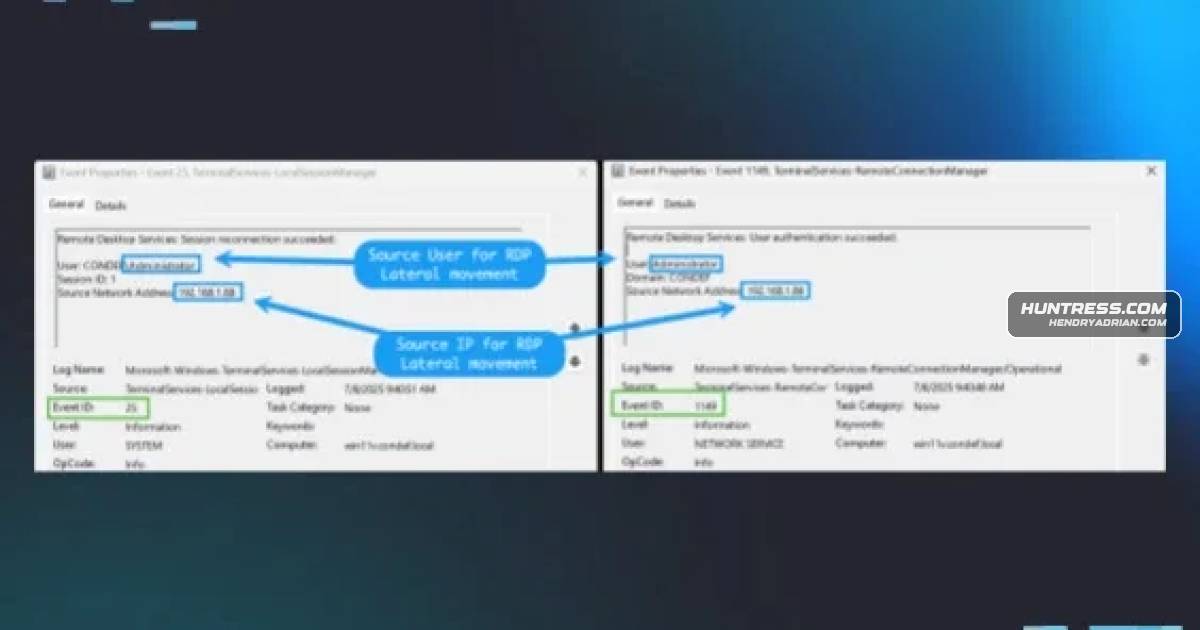
- If Windows Security logs are cleared, TerminalServices LocalSessionManager and RemoteConnectionManager logs may help investigate RDP activity.
- The methods emphasize analyzing and correlating raw telemetry, including with Event Viewer or PowerShell when SIEM tooling is unavailable.
Article Details
- Defense Focus
- Turn Windows authentication, credential-access, and RDP telemetry into actionable intrusion findings by analyzing event details, historical patterns, and correlated activity.
- Detection Methods
- Interpret Windows Security event 4625 SubStatus codes to distinguish nonexistent usernames from incorrect passwords or expired credentials; prioritize unusual activity involving accounts that do not exist in the environment.
- Assess failed logins using workstation identity and whether the source IP appears in organizational inventory; compare these details with historical activity.
- Review event 4624 AuthenticationPackageName and compare NTLM use with the account's historical authentication pattern, including whether Kerberos is normally used.
- Correlate successful 4624 events across hosts by account, timestamp, source IP, workstation, and authentication protocol to identify suspicious multi-host login patterns.
- Pivot from a suspicious 4624 logon ID to related events, including 5145 events showing activity involving administrative file shares and relative target names such as winreg, samr, and svcctl.
- For suspected RDP activity, inspect TerminalServices operational logs for events 25 and 1149, including when Security event 4624 with logon type 10 is absent or the Security log has been cleared.
- Enrich RDP source IP addresses with ASN information to help assess whether activity is malicious or benign.
- Data Sources
- Windows Security event 4624, including AuthenticationPackageName, logon type, source address, workstation, and logon ID
- Windows Security event 4625, including SubStatus, source address, and workstation
- Windows Security event 5145
- Windows Security event 1102
- Microsoft-Windows-TerminalServices-LocalSessionManager/Operational, event 25
- Microsoft-Windows-TerminalServices-RemoteConnectionManager/Operational, event 1149
- Historical authentication patterns and organizational asset inventory
- Platforms
- Windows hosts and event logs
- Windows Event Viewer
- SIEM platforms, when available
- Defensive Actions
- Prioritize investigation of failed logins for usernames absent from the environment when the activity is not historically observed.
- Validate unfamiliar workstation names and source IP addresses against organizational inventory and historical activity.
- Investigate unusual NTLM authentication, particularly when an account has historically used Kerberos.
- Aggregate related successful logins across hosts instead of assessing each event in isolation.
- Use the logon ID to correlate a suspicious session with subsequent event 5145 activity.
- When investigating possible RDP movement, check both TerminalServices operational channels even if Security event 4624 type 10 is absent.
- Ship telemetry off-host to a SIEM where available, so log clearing does not remove the only available copy.
MITRE ATT&CK
T1003.002 · Security Account ManagerThe article describes remote registry credential dumping to obtain credential material in the form of hashes.T1021.001 · Remote Desktop ProtocolThe article discusses RDP as a method used for lateral movement and recommends hunting for its authentication activity.T1070.001 · Clear Windows Event LogsThe article identifies clearing the Windows Security event log as indicator removal and discusses event 1102 and alternate RDP telemetry.T1110 · Brute ForceThe article describes intrusion scenarios involving brute-force logins, including successful authentication to multiple hosts.