Research Maps North Korea’s Cyber Units, Revenue Operations and Support Networks
Summary
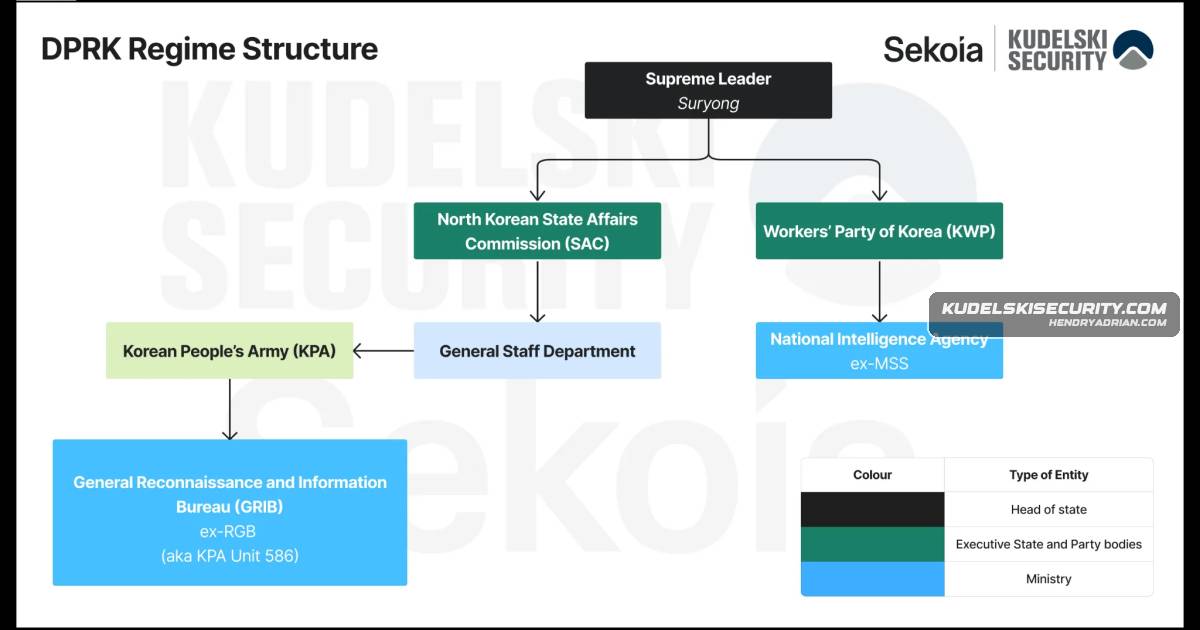
Kudelski Security and Sekoia analyze how North Korea organizes cyber operations across state agencies, threat clusters and overseas IT workers, using them for espionage, revenue generation and sanctions evasion.
Key points
- The research describes cyber operations as part of North Korea’s strategy for regime security, intelligence gathering and revenue generation.
- It says the GRIB (formerly RGB) leads offensive cyber operations, while responsibilities across agencies are frequently reorganized.
- The researchers split the former Lazarus umbrella into six clusters, including groups focused on espionage, financial operations and fake IT-worker activity.
- North Korean IT workers allegedly use false identities to obtain overseas technology jobs, remit earnings and exploit access for further operations.
- The report describes shared infrastructure and overlapping activity between IT workers and cyber operators, as well as cryptocurrency theft and laundering methods.
- Educational institutions, overseas intermediaries and front companies are described as supporting operator training, operational access and financial flows.
- The researchers say DPRK activity combines espionage and revenue generation, making the distinction between those objectives less clear.
Article Details
- Attack Vectors
- DPRK IT workers obtain technical employment under false identities, generating revenue and gaining insider access that can support espionage or cryptocurrency theft.
- Workers placed as remote consultants extend their access into client organizations and query internal corporate documentation.
- DPRK-linked clusters deploy custom ransomware and ransomware-as-a-service for revenue generation.
- Overseas relay networks, shared VPN exit nodes, and US-based laptop farms conceal operators' locations and support remote operations.
- Historical destructive operations used wipers, including disk wiping described as an anti-forensics measure.
- Defensive Notes
- The researchers identify communication channels and shared VPN exit nodes as monitoring opportunities linking dispersed IT-worker units with offensive operations.
- Cluster names and institutional affiliations change frequently; the article recommends tracking characteristic tradecraft, motivations, and successive reorganizations rather than relying solely on organizational labels.
- The article reports overlap between financially motivated access and intelligence collection, making a strict separation between revenue-generation and espionage activity unreliable.
Indicators of compromise
| Type | Indicator | Context |
|---|---|---|
| IPV4 | 103[.]214[.]44[.]138 | Exit node used by DPRK fake IT workers and listed in the annex as overlapping with Contagious Interview infrastructure. |
| IPV4 | 167[.]88[.]61[.]117 | Exit node used by DPRK fake IT workers and listed in the annex as overlapping with Contagious Interview infrastructure. |
| IPV4 | 185[.]135[.]76[.]89 | Exit node used by DPRK fake IT workers and listed in the annex as overlapping with Contagious Interview infrastructure. |
| IPV4 | 188[.]43[.]33[.]252 | Exit node used by DPRK fake IT workers and listed in the annex as overlapping with Contagious Interview infrastructure. |
| IPV4 | 211[.]211[.]6[.]181 | Exit node used by DPRK fake IT workers and listed in the annex as overlapping with Contagious Interview infrastructure. |
| IPV4 | 23[.]237[.]102[.]130 | Exit node used by DPRK fake IT workers and listed in the annex as overlapping with Contagious Interview infrastructure. |
| IPV4 | 37[.]120[.]154[.]98 | Exit node used by DPRK fake IT workers and listed in the annex as overlapping with Contagious Interview infrastructure. |
| IPV4 | 38[.]75[.]137[.]97 | Exit node used by DPRK fake IT workers and listed in the annex as overlapping with Contagious Interview infrastructure. |
| IPV4 | 45[.]86[.]208[.]162 | Exit node used by DPRK fake IT workers and listed in the annex as overlapping with Contagious Interview infrastructure. |
| IPV4 | 50[.]7[.]159[.]34 | Exit node used by DPRK fake IT workers and listed in the annex as overlapping with Contagious Interview infrastructure. |
| IPV4 | 66[.]118[.]255[.]35 | Exit node used by DPRK fake IT workers and linked in the annex to the Bybit attack through Silent push reporting. |
| IPV4 | 70[.]32[.]3[.]15 | Exit node used by DPRK fake IT workers and linked in the annex to Contagious Interview reporting by Sentinel One. |
| IPV4 | 91[.]239[.]130[.]102 | Exit node used by DPRK fake IT workers and listed in the annex as overlapping with Contagious Interview infrastructure. |
MITRE ATT&CK
T1090 · ProxyDPRK operators route activity through overseas relays and VPN exit nodes; laptop farms act as third-party proxies to make overseas IT workers appear US-based.T1213 · Data from Information RepositoriesObserved IT workers queried internal corporate documentation while employed by organizations and while deployed into client organizations as remote consultants.T1486 · Data Encrypted for ImpactAndariel used Maui and H0lyGh0st ransomware; Moonstone Sleet deployed FakePenny in 2024 and Qilin ransomware-as-a-service in 2025.T1561 · Disk WipeThe article reports that APT38 used KillDisk disk-wiping techniques as an anti-forensics measure in 2017.T1657 · Financial TheftDPRK-linked operations steal cryptocurrency for revenue; the article describes IT workers using insider access to blockchain projects for cryptocurrency theft.
People
CliffordKudelski Security contributor to the joint research.Coline C.Named contributor to the joint Kudelski Security and Sekoia research.Kim Jong-unThe article describes him as directly overseeing the intelligence apparatus and setting strategic priorities that shape DPRK offensive cyber operations.Saee V.Named contributor to the joint Kudelski Security and Sekoia research.
Threat Actors
AndarielDPRK-linked cluster with espionage and revenue-generation activity; used Maui and H0lyGh0st ransomware and was observed collaborating with Play in 2024.Jade SleetThe researchers identify this financially motivated cluster as one of two clusters into which APT38 likely split, focusing on revenue generation for the regime.LazarusHistorical DPRK threat umbrella associated with espionage and destructive operations. The researchers divide it into six distinct sub-clusters rather than treating those clusters as aliases.Sapphire SleetThe researchers identify this financially motivated cluster as one of two clusters into which APT38 likely split, focusing on revenue generation for the regime.Void DokkaebiIdentified as a distinct sub-cluster of the former Lazarus umbrella representing malicious fake IT-worker activity that often supports other cyber warfare units.
Malware
FakePennyPlay in 2024. Another DPRK cluster, Moonstone Sleet, acted similarly by deploying its custom malware FakePenny in 2024, but also the Qilin RaaS in 2025. It is interesting to note that the two clusters integratedH0lyGh0stOf note, Andariel is particular as it used custom ransomware (Maui and H0lyGh0st) for financial theft, as well as ransomware-as-a-service (RaaS) developed by an operator of the Russian cybercrime ecosystem. It wasKillDiskand Jade Sleet, which was a financially-motivated threat cluster, which leveraged disk-wipe techniques (KillDisk) as an anti-forensics measure in 2017.MauiOf note, Andariel is particular as it used custom ransomware (Maui and H0lyGh0st) for financial theft, as well as ransomware-as-a-service (RaaS) developed by an operator of the Russian cybercrime ecosystem. It wasQilincluster, Moonstone Sleet, acted similarly by deploying its custom malware FakePenny in 2024, but also the Qilin RaaS in 2025. It is interesting to note that the two clusters integrated RaaS in their campaigns withinWannaCryof first DPRK-led destructive cyber operations (Operation DarkSeoul 2013, Sony PIctures Hack 2014, WannaCry 2017), the multiplication of intelligence gathering operations, and the systematic use of cyber
Products
Countries
Cambodiaand cryptocurrency exchanges with high-volume cash conversion channels in Myanmar, Thailand, Laos, and Cambodia have served as key operational nodes for money laundering.China> This parallel web of third-country relays often extends to allies like China and Russia, as well as countries in Africa and Southeast Asia. Front companies across these regions participate in generating revenue andDPRK> The DPRK built its cyber capability as a deliberate extension of its asymmetric deterrence doctrine, treating cyber operations as a cheap, deniable "all-purpose sword" alongside nuclear weapons to ensure regimeGuineain countries like Tanzania. According to the Chollima group, DPRK operatives are also likely deployed in Guinea and Nigeria through similar fronts.Laosthe generation of illicit revenue abroad. Chinyong’s teams are primarily known to operate out of China, Laos, and Russia, where they engage in “traditional” freelance IT work, as well as in cryptocurrency theftMyanmaractors. In particular, casinos and cryptocurrency exchanges with high-volume cash conversion channels in Myanmar, Thailand, Laos, and Cambodia have served as key operational nodes for money laundering.Nigerialike Tanzania. According to the Chollima group, DPRK operatives are also likely deployed in Guinea and Nigeria through similar fronts.Russia> This parallel web of third-country relays often extends to allies like China and Russia, as well as countries in Africa and Southeast Asia. Front companies across these regions participate in generating revenue andSouth Koreadismantled unification-oriented institutions and revised the constitution in 2026 to define South Korea as foreign territory rather than a temporarily separated part of the same nation. This shift reflectsTanzaniacompanies such as Junggongchon Trading Corporation are known to deploy IT worker teams in countries like Tanzania. According to the Chollima group, DPRK operatives are also likely deployed in Guinea and Nigeria throughThailandparticular, casinos and cryptocurrency exchanges with high-volume cash conversion channels in Myanmar, Thailand, Laos, and Cambodia have served as key operational nodes for money laundering.United Statesdeniable, and effective against wealthier and more networked states, such as South Korea and the United States, they became a natural extension of the asymmetric-deterrence line of DPRK.
Industries
Cryptocurrencyevolved from espionage and sabotage into a load-bearing revenue stream, bank heists, ransomware, and cryptocurrency theft, financing the very weapons programmes that international sanctions were designed to constrain.IT> These APT intrusion sets are complemented by thousands of IT workers operating under false identities worldwide, who serve a dual function: remitting salaries to the regime and leveraging their insider access within