
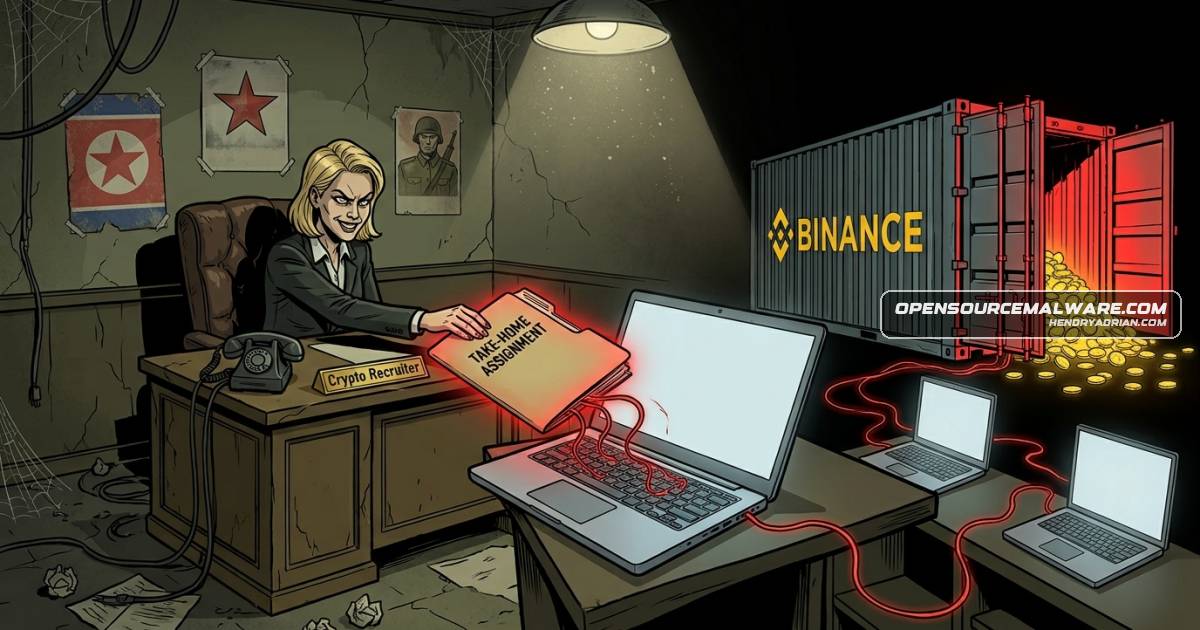
Binance Report Details How a Fake Job Interview Led to a $6.34 Billion Theft
Summary
Binance says a fake developer interview and malicious pyenv replacement helped attackers reach its wallet-signing service and steal about $6.34 billion. The article examines the attack chain, qualified TraderTraitor attribution, detection gaps and defenses.
Key points
- Binance’s account describes an initial June 2026 intrusion through a tampered Homebrew installer, followed in September by a fake job interview that led an engineer to run a malicious coding assignment on a work computer.
- Binance says the assignment’s setup code replaced part of pyenv with a malicious version. Attackers then used an internal AI tool to access at least two more machines.
- On October 29, attackers used a container-deployment token and an internal wallet-signing service to move cryptocurrency from Binance hot wallets; Binance reported that about $6.34 billion was taken in under four hours.
- The FBI attributes the attack to TraderTraitor. TRM Labs and Chainalysis cited similarities and on-chain links to other thefts, while the article cautions that individual patterns do not prove common attribution.
- The attackers reportedly used EIP-7702 delegations to give a smart contract partial execution rights over a hot wallet. Binance said it froze or intercepted about $2.85 billion.
- Binance’s endpoint security tools did not detect the activity. The article explains how malicious setup code and a modified legitimate developer tool can evade controls that focus on unusual files, package dependencies or known indicators.
- Recommended defenses include limiting developer-machine access to sensitive systems, tightly scoping deployment credentials, monitoring changes to developer tools, and making suspicious interview activity easy to report.
Article Details
- Attack Vectors
- A fake recruiter contacted a Binance engineer through a job-hunting site, followed by staged video interviews and a coding-assignment repository.
- Running the assignment's setup code replaced part of pyenv with a malicious version that executed commands and connected to an attacker-controlled server.
- Binance reported an earlier compromise in which an engineer downloaded a tampered Homebrew installer from a lookalike site.
- Attackers used an internal AI tool to take control of at least two additional machines, then used a real container-deployment token to deploy a container.
- A script run from a developer's machine accessed Binance's internal wallet signing service and initiated transactions outside the normal withdrawal process.
- According to TRM, three small Tornado Cash withdrawals funded the operator wallet before the attackers rehearsed the theft on other wallets.
- Binance reported obfuscation and removal of traces; Unit 42's separate TraderTraitor research describes a macOS stealer targeting credentials, SSH keys, and cloud configuration files, but the article says its relationship to the Binance tooling is unconfirmed.
- Defensive Notes
- Limit what developer machines can access; keep container-deployment credentials off laptops, short-lived, and narrowly scoped.
- Review and log internal AI tools' permissions and actions on other machines; segment developer workstations from production systems and sensitive signing services.
- Compare developer tools such as pyenv against clean copies and use file-integrity monitoring to detect unexpected changes.
- Inspect repositories for setup scripts, auto-run editor tasks, and unexpected code in configuration files; scan all branches for suspicious force-pushes.
- Alert on exact malicious domains or URLs rather than blocking shared platforms wholesale, and search historical DNS, proxy, and endpoint logs when new indicators arrive.
- Make it easy for developers to report running code from a suspicious interview, and ensure developer laptops and CI runners are covered by endpoint monitoring.
- Consider outbound-connection controls such as Little Snitch or LuLu, while accounting for the risk that frequent prompts may be approved without review.
MITRE ATT&CK
T1027 · Obfuscated Files or InformationBinance said the malicious code used obfuscation to avoid detection.T1059.004 · Unix ShellBinance reported that the malicious pyenv version ran commands and spawned zsh.T1070.004 · File DeletionBinance said the attacker removed traces after the intrusion.T1078 · Valid AccountsThe attackers used a real container-deployment token found on an employee's machine.T1204.002 · Malicious FileThe engineer ran the coding-assignment repository on a work computer, causing its setup code to execute.T1552.004 · Private KeysUnit 42's separate research on TraderTraitor describes a macOS stealer targeting SSH keys; the article says it cannot confirm that this was the tooling used in the Binance attack.T1554 · Compromise Host Software BinaryThe malicious setup replaced part of the legitimate pyenv installation with a malicious version that ran when the tool was used.T1566.003 · Spearphishing via ServiceThe attackers contacted a Binance engineer through a job-hunting service using a fake recruiter identity.T1610 · Deploy ContainerThe attackers used the deployment token to deploy a container before running a script against the wallet signing service.T1657 · Financial TheftThe attack used Binance's internal wallet signing service to steal cryptocurrency from hot wallets.
Threat Actors
Contagious InterviewThe article says Contagious Interview operators are tracked as WaterPlum; the campaign uses fake interviews and coding tests to install malware.Jade SleetThe FBI attributes the Binance attack to TraderTraitor. The article also reports that TRM Labs and Chainalysis linked the theft to earlier North Korean thefts, while noting that the cited patterns alone do not prove the same group was responsible.UNC5342The article says Contagious Interview operators are tracked as UNC5342; the campaign uses fake interviews and coding tests to install malware.Void DokkaebiThe article says Contagious Interview operators are tracked as Famous Chollima; the campaign uses fake interviews and coding tests to install malware.
Products
BinanceIn September 2026, a software engineer at Binance got a message on a job-hunting site. Someone posing as a Project Director wanted to talk about a role. What followed looked like a normal hiring process. First came aHomebrewIn June 2026, a Wallet DevOps engineer searched for a popular AI coding tool and downloaded a tampered Homebrew installer from a lookalike site. This is a coarse-grained tactic, closer to email phishing than a targetednpmKorean malware killchains. For example, PolinRider victims have reported that the malware replaced the npm CLI (npm/lib/cli.js) with a malicious version that re-runs the malware each time they use npm. This meanspyenvthe coding assignment on his work computer. Binance says the code ran during setup and replaced part of pyenv (an open source tool developers use to install and switch between versions of Python) with a maliciousVS CodeCommand injection into apps the developer uses every day, like VS Code, Cursor, Discord, GitHub Desktop
Tools
Little SnitchAn egress firewall (such as Little Snitch or LuLu) asks before any app connects somewhere new. In our view, that would stop most of this malware when it calls home to pull its next stage or send stolen data, as long asLuLu FirewallAn egress firewall (such as Little Snitch or LuLu) asks before any app connects somewhere new. In our view, that would stop most of this malware when it calls home to pull its next stage or send stolen data, as long as