
Linux mini_agent Backdoor Hides in Memory and Mimics Microsoft Graph
Summary
An analysis describes mini_agent, a Linux backdoor that runs from a deleted memfd, mimics Microsoft Graph HTTPS traffic and uses AdaptixC2-compatible messaging. It reports nine builds and identifies TLS and process artifacts defenders can hunt; the delivery method is un
Key points
- The 64-bit Linux backdoor copies itself into a memfd, deletes its original file and runs under names resembling system processes; sandbox analysis observed this behavior.
- Its AdaptixC2-compatible commands support program execution, file operations, screenshots and network tunnels.
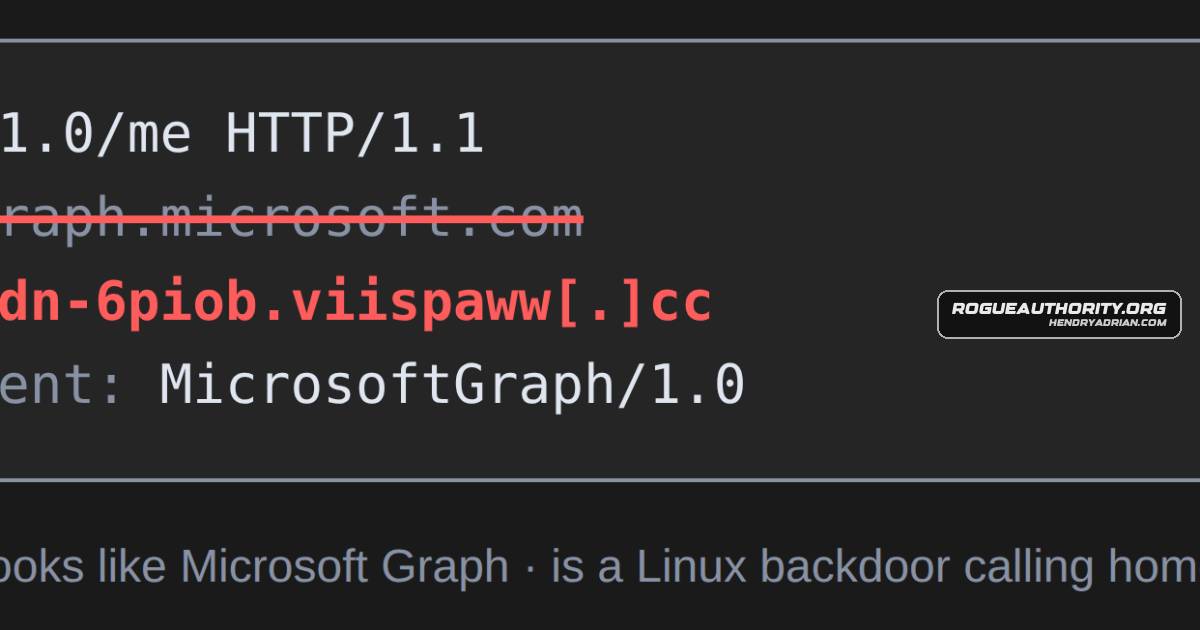
- The agent sends Graph API-style HTTPS requests to non-Microsoft hosts behind Cloudflare, disguising check-ins in request headers.
- Its custom TLS client produced a JA3 fingerprint of 5e2df0c3adc551a34e46a9ecb0d7cb66; sandbox ClientHello messages also began with four zero bytes in the random field.
- The analysis identified nine builds from mid-October to mid-November 2026 with the same internal AdaptixC2 agent ID. Related Windows agents used the same server addresses, paths and keys; the authors could not prove the same operators deployed an associated clipboard wallet-swapping DLL.
- The authors did not determine how the Linux backdoor is delivered or identify the C2 origin server. They found no built-in reboot persistence and observed no commands during the sandbox run.
Article Details
- Attack Vectors
- The Linux backdoor runs from an in-memory memfd, deletes its original file, and uses names resembling system processes.
- It sends HTTPS command-and-control traffic to attacker-controlled hosts while imitating Microsoft Graph paths, headers, and user-agent strings.
- Through AdaptixC2, the operator can run programs, browse and manipulate files, transfer files, capture screenshots, and open network tunnels or reverse port-forwards.
- Related Windows samples reportedly use launchers for the standard AdaptixC2 agent and share server addresses, paths, and keys with the Linux builds.
- A cryptocurrency clipper DLL was observed alongside the same servers during the same week; the article says it cannot prove the same operators deployed it.
- Defensive Notes
- Investigate Linux processes with kernel-thread-like names when their executable points to a deleted memfd, such as /memfd:… (deleted).
- Alert when Graph-style paths or the MicrosoftGraph/1.0 user-agent are sent to hosts that are not Microsoft.
- Hunt for the reported JA3 fingerprint 5e2df0c3adc551a34e46a9ecb0d7cb66 and TLS ClientHello random fields beginning with four zero bytes.
- Look for tunnel requests with an X- header followed by eight hexadecimal characters and value 1, with a server response of TUOK.
- The article reports no built-in reboot persistence; rebooting removes the agent from memory, but affected systems should still be treated as compromised and investigated for how access was gained.
Indicators of compromise
| Type | Indicator | Context |
|---|---|---|
| DOMAIN | 04c2f3c0[.]netutilsblog[.]com | C2 subdomain used by an agent build on a reused domain. |
| DOMAIN | 1a993dc0[.]ccjszl[.]com | C2 subdomain used by an agent build on a reused domain. |
| DOMAIN | 8ted50-dl[.]viispaww[.]vip | C2 domain identified for the mini_agent builds. |
| DOMAIN | cdn-6piob[.]viispaww[.]cc | C2 domain contacted by mini_agent in the sandbox. |
| DOMAIN | cdn-httptest[.]saisa[.]vip | C2 domain used by a test build. |
| DOMAIN | db69f5ff[.]cjkingentertainment[.]com | C2 subdomain used by an agent build on a reused domain. |
| DOMAIN | dxdzhu-api[.]viispaww[.]cc | C2 domain identified for the mini_agent builds. |
| DOMAIN | edge-hm1na[.]viispaww[.]vip | C2 domain identified for the mini_agent builds. |
| DOMAIN | leidanwmo[.]top | C2 domain used by November builds of the agent. |
| DOMAIN | mtc-factura[.]top | C2 domain contacted by mid-October builds of the agent. |
| DOMAIN | qshuimusic[.]top | C2 domain contacted by mid-October builds of the agent. |
| DOMAIN | sat-boleto[.]top | C2 domain contacted by mid-October builds of the agent. |
| DOMAIN | sat-servir[.]top | C2 domain used by November builds of the agent. |
| DOMAIN | static-eo9jo[.]viispaww[.]cc | C2 domain identified for the mini_agent builds. |
| SHA256 | 1d3535d5a782488ca1e8c140877bbf7e8a2c8ba7716ef5ac329dde1c47798dc7 | SHA-256 hash of a Windows launcher for the AdaptixC2 agent. |
| SHA256 | 3faf495eaf1d057505fd0ed5f69d7ec554c6988b0b0e1ea7129b39d7a2f757f6 | SHA-256 hash of a 32-bit Windows AdaptixC2 agent. |
| SHA256 | 58bfff115cfe2c4a5088f4bbf5fa2e86bbecf118f71090da15c9dd6650cb6d27 | SHA-256 hash of a sibling procmgrd build. |
| SHA256 | 5cdc55446a63ac08326e1785da344743f9608d64cadccc59110a873527aea705 | SHA-256 hash of the c2_memfd_implant test build. |
| SHA256 | 626620ecdeba3a257dd328bc6921b137a162b4c06d9db4f2c1d05d382f75266f | SHA-256 hash of a Windows launcher for the AdaptixC2 agent. |
| SHA256 | 84a7c586f6c920596d9c7be66a56b8ad6810d86aa085ad3ac6b6350c3aad70cc | SHA-256 hash of a sibling mgx.bin build. |
| SHA256 | a5a6c3c4779f1e14e7c2dd82f9e1d516590195e4ac5f41f6c3b107ae38723868 | SHA-256 hash of the mini_agent ELF x64 backdoor. |
| SHA256 | ae21c47b45e3e7a819d8050e01b6718dd5fa4995e25add992ab325be27a156ab | SHA-256 hash of a sibling agent build. |
| SHA256 | bc8cdd337b47637c0193714f3a82b1e6e8992f75cacc28618d93d6c2e19dd3b5 | SHA-256 hash of the cryptocurrency clipper DLL observed alongside the C2 servers. |
| SHA256 | c5b55958b4e829c01345b0d74958cbe7473b74ccda92e3ea6788dbc49fcdea49 | SHA-256 hash of a sibling mgx.bin build. |
| SHA256 | dbce2dd297dd9689cbc6b4267931c16c990538036d6872f552aca2d0b885477e | SHA-256 hash of a sibling fsmonitord build. |
| SHA256 | e04c19e6be1f43bcc49098d2167171838c8980d258f4594091b868912941ee57 | SHA-256 hash of a Windows launcher for the AdaptixC2 agent. |
| SHA256 | eea28da56c06a32849dfaa0832b2ad9c7397974e3ab1365b66537e03b42331e9 | SHA-256 hash of a sibling mgx3.bin build. |
| SHA256 | fb29c836a1fb49db4dbc86d104279b27547756081eacbe387085c6fe38b38172 | SHA-256 hash of a sibling build reported as coming from a live host. |
MITRE ATT&CK
T1005 · Data from Local SystemThe operator can read and download files and folders from the infected machine.T1036 · MasqueradingThe agent uses names resembling Linux system processes, such as udevd and systemd-journal, to disguise its process.T1041 · Exfiltration Over C2 ChannelThe agent can send stolen files, including zipped folders, through its C2 channel.T1057 · Process DiscoveryThe agent can list and kill processes on the infected machine.T1070.004 · File DeletionThe agent deletes its original program file after copying itself into memory.T1071.001 · Web ProtocolsThe agent uses HTTPS requests with Graph-like API paths, headers, and a MicrosoftGraph user-agent for C2.T1083 · File and Directory DiscoveryThe agent supports listing files and folders on the infected machine.T1105 · Ingress Tool TransferThe operator can upload files to the infected machine through the backdoor.T1113 · Screen CaptureThe operator can use the agent to take screenshots of the infected machine.T1572 · Protocol TunnelingThe agent can open network tunnels and reverse port-forwards through the infected machine.T1620 · Reflective Code Loadingmini_agent copies its program into a memfd in memory and restarts from that in-memory copy.