
Fortinet Details XWorm Campaign Using CVE-2018-0802 and Process Hollowing
Summary
FortiGuard Labs analyzed a phishing campaign using Excel attachments to exploit CVE-2018-0802, load a fileless .NET module, and inject XWorm 7.2 into Msbuild.exe; the RAT uses AES-encrypted C2 and modular plugins.
Key points
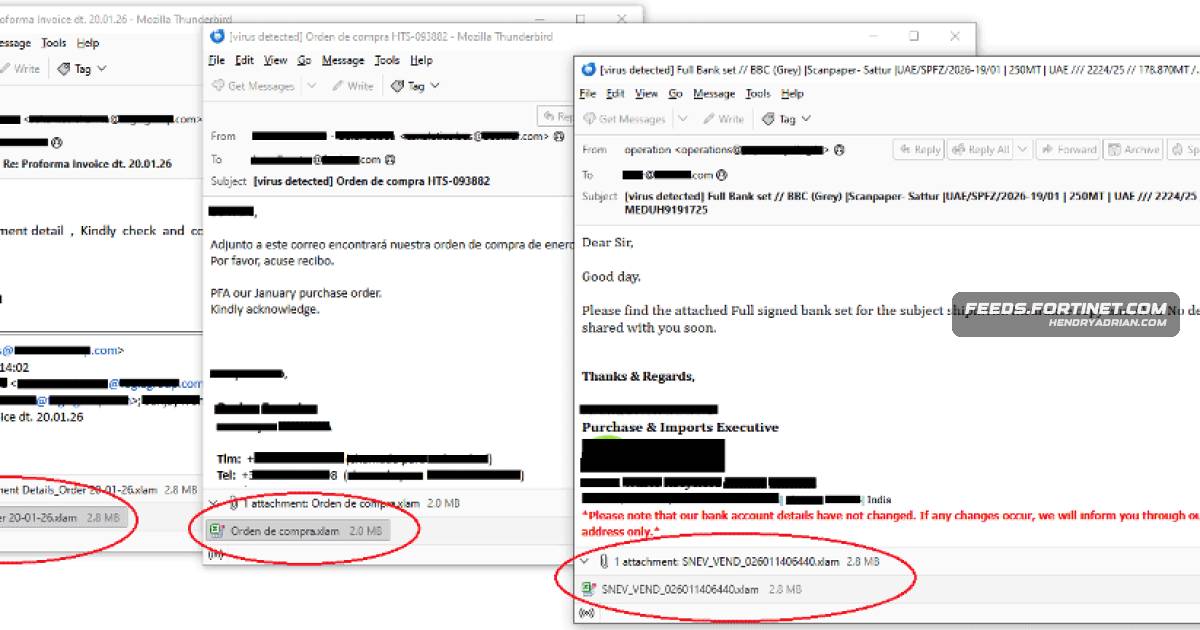
- The campaign used multilingual, business-themed phishing emails with malicious Excel add-in attachments; the analyzed messages were flagged and blocked by FortiMail.
- An embedded OLE object exploited CVE-2018-0802 in EQNEDT32.EXE to execute shellcode and download an HTA file.
- The HTA ran JScript and PowerShell, which extracted a fileless .NET module from a JPEG and loaded it into memory.
- The .NET module decoded and downloaded the XWorm payload, then used process hollowing to inject it into a suspended Msbuild.exe process.
- Fortinet identified XWorm version 7.2 and a C2 server at berlin101[.]com:6000; the RAT encrypts network traffic with AES.
- XWorm’s control commands and more than 50 plugins support remote system control and capabilities including data collection, DDoS, and ransomware.
- Fortinet says its email, web-filtering, IPS, antivirus, and content-disarm protections detect or block elements of the campaign.
Article Details
- Attack Vectors
- Multilingual, business-themed phishing emails carried malicious Excel add-in (.XLAM) attachments.
- An embedded OLE object exploited CVE-2018-0802 in EQNEDT32.EXE to execute shellcode and download an HTA file.
- The HTA ran JScript that decoded and executed a PowerShell payload; PowerShell retrieved an image containing a fileless .NET module.
- The .NET module downloaded the XWorm payload and used process hollowing to run it in a newly created Msbuild.exe process.
- Defensive Notes
- FortiMail flagged the phishing emails as “virus detected” and blocked them before delivery.
- FortiGuard Web Filtering rated the campaign URLs as malicious; FortiGuard Antivirus detects the Excel document, HTA, image file, and XWorm payload.
- FortiOS and FortiMail CDR can disarm the embedded OLE object.
- The article recommends phishing awareness and training, including FortiPhish phishing simulations.
Indicators of compromise
| Type | Indicator | Context |
|---|---|---|
| DOMAIN | berlin101[.]com | XWorm command-and-control server; the article reports port 6000. |
| SHA256 | 3f4c3c16f63fb90d1fd64b031d8a9803035f3cb18332e198850896881fb42fe5 | SHA-256 hash of the image file containing the embedded .NET module. |
| SHA256 | eacd8e95ead3ffe2c225768ef6f85672c4bfdf61655ed697b97f598203ef2cf6 | SHA-256 hash of the XWorm RAT payload. |
| SHA256 | ee663d016894d44c69b1fdc9d2a5be02f028a56fc22b694ff7c1dacb2bbbcc6d | SHA-256 hash of the malicious XLAM sample. |
| SHA256 | fd9ba9e6bd4886edc1123d4074d0eac363df61162364530b1303390aa621140b | SHA-256 hash associated with the downloaded HTA file. |
| URL | hxxp[:]//pub-3bc1de741f8149f49bdbafa703067f24[.]r2[.]dev/wwa.txt | URL used by the .NET module to retrieve the encoded XWorm payload. |
| URL | hxxps[:]//res[.]cloudinary[.]com/dbjtzqp4q/image/upload/v1767455040/optimized_MSI_lpsd9p.jpg | Specific image URL identified as malicious; the image contains the .NET module. |
| URL | hxxps[:]//retrodayaengineering[.]icu/HGG.hta | Malicious HTA download location used by the campaign. |
MITRE ATT&CK
T1027 · Obfuscated Files or InformationThe HTA was obfuscated with junk data, and the XWorm payload was reported as obfuscated with DeepSea Obfuscator.T1055.012 · Process HollowingThe .NET module used process hollowing to inject and execute XWorm in a newly created Msbuild.exe process.T1059.001 · PowerShellThe HTA decoded and executed a Base64-encoded PowerShell payload.T1059.007 · JavaScriptThe HTA executed JScript code.T1105 · Ingress Tool TransferThe campaign downloaded an HTA, an image containing a .NET module, and wwa.txt containing the encoded XWorm payload.T1203 · Exploitation for Client ExecutionThe embedded OLE object exploited CVE-2018-0802 in EQNEDT32.EXE to execute shellcode.T1218.005 · MshtaShellcode executed the downloaded HTA, which ran under mshta.exe.T1566.001 · Spearphishing AttachmentPhishing emails used business-themed lures to deliver malicious Excel attachments.T1573 · Encrypted ChannelXWorm encrypted its command-and-control network traffic using AES.
CVE
Malware
Vendors
FortinetFortinet protections (FortiMail, FortiGuard Web Filtering, IPS, AntiVirus, FortiOS CDR) detect and block elements of the campaign, including the exploit, HTA, image payload, and in-memory XWorm artifacts.MicrosoftThe .NET module (disguised as Microsoft.Win32.TaskScheduler) decoded a URL, downloaded a Base64 PE (XWorm), and performed process hollowing to inject XWorm into a newly created Msbuild.exe process.
Products
ExcelFortiGuard Labs observed a phishing campaign delivering a new XWorm RAT variant via malicious Excel attachments that exploit CVE-2018-0802 to execute an HTA which runs JScript/PowerShell, loads a fileless .NET module,FortiGuard AntivirusFortiGuard Antivirus service detects the Excel document, the downloaded HTA file and image file as well as the fileless XWorm payload file with the following AV signatures.FortiGuard Web FilteringFortinet protections (FortiMail, FortiGuard Web Filtering, IPS, AntiVirus, FortiOS CDR) detect and block elements of the campaign, including the exploit, HTA, image payload, and in-memory XWorm artifacts.FortiMailFortinet protections (FortiMail, FortiGuard Web Filtering, IPS, AntiVirus, FortiOS CDR) detect and block elements of the campaign, including the exploit, HTA, image payload, and in-memory XWorm artifacts.FortiOSFortinet protections (FortiMail, FortiGuard Web Filtering, IPS, AntiVirus, FortiOS CDR) detect and block elements of the campaign, including the exploit, HTA, image payload, and in-memory XWorm artifacts.Microsoft Office Equation EditorCVE-2018-0802 is a remote code execution vulnerability in the Microsoft Equation Editor (EQNEDT32.EXE) that continues to be actively exploited.Microsoft WindowsAffected Platforms: Microsoft Windows