
Google GTIG Tracked 90 Zero-Days in 2025 as Enterprise Exploitation Reached a Record Share
Summary
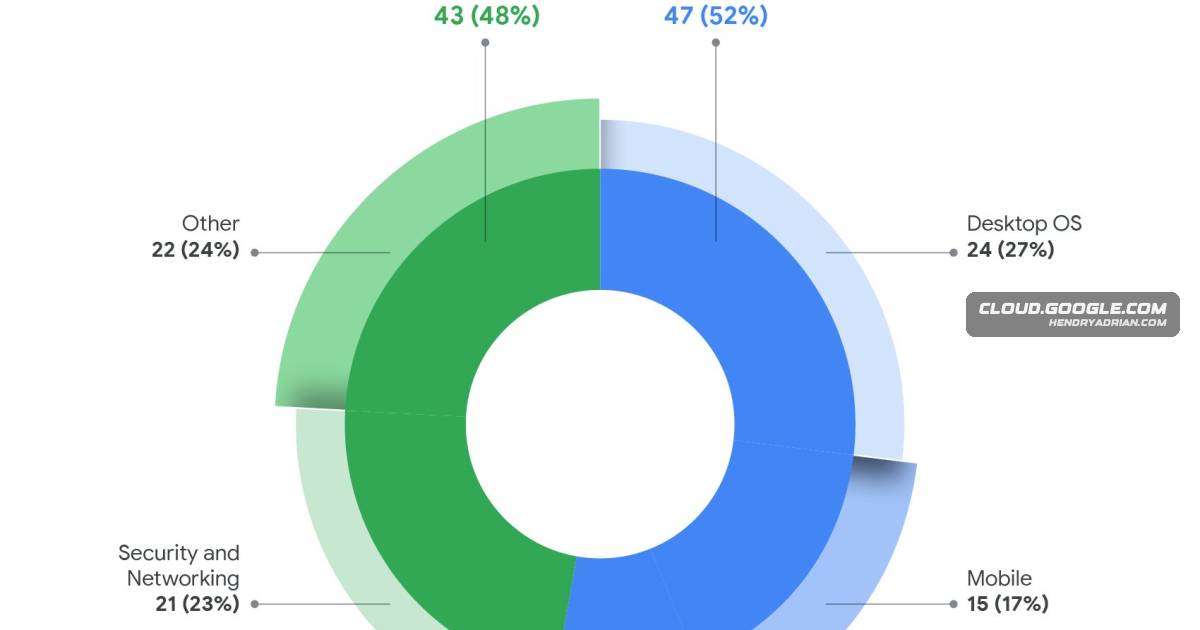
Google GTIG tracked 90 zero-days exploited in 2025; 43 (48%) affected enterprise technologies, a record share. OS and mobile exploitation rose, browser exploitation fell, and commercial surveillance vendors were attributed more zero-days than state groups.
Key points
- GTIG tracked 90 vulnerabilities exploited as zero-days in 2025, within the 60–100 range seen in recent years. The dataset may change as past incidents are discovered; all included vulnerabilities have patches available.
- Enterprise technologies accounted for 43 zero-days (48%), a record share. Security and networking products made up 21 of those cases.
- Operating systems were the most exploited category, with 39 zero-days (44%); mobile exploitation rose to 15 from 9 in 2024, while browser exploitation fell below 10%.
- For the first time in GTIG’s tracking, commercial surveillance vendors were attributed more zero-days than traditional state-sponsored espionage groups. PRC-nexus groups remained the most prolific state actors, with at least 10 attributed zero-days and a focus on edge and networking devices.
- GTIG described a SonicWall SMA 1000 exploit chain combining authentication bypass, remote code execution, and a zero-day privilege-escalation flaw. It also analyzed Samsung DNG image exploits, while noting it had not confirmed zero-day exploitation of CVE-2025-21042.
- GTIG said BRICKSTORM-linked intrusions targeting technology companies may have sought intellectual property that could support future zero-day development; this is presented as a possibility, not a confirmed outcome.
- GTIG forecast that AI could accelerate vulnerability discovery and exploit development, and recommended asset inventory, segmentation, timely patching, monitoring, and response planning.
Article Details
- Publisher
- Google Threat Intelligence Group (GTIG)
- Report Period
- 2025 (data cutoff: 2025-12-31)
- Scope
- GTIG analysis of zero-day vulnerabilities exploited in the wild and disclosed in 2025, based on original research and open-source reporting. GTIG notes the dataset may not include all exploitation and could be revised.
- Sample Size
- 90 zero-day vulnerabilities tracked by GTIG; the report says all included vulnerabilities had patches available.
- Key Statistics
- GTIG tracked 90 zero-day vulnerabilities exploited in the wild in 2025, compared with 78 in 2024 and 100 in 2023.
- 43 zero-days (48%) affected enterprise software and appliances, up from 36 (46%) in 2024.
- Operating systems accounted for 39 zero-days (44%) in 2025.
- Mobile OS exploitation accounted for 15 zero-days in 2025, compared with 9 in 2024.
- GTIG attributed nine zero-days to likely or confirmed financially motivated threat groups in 2025.
- Recommendations
- Segment DMZs, firewalls, and VPNs from critical assets, including core networks and domain controllers.
- Maintain a real-time asset inventory and a Software Bill of Materials to locate affected systems and libraries.
- Apply patches promptly; when a patch is unavailable, isolate affected systems or use stop-gap measures such as disabling services or blocking ports.
- Monitor application execution flow, establish baselines for system processes, and flag anomalous kernel-level behavior.
- For personal devices, enable Android Advanced Protection Mode or iOS Lockdown Mode and avoid links or attachments from unknown contacts.
MITRE ATT&CK
T1059 · Command and Scripting InterpreterThe SonicWall exploit chain used ysoserial-generated payloads to execute arbitrary shell commands on an appliance.T1068 · Exploitation for Privilege EscalationA zero-day in SonicWall SMA 1000 series ctrl-service was used to escalate from the mgmt-server user to root.T1190 · Exploit Public-Facing ApplicationThe report describes exploitation of web-facing enterprise appliances, including SQL and command injection, to gain initial access.T1203 · Exploitation for Client ExecutionBrowser, mobile, and driver vulnerabilities were exploited for code execution and sandbox escapes.T1204 · User ExecutionThe DNG exploit could require a target to click an image to trigger its download and parsing; GTIG described this as a “1-click” exploit and said it had no evidence of a bypass enabling zero-click exploitation.T1574 · Hijack Execution FlowThe report describes memory-corruption primitives, including use-after-free and out-of-bounds writes, being used to hijack control flow and achieve code execution.
CVE
CVE-2024-0519Google · ChromeWe observed in-the-wild exploitation of this vulnerability in a chain with vulnerabilities in the Chrome renderer (CVE-2024-0519) and the KGSL driver (CVE-2023-33106).CVE-2025-0282Ivanti · Connect Secure; Ivanti · Neurons for ZTA gateways; +1 moreExamples of this include the exploitation of CVE-2025-21590 by UNC3886 and the exploitation of CVE-2025-0282 by UNC5221.CVE-2025-21042Samsung Mobile · Samsung Mobile Devices[CVE Identifiers ] Vulnerability identifiers referenced in tracked zero-days – CVE-2025-61882, CVE-2025-8088, and 17 more CVEs (e.g., CVE-2025-21590, CVE-2025-21042, CVE-2025-23006).CVE-2025-21590Juniper Networks · Junos OS[CVE Identifiers ] Vulnerability identifiers referenced in tracked zero-days – CVE-2025-61882, CVE-2025-8088, and 17 more CVEs (e.g., CVE-2025-21590, CVE-2025-21042, CVE-2025-23006).CVE-2025-23006SonicWall · SMA1000[CVE Identifiers ] Vulnerability identifiers referenced in tracked zero-days – CVE-2025-61882, CVE-2025-8088, and 17 more CVEs (e.g., CVE-2025-21590, CVE-2025-21042, CVE-2025-23006).CVE-2025-27038Qualcomm, Inc. · SnapdragonCVE-2025-27038 is a UAF vulnerability in the Qualcomm Adreno GPU user-land library that can be triggered through a sequence of WebGL commands followed by a specifically crafted glFenceSync call.CVE-2025-2783Google · ChromeCVE-2025-2783 targeted the Chrome sandbox on Windows.CVE-2025-38352Linux · LinuxWe observed in-the-wild exploitation of this vulnerability in a chain with vulnerabilities in the Chrome renderer (CVE-2025-5419) and in the Linux kernel’s posix CPU timers implementation (CVE-2025-38352).CVE-2025-40602SonicWall · SMA1000GTIG reported this vulnerability to SonicWall, who published a patch for it in December 2025 as CVE-2025-40602.CVE-2025-48543Google · AndroidCVE-2025-48543 affected the Android Runtime (ART), the system that translates application bytecode into native machine instructions to improve execution speed and power efficiency.CVE-2025-5419Google · ChromeWe observed in-the-wild exploitation of this vulnerability in a chain with vulnerabilities in the Chrome renderer (CVE-2025-5419) and in the Linux kernel’s posix CPU timers implementation (CVE-2025-38352).CVE-2025-61882Oracle Corporation · Oracle Concurrent Processing[CVE Identifiers ] Vulnerability identifiers referenced in tracked zero-days – CVE-2025-61882, CVE-2025-8088, and 17 more CVEs (e.g., CVE-2025-21590, CVE-2025-21042, CVE-2025-23006).CVE-2025-61884Oracle Corporation · Oracle ConfiguratorThe threat actor exploited CVE-2025-61882 and/or CVE-2025-61884 as a zero-day against Oracle EBS customers as early as Aug.CVE-2025-6558Google · ChromeIn a similar instance, CVE-2025-6558 targeted the Mali GPU user-land library.CVE-2025-8088win.rar GmbH · WinRAR[CVE Identifiers ] Vulnerability identifiers referenced in tracked zero-days – CVE-2025-61882, CVE-2025-8088, and 17 more CVEs (e.g., CVE-2025-21590, CVE-2025-21042, CVE-2025-23006).
Threat Actors
ARMORY CASTLEGTIG attributed exploitation of CVE-2025-0282 to this PRC-nexus cyber espionage group, which it said focused on edge and networking devices.CIGARGTIG reported evidence suggesting that a threat cluster exploiting CVE-2025-8088 had suspected overlaps with CIGAR/UNC4895; the report presents this as suspected, not confirmed, attribution.Cl0pIn a 2025 extortion campaign, an actor claimed affiliation with the CL0P extortion brand. GTIG reported that the campaign followed months of intrusion activity targeting Oracle E-Business Suite customer environments.Evil CorpGTIG described UNC2165 as overlapping with public reporting on Evil Corp; the article does not state that Evil Corp itself conducted the CVE-2025-8088 activity.EvilCorpGTIG identified this financially motivated group leveraging CVE-2025-8088 to distribute malware in mid-July 2025, its first observed use of a zero-day for initial access. The report says UNC2165 overlaps with public reporting on Evil Corp.FIN11GTIG observed zero-day exploitation by FIN11 or associated clusters in four of the five years 2021, 2023, 2024, and 2025. The report says the CL0P extortion brand has predominantly been used by FIN11.IntellexaGTIG described Intellexa as a prolific procurer and user of zero-days that adapted its operations and tool suite and continued to deliver spyware to high-paying customers.RomComThe report says the CIGAR/UNC4895 activity was publicly reported as RomCom; the connection is presented in the context of suspected overlap.UNC3886GTIG attributed exploitation of CVE-2025-21590 to this PRC-nexus cyber espionage group, which it said focused on edge and networking devices.UNC4895GTIG described UNC4895 as a Russian threat group that has conducted financially motivated and espionage operations, and said it had exploited two zero-days in 2024. The report also noted suspected overlaps between a cluster exploiting CVE-2025-8088 and CIGAR/UNC4895.
Malware
Vendors
Google[Affected Vendors / Products ] Targeted vendors and products used as exploitation surfaces – SonicWall SMA 1000 series, Oracle E-Business Suite (EBS), and other vendors such as Cisco, Fortinet, Samsung, Google Chrome.Intellexa[Threat Actors / Malware ] Named actors and tooling observed or attributed in exploits – BRICKSTORM, UNC5221, and 8 more (e.g., UNC3886, FIN11, UNC2165, CL0P, Intellexa, UNC4895).Oracle[Affected Vendors / Products ] Targeted vendors and products used as exploitation surfaces – SonicWall SMA 1000 series, Oracle E-Business Suite (EBS), and other vendors such as Cisco, Fortinet, Samsung, Google Chrome.Qualcommprocess and the Quram image-parsing library, and other components such as Android ART, Qualcomm Adreno and Mali GPU userâland libraries.Samsungfocus on edge/security appliances, high-profile chains such as the SonicWall full-chain and DNG-based Samsung exploits, and warns that AI will accelerate both exploit discovery and exploit development.SonicWallactivity, sustained PRCânexus focus on edge/security appliances, high-profile chains such as the SonicWall full-chain and DNG-based Samsung exploits, and warns that AI will accelerate both exploit discovery and
Products
Android– com.samsung.ipservice process and the Quram image-parsing library, and other components such as Android ART, Qualcomm Adreno and Mali GPU userâland libraries.Google Chrome[Affected Vendors / Products ] Targeted vendors and products used as exploitation surfaces – SonicWall SMA 1000 series, Oracle E-Business Suite (EBS), and other vendors such as Cisco, Fortinet, Samsung, Google Chrome.Linux kernelWe observed in-the-wild exploitation of this vulnerability in a chain with vulnerabilities in the Chrome renderer (CVE-2025-5419) and in the Linux kernel’s posix CPU timers implementation (CVE-2025-38352).Microsoft WindowsCVE-2025-2783 targeted the Chrome sandbox on Windows.Oracle E-Business Suite[Affected Vendors / Products ] Targeted vendors and products used as exploitation surfaces – SonicWall SMA 1000 series, Oracle E-Business Suite (EBS), and other vendors such as Cisco, Fortinet, Samsung, Google Chrome.SonicWall SMA 1000 series[Affected Vendors / Products ] Targeted vendors and products used as exploitation surfaces – SonicWall SMA 1000 series, Oracle E-Business Suite (EBS), and other vendors such as Cisco, Fortinet, Samsung, Google Chrome.
Tools
Countries
People’s Republic of ChinaPeople’s Republic of China (PRC)-nexus cyber espionage groups continue to dominate traditional state-sponsored espionage zero-day exploitation.RussiaGTIG identified UNC2165, a financially motivated group that overlaps with public reporting on Evil Corp and has prominent members in Russia, leveraging CVE-2025-8088 to distribute malware in mid-July 2025.