
K7Labs Details VIP_Keylogger’s In-Memory Delivery and Data Theft
Summary
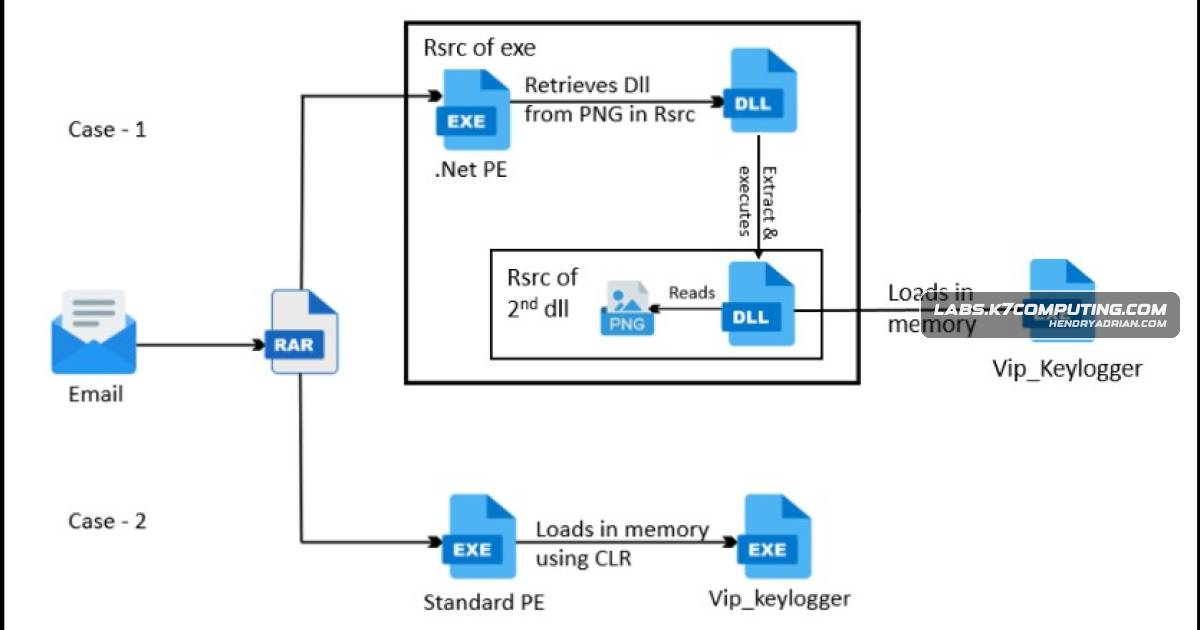
K7Labs analyzed two VIP_Keylogger delivery chains: spear-phishing RAR attachments lead to in-memory loading via steganography and process hollowing or AES decryption and CLR. The keylogger steals browser, email and app credentials and supports several exfiltration paths
Key points
- K7Labs found spear-phishing emails using RAR attachments to deliver an executable that loads VIP_Keylogger in memory; campaign samples showed packaging and execution variations and targeted multiple countries.
- One chain hides DLLs and a PNG payload using steganography, then uses process hollowing to execute the keylogger.
- A second chain decrypts an AES-encrypted payload in memory, patches AMSI and ETW, and loads VIP_Keylogger through CLR.
- The keylogger collects browser-stored credentials and artifacts, email account credentials, Discord tokens, and FileZilla and Pidgin account data.
- The malware supports FTP, SMTP, Telegram, HTTP POST, and Discord exfiltration. K7Labs observed SMTP use; other listed channels lacked proper URLs or inputs in the analyzed sample.
- K7Labs reported C2 indicators including varders[.]kozow[.]com, aborters[.]duckdns[.]org, and anotherarmy[.]dns[.]army. Some described features, including keylogging and screenshot capture, were not executed in the analyzed build.
Article Details
- Attack Vectors
- Spear-phishing emails persuade recipients to open a RAR attachment containing an executable disguised as a purchase order.
- The executable loads VIP_Keylogger in memory. One analyzed variant hides DLLs and a PNG payload using steganography and performs process hollowing; another decrypts an AES-encrypted payload in memory and loads it using CLR.
- VIP_Keylogger collects browser-stored credentials and artifacts, email-client credentials, Discord tokens, and FileZilla and Pidgin account data.
- The malware supports exfiltration through FTP, SMTP, Telegram, HTTP POST, and Discord. The analyzed sample was observed sending stolen information by SMTP.
- Defensive Notes
- Use the supplied hashes, C2 domains, and IP address for detection and response.
- The article recommends using a trusted security product such as K7 to safeguard enterprise resources.
Indicators of compromise
| Type | Indicator | Context |
|---|---|---|
| DOMAIN | aborters[.]duckdns[.]org | C2 domain listed for the malware. |
| DOMAIN | anotherarmy[.]dns[.]army | Domain listed in the article's C2 indicators. |
| DOMAIN | varders[.]kozow[.]com | C2 domain listed for the malware. |
log@gtpv[.]online | Recipient account for stolen information sent via SMTP. | |
logs@gtpv[.]online | Sender account observed sending stolen information via SMTP. | |
| IPV4 | 51[.]38[.]247[.]67 | IP address listed as an observed C2 host. |
| MD5 | 694c313b660123f393332c2f0f7072b5 | Hash of a malicious sample detected as spyware. |
| MD5 | d1df5d64c430b79f7e0e382521e96a14 | Hash of a malicious sample detected as a Trojan. |
| MD5 | e7c42f2d0ff38f1b9f51dc5d745418f5 | Hash of a malicious sample detected as a Trojan. |
| MD5 | ea72845a790da66a7870da4da8924eb3 | Hash of a malicious sample detected as a Trojan. |
MITRE ATT&CK
T1027.009 · Embedded PayloadsOne loader variant concealed DLLs and the final PNG payload in executable resources using steganography.T1055.012 · Process HollowingOne loader variant created a host executable in suspended mode and used process-hollowing APIs to load VIP_Keylogger.T1056.001 · KeyloggingThe payload is identified as a keylogger; the article says its keylogging feature was available but had not been executed in the analyzed build.T1140 · Deobfuscate/Decode Files or InformationAnother variant decrypted an AES-encrypted payload in memory before loading VIP_Keylogger.T1555.003 · Credentials from Web BrowsersThe malware retrieved and decrypted credentials stored by Chromium-based and Firefox-based browsers.T1562.001 · Disable or Modify ToolsThe second variant patched AMSI and ETW after decrypting its payload.T1566.001 · Spearphishing AttachmentThe campaign used spear-phishing emails with a malicious RAR attachment disguised as a purchase order.
Malware
Vendors
Products
Discordmaster key/DPAPI handling and PK11SDR_Decrypt), email clients (Outlook, Foxmail, Thunderbird, Postbox), Discord tokens, FileZilla and Pidgin account data.FileZillahandling and PK11SDR_Decrypt), email clients (Outlook, Foxmail, Thunderbird, Postbox), Discord tokens, FileZilla and Pidgin account data.Foxmailbrowsers (including master key/DPAPI handling and PK11SDR_Decrypt), email clients (Outlook, Foxmail, Thunderbird, Postbox), Discord tokens, FileZilla and Pidgin account data.Mozilla FirefoxVIP_Keylogger harvests credentials and artifacts from a long list of Chromium-based and Firefox-based browsers (including master key/DPAPI handling and PK11SDR_Decrypt), email clients (Outlook, Foxmail, Thunderbird,Mozilla Thunderbirdbrowsers (including master key/DPAPI handling and PK11SDR_Decrypt), email clients (Outlook, Foxmail, Thunderbird, Postbox), Discord tokens, FileZilla and Pidgin account data.Outlookand Firefox-based browsers (including master key/DPAPI handling and PK11SDR_Decrypt), email clients (Outlook, Foxmail, Thunderbird, Postbox), Discord tokens, FileZilla and Pidgin account data.PidginPK11SDR_Decrypt), email clients (Outlook, Foxmail, Thunderbird, Postbox), Discord tokens, FileZilla and Pidgin account data.Postbox(including master key/DPAPI handling and PK11SDR_Decrypt), email clients (Outlook, Foxmail, Thunderbird, Postbox), Discord tokens, FileZilla and Pidgin account data.