
Fake Marvell RAID Utility Uses Signed MSBuild to Load Malware
Summary
A fake Marvell RAID MSI uses renamed Microsoft-signed MSBuild and a tampered .NET library to decrypt and run a payload in memory, then downloads five DLL-sideloading kits. Researchers link its C2 to CNCMachineRMS by behavior, but have no code-level match.
Key points
- The MSI masquerades as a Marvell RAID utility but installs no useful tool; it was signed with a newly issued certificate in an individual’s name.
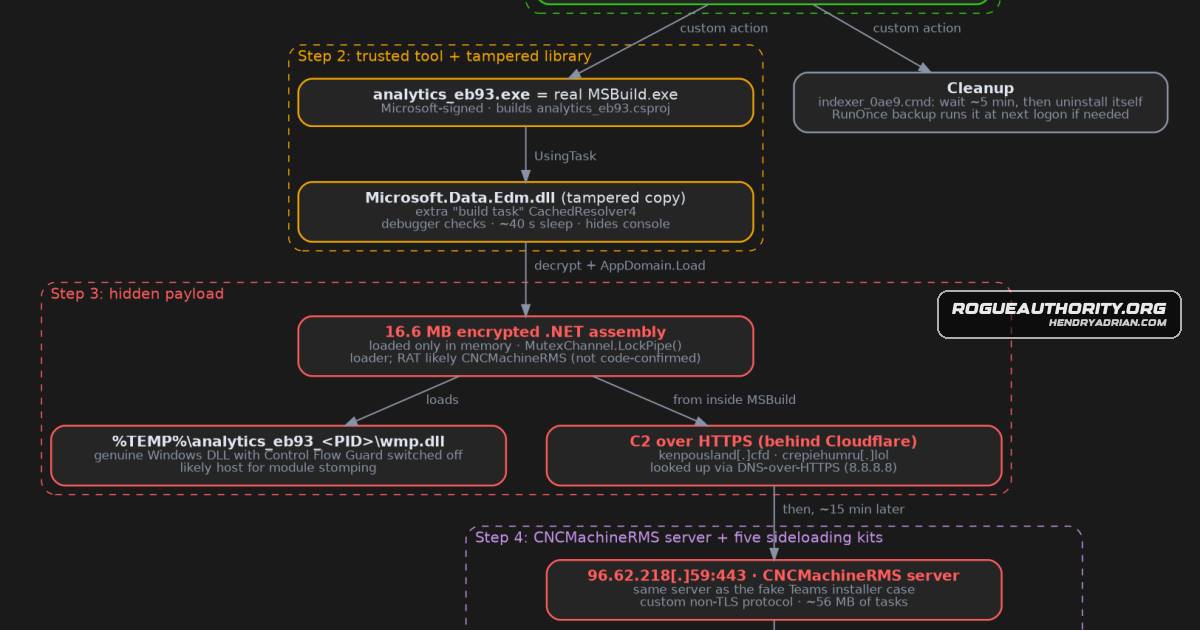
- Renamed Microsoft-signed MSBuild loads a tampered Microsoft.Data.Edm.dll, waits and checks for debuggers, then decrypts a 16.6 MB .NET payload into memory. A cleanup action removes the installer files after about five minutes.
- The payload uses Google DNS-over-HTTPS and connects to kenpousland[.]cfd and crepiehumru[.]lol, both behind Cloudflare.
- A modified wmp.dll with Control Flow Guard disabled is loaded from a temporary folder; the researchers say it is likely used for module stomping.
- About 20 minutes after installation, the payload contacts 96.62.218[.]59 over a custom protocol and downloads five DLL-sideloading kits. The server matches one used by CNCMachineRMS, but the researchers have not confirmed the connection at code level.
- The kits pair tampered DLLs with signed programs associated with MAGIX, ACD Systems, ASUS, NetEase, and VNG; the final payload families remain unknown.
- Defensive advice includes alerting on MSBuild launched from user-writable folders or by msiexec, monitoring RunOnce cleanup entries, and looking for DLL sideloading and non-TLS traffic on port 443.
Article Details
- Attack Vectors
- A signed MSI posing as a Marvell RAID utility drops a renamed, Microsoft-signed MSBuild executable and a project file that loads a tampered Microsoft.Data.Edm.dll.
- The loader checks for debuggers, delays execution for about 35–43 seconds, decrypts a .NET payload, and runs it in memory.
- The payload loads a modified wmp.dll from a temporary folder and appears to overwrite its code in memory (module stomping).
- The payload communicates with two domains over HTTPS and later uses a custom binary protocol on port 443 to contact 96.62.218[.]59 and download five DLL sideloading kits.
- The kits pair signed applications with tampered DLLs. A later program, VHandler.exe, uploads about 2 MB to 93.152.220[.]219 and exchanges UDP packets with two additional servers.
- A cleanup script uses hidden PowerShell and command-prompt processes to uninstall the MSI and remove dropped files; a RunOnce registry value is set as a fallback.
- Defensive Notes
- Alert when MSBuild.exe, including renamed copies identified by OriginalFileName, runs from user-writable folders or is launched by msiexec.exe.
- Monitor for the environment variables CFG_SYSTEM_TASK_add8 and CFG_CONTEXT_PATH_0fa5, and RunOnce entries that launch msiexec /x … /qn after installation.
- Look for system DLLs such as wmp.dll loaded from %TEMP%, especially when Control Flow Guard is disabled or the PE header checksum fails.
- Hunt for signed applications running from %LOCALAPPDATA%\appdata, appspace, or appspace1, and for the listed suspicious C:\ProgramData folders.
- Investigate non-TLS traffic on port 443 and MSBuild connections to public DNS-over-HTTPS resolvers.
- The article advises obtaining driver and storage utilities from the vendor or PC maker and avoiding installers whose signature names an individual rather than the purported company.
Indicators of compromise
| Type | Indicator | Context |
|---|---|---|
| DOMAIN | crepiehumru[.]lol | Domain contacted by the payload over HTTPS as command-and-control infrastructure. |
| DOMAIN | kenpousland[.]cfd | Domain contacted by the payload over HTTPS as command-and-control infrastructure. |
| IPV4 | 93[.]152[.]220[.]219 | Second-wave server contacted by VHandler.exe for an upload of about 2 MB over a custom protocol on port 443. |
| IPV4 | 93[.]152[.]224[.]17 | Server that VHandler.exe exchanged UDP packets with on port 81. |
| IPV4 | 94[.]26[.]41[.]43 | Server that VHandler.exe exchanged UDP packets with on port 81. |
| IPV4 | 96[.]62[.]218[.]59 | Server contacted by the payload over a custom binary protocol on port 443; the article identifies it as the server used by CNCMachineRMS in an earlier case. |
| SHA256 | 1e8a6a7f8605279f0e0479adbc6b7392705d093f7f8f5b8d7fd0f01651e1b254 | SHA-256 of the modified wmp.dll found in the payload's temporary folder; the article reports that it has Control Flow Guard data removed. |
| SHA256 | 28392302b64af9777f23b2d44222bf584bbe66bf94f1d7c0c8147febe4f2cb07 | SHA-256 of the tampered webview_support.dll included in a DLL sideloading kit. |
| SHA256 | 2cb6a818f929c3c175db6e7c39cb26c5bfc9f318e3f90493293af79bb2c2bc60 | SHA-256 of the tampered msadox.dll included in a DLL sideloading kit. |
| SHA256 | 3500f12e1f73ff0bbeac8729130101d43c5a95cbff457e0562133f612063d889 | SHA-256 of the tampered Qt5Network.dll included in a DLL sideloading kit. |
| SHA256 | 40881005ee0347d450ccf5bdb4aae2722536d603400d93b078d48bf091b0e579 | SHA-256 of the cleanup script dropped by the malicious installer. |
| SHA256 | 5d2b86d5c438bef3eef38807de798a70f6c44fa3489dc9f21022a74a118136dc | SHA-256 of the scrambled data file dropped with the malicious installer; the article says it is most likely payload configuration. |
| SHA256 | 7131fb3e5d6999532430f630414116ffa69d8251350461e9a7d5f7618957baca | SHA-256 of the encrypted payload resource associated with the malicious loader. |
| SHA256 | 86b3cdcc9cf4f93d49e1a52f34c644b41bf0629c3390d7ec591ef4a97bc0cc15 | SHA-256 of the tampered Microsoft.Data.Edm.dll used as the loader. |
| SHA256 | 8d55faa0a0a00f666a9c6e01bccf891d5669858238613e889801c29f0f952171 | SHA-256 of the project file used to invoke the malicious MSBuild task. |
| SHA256 | a86733c70d1eed6bbcd4e587ada4580289abc740187eb7cefff3b1a41b4d0434 | SHA-256 of the tampered WebView2Loader.dll identified in a DLL sideloading kit. |
| SHA256 | e4765f3d293f969916e61c756691868b1c8f530e7e00abffca16b95fec4fdcf4 | SHA-256 of the tampered vcomp140.dll that loads the malicious msadox.dll in a sideloading kit. |
| SHA256 | e98126909c5d2ea0d1f744ba7be5ff5ac6253f89e6468aa3594b3705813a4c66 | SHA-256 of the tampered AsusTPApi.dll included in a DLL sideloading kit. |
| SHA256 | fbdcf1c1ef19a5bef2c9ca43b3685aa5dacd78b7b071a90ced67ead83b736fa7 | SHA-256 of the malicious MSI installer posing as a Marvell RAID utility. |
MITRE ATT&CK
T1027.007 · Dynamic API ResolutionThe loader looks up Windows functions by comparing hashes of their names rather than using the names directly.T1041 · Exfiltration Over C2 ChannelVHandler.exe uploads about 2 MB to a second-wave server over a custom connection.T1055 · Process InjectionThe payload overwrites code in a loaded Windows DLL, which the article describes as module stomping.T1059.001 · PowerShellThe cleanup script starts a hidden PowerShell window.T1059.003 · Windows Command ShellThe cleanup sequence starts a hidden command prompt to wait before uninstalling the MSI.T1070.004 · File DeletionThe cleanup action silently uninstalls the MSI and deletes its dropped files.T1095 · Non-Application Layer ProtocolThe payload and later program communicate with servers using custom non-TLS protocols on port 443.T1105 · Ingress Tool TransferThe payload downloads five sideloading kits from the server at 96.62.218[.]59.T1127.001 · MSBuildThe MSI launches a renamed, Microsoft-signed MSBuild executable to run a project-defined malicious task.T1140 · Deobfuscate/Decode Files or InformationThe loader decrypts an encrypted payload and runs the resulting .NET program from memory.T1497.003 · Time Based ChecksThe loader waits about 35–43 seconds before proceeding, a delay the article says helps it outlast short automated sandboxes.T1547.001 · Registry Run Keys / Startup FolderThe installer sets a RunOnce registry value to run the uninstall at the next logon if cleanup has not already occurred.T1574.002 · DLL Side-LoadingFive kits pair signed applications with tampered DLLs that the applications load.T1622 · Debugger EvasionThe loader checks for a debugger in three ways and stops if it detects one.
Malware
Products
ASUS Smart GesturePiloMeta.exe, really an ASUS Smart Gesture component (ASUSTeK Computer)Bvckup 2Two of those are also signed: a copy of the backup tool Bvckup 2 (IO Bureau SA) and a program signed by CHENGDU YIWO Tech Development.LUXEA Pro PackSmartLab.exe, really LUXEA Pro Pack Manager (ACD Systems International)Microsoft.Data.EdmHidden payload: a 16.6 MB encrypted .NET program inside a tampered Microsoft.Data.Edm.dll, loaded only in memory.VEGASOvSupervisor.exe, really VEGAS’s error reporter (MAGIX Software GmbH)Windows Media PlayerA copy of wmp.dll (Windows Media Player’s library) also appears in a folder under %TEMP% named after the MSBuild program and its process number (in hexadecimal), and the MSBuild process loads it.