
Google and Partners Disrupt XCPE Botnet Affecting 1.3 Million Set-Top Boxes
Summary
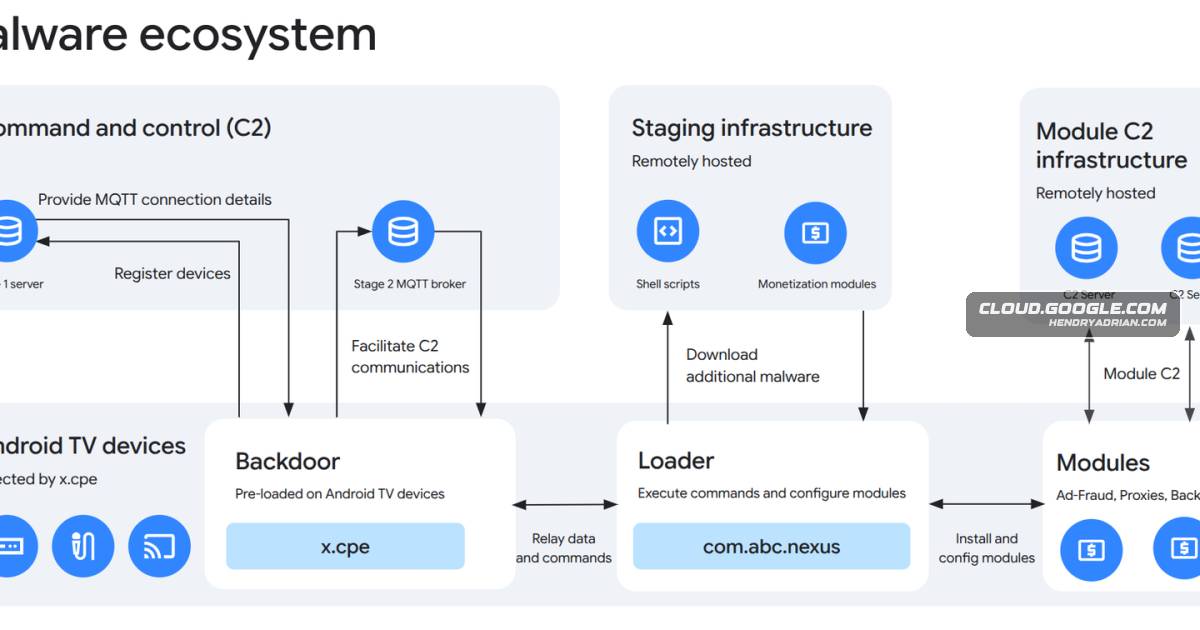
Google and partners say they disrupted the XCPE backdoor, which enrolled more than 1.3 million set-top boxes. Mandiant details its persistence, MQTT command channel and affiliate modules used for ad fraud, proxying and additional malware.
Key points
- Google assesses with high confidence that Videostrong intentionally developed and operated XCPE for financial gain, selling affiliate access to infected devices.
- The backdoor was preloaded in device firmware with system-level privileges and could reinstall itself after removal from the app directory.
- XCPE used HTTP for initial configuration and persistent MQTT connections for commands, including silent app installs, shell execution, screen capture and network reconnaissance.
- Google and partners found affiliate modules that turned devices into residential proxy nodes, performed ad fraud or loaded additional malware; operators were also observed exfiltrating device and account information.
- Google says the botnet enrolled more than 1.3 million set-top boxes; it also expects disruption of affiliate command-and-control domains to sever access to at least 10 million additional compromised devices.
- Google took legal action against control and affiliate command-and-control infrastructure, banned Videostrong from supplying certified Android devices, and changed its firmware review process.
- Since August 2026, newer dropper packages have reportedly used root ADB access to install themselves in the system partition and deploy individual monetization modules.
Article Details
- Attack Vectors
- XCPE was preloaded in device firmware with system-level privileges and reinstalled from the /oem/ partition after reboot if removed from /data/app/.
- The backdoor fetched configuration over HTTP, then used persistent MQTT connections to receive commands, install applications, download modules, and execute shell commands or scripts.
- Operators loaded affiliate modules that used infected devices for residential proxy traffic, ad fraud, and additional backdoor activity.
- The malware disabled Google Play Protect app verification, used anti-analysis protections, and disguised newer droppers as Android system applications.
- Defensive Notes
- Keep Google Play Protect and built-in device security protections enabled; review permissions for third-party VPN and proxy applications.
- Use trusted app stores and buy connected devices from reputable manufacturers.
- The article recommends independent security audits of device manufacturers and stronger firmware-integrity checks. Google reports that it changed its review process and took legal action to disrupt XCPE infrastructure.
Indicators of compromise
| Type | Indicator | Context |
|---|---|---|
| DOMAIN | intermedia-arts[.]tv | Fallback command-and-control domain for system packages. |
| DOMAIN | mqtt[.]szbboys[.]com | MQTT command-and-control broker used by XCPE samples. |
| DOMAIN | ott[.]szbboys[.]com | XCPE infrastructure used for file upload and download and OTA updates. |
| DOMAIN | szbboys[.]com | Domain identified as hosting core XCPE command-and-control infrastructure. |
| IPV4 | 219[.]134[.]163[.]210 | Host identified as an MQTT command-and-control broker for XCPE. |
| IPV4 | 219[.]134[.]163[.]211 | Host identified as an MQTT command-and-control broker for XCPE. |
| IPV4 | 23[.]94[.]49[.]57 | Operator server used for file hosting and command-and-control. |
| IPV4 | 38[.]145[.]197[.]135 | Operator server hosting anyevonline infrastructure and files. |
| SHA256 | 1f2ab93c35f0c37d9b88f82268183a2f77491aa6b142a48381524b18e217b960 | Malicious com.abc.nexus sample hash listed in the article. |
| SHA256 | 350d6db477e8567cf9347c1144b3a0b25550e7ce63bb800b056b8a7a8ef56af4 | Malicious com.oemservice sample hash listed in the article. |
| SHA256 | 3768f470934a111f1c3e3d098eb1392a3cb6f3e298ef5fd2a6309e6a98ee1e18 | Representative XCPE malware sample hash listed in the article. |
| SHA256 | 42be8f18d6006ca092de191331d38e70a0d8383db701a759466dec59a0986135 | Hash of libexploit.so, a privilege-escalation component bundled with the sso.authHandler dropper. |
| SHA256 | 7830ce3c3222dd9b25a77a16116dcf832a24b4b9a0bc998501e12415a828fb42 | Hash of libnative_keys.so, identified as key storage for the AppSalt SDK bundled with the malware. |
| SHA256 | 8cb62b3a9b74ca8b907aef7d83fee65f3ab80e0f4acbf4b2415ea1c2a6caf796 | Malicious classes.dex sample hash listed among affiliate-malware indicators. |
| SHA256 | 9e18c113eb8d2ba813199c7f90e26d80af3124d871fc31eea7253319a8406e8e | Hash of libfleetshare.so, an ELF binary dropped by com.abc.nexus for the Fleet SDK. |
| SHA256 | a63757715b35ddd99916b63a1354de1ec05ac5855a480fe9a547b002e2091dcb | Hash of Traffmonetizer key-storage material dropped by com.abc.nexus. |
| SHA256 | b3690b3b013ac60752a6d05c3f53ea1f3e844d4603c5b90d258a30c596d0691b | Hash of libseccomp_guard.so, an anti-analysis component extracted by com.abc.nexus. |
| SHA256 | ebcca22b96f7a30ae155efa2f25af29a369c6e9cfc99cb3bb0b72f35bc5528ed | Hash listed for the com.android.sso.auth.handler dropper package that installs AppSalt. |
| SHA256 | f2ed4a40fbb21d0560e82bdd2e85e825970d32052348241b487dd93191ebef2a | Malicious module sample hash listed in the affiliate-malware indicators. |
| URL | hxxp[:]//mcstb[.]anyevonline[.]com:8000 | XCPE HTTP bootstrap command-and-control URL used when the device property ro.mecool.device is true. |
| URL | hxxp[:]//ott[.]szbboys[.]com:8000/cpe/file/upload | XCPE endpoint for uploading device files, logs, or diagnostic dumps. |
| URL | hxxps[:]//github[.]com/Aviciiii/ott/releases/download/cpe_ext_lib/lw_android_agent_special_ndk_64 | Specific operator-hosted GitHub release URL identified as a Linkfog payload download. |
MITRE ATT&CK
T1016 · System Network Configuration DiscoveryEmbedded binaries perform traceroute, ping tests, and AS-lookups for network reconnaissance.T1036.005 · Match Legitimate Resource Name or LocationNew dropper packages use Android system-like names, including com.android.system.ntp and com.android.sso.auth.handler.T1041 · Exfiltration Over C2 ChannelOperators exfiltrate account and device information, package inventories, and system logs through the malware's communications.T1059.004 · Unix ShellOperators send shell commands and scripts that XCPE executes through sh on the device.T1070.006 · TimestompA malware property overrides the app timestamp to align it with other packages in the system directory.T1071 · Application Layer ProtocolThe backdoor uses HTTP for bootstrap requests and MQTT for persistent command-and-control and tasking.T1082 · System Information DiscoveryThe malware collects device hardware, operating-system, manufacturer, and model information.T1090 · ProxyAffiliate modules turn infected devices into residential proxy exit nodes that route remote parties' traffic.T1105 · Ingress Tool TransferThe malware downloads APKs, shell scripts, native modules, and other payloads from staging infrastructure.T1113 · Screen CaptureThe backdoor captures device screens and publishes the images over MQTT.T1407XCPE and its loader download and execute secondary APKs, native binaries, JARs, and other modules at runtime.T1497.001 · System Checkscom.abc.nexus uses anti-analysis protections intended to thwart sandbox detection and security instrumentation.T1562.001 · Disable or Modify ToolsThe malware changes the package-verifier setting to disable Google Play Protect app verification.T1571 · Non-Standard PortThe MQTT broker listens on ports 3885–3887, which the article identifies as non-standard MQTT ports.T1624.001The malware uses an Android BootReceiver to start its service and restore the package after reboot.
Threat Actors
Malware
BirdBird is a 2-stage backdoor previously tied to the BadBox enterprise.com.abc.nexusLoader and Execution Engine: To evade security scans, x.cpe acts primarily as the C2 communicator and offloads module execution to an external loader, com.abc.nexus.FissionFission is a dynamic code loading (DCL) backdoor embedded within standard video applications (e.g., com.newtv.cboxtv).HiddenViewinto residential proxy exit nodes (e.g., Linkfog, AppSalt, NetNut), ad-fraud engines (e.g., CBOXTV, HiddenView), or execute additional backdoors that load even more monetization modules (e.g.Jaguarcom.abc.nexus package initializes Jaguar at com.abc.nexus.service.AdtimeServiceMoyuMoyu, Spirit).SpiritMoyu, Spirit).XCPELast week, Google and industry partners dismantled the XCPE backdoor which enrolled more than 1.3 million set-top boxes into a botnet.
Vendors
EarnFMWe observe GaGaNode initializing PopaNet/NetNut and EarnFM Fleet residential proxy SDKs.GoogleLast week, Google and industry partners dismantled the XCPE backdoor which enrolled more than 1.3 million set-top boxes into a botnet.HoneygainAppSalt / HoneygainIPColaGaGaNode is the first-party SDK owned by residential proxy operator IPCola.LinkfogThe loaded modules transform infected devices into residential proxy exit nodes (e.g., Linkfog, AppSalt, NetNut), ad-fraud engines (e.g., CBOXTV, HiddenView), or execute additional backdoors that load even moreNetNutThe loaded modules transform infected devices into residential proxy exit nodes (e.g., Linkfog, AppSalt, NetNut), ad-fraud engines (e.g., CBOXTV, HiddenView), or execute additional backdoors that load even moreOxylabsAppSalt SDK is the residential proxy SDK owned by Honeygain, which is in turn owned by Oxylabs.TraffMonetizerThe Traffmonetizer SDK is initialized inside the primary background service com.abc.nexus.service.CoreService.Videostrong Technology Co.backdoor and botnet were intentionally developed, deployed, and operated for financial gain by Videostrong Technology Co., an Android Original Equipment Manufacturer (OEM) and Original Design Manufacturer (ODM).
Products
Androidintentionally developed, deployed, and operated for financial gain by Videostrong Technology Co., an Android Original Equipment Manufacturer (OEM) and Original Design Manufacturer (ODM).Android TVImplementing improvements to how we ensure the integrity of firmware on certified Android TV devices AppSalt SDKAppSalt SDK is the residential proxy SDK owned by Honeygain, which is in turn owned by Oxylabs.Fleet SDKEarnFM is a residential proxy provider, and Fleet SDK is the provider’s SDK that enrolls devices as exit nodes into the proxy network.Google Play ProtectDisable Google Play Protect: To bypass security, AppUtils.disablePackageVerify() targets the global setting "package_verifier_user_consent" via Settings.Global.putInt and sets it to -1, disabling Google Play Protect appYokaTV PlayerThis enables other apps in Videostrong’s ecosystem, such as their YokaTV Player streaming software, to fetch configuration parameters provided by the C2 server mentioned below.