
Cyber Threat Daily Report
2026-11-12- Reporting period
- 12 November 2026 (UTC)
- Publication date
- Eligible Articles
- 40
- Distinct Publishers
- 18
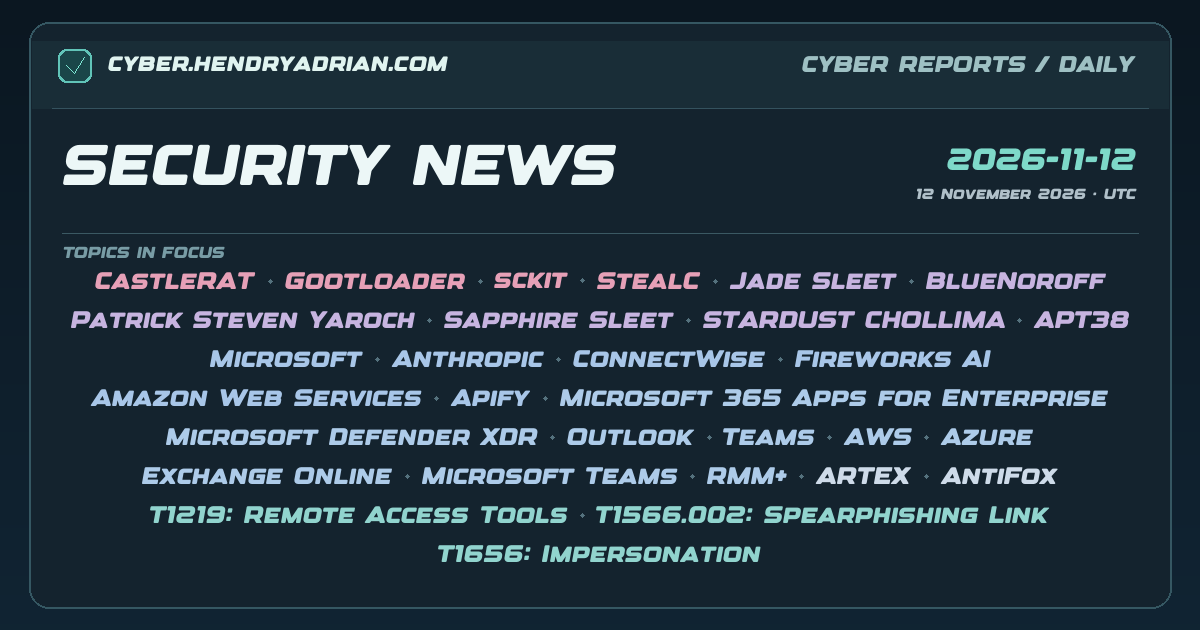
Daily Report (12 November 2026), ScreenConnect campaign compromised 288 hosts across 48 organizations, Credential-theft campaign probed thousands of GitHub repositories
Highlighted News
The day’s leading storiesScreenConnect campaign compromised 288 hosts across 48 organizations
Huntress says attackers used cloud-hosted ScreenConnect panels to deploy rogue clients and the SCKit toolkit across at least six managed service providers and 48 organizations. A likely authentication weakness in the RMM+ extension is under investigation. ConnectWise disabled five related extensions.
Security Significance: The affected hosts were hit within 90 minutes. Huntress and ConnectWise released indicators and recommended disabling the extensions; not all SCKit capabilities were observed during the incidents.
Credential-theft campaign probed thousands of GitHub repositories
Researchers say the wfx-loot campaign used stolen tokens to probe 61,764 GitHub repositories and inserted credential-stealing code where permissions allowed. SafeDep counted 8,093 public repositories with malicious commits; Aikido found signs the stealer executed in more than 1,800 repositories.
Security Significance: The campaign used repository access to spread credential-stealing code. A malicious commit does not necessarily mean the code executed.
Daily News Digest
Additional developmentsIncident Nitori reports exposure of up to 37.62 million customer records
Nitori says attackers breached its management servers, exposing data associated with up to 37.62 million individual, corporate and online-buyer records. The company said it found no evidence that its international customer database was exfiltrated.
Security Significance: The reported exposed records include contact details, birthdates, membership numbers and purchase-related information.
Incident Notion AI chat transcripts accessed in Fireworks AI breach
Notion says attackers accessed Insights chat transcripts after an October 24 incident involving Fireworks AI. Fewer than 1% of Notion workspaces were affected, and customers were advised to rotate exposed credentials.
Security Significance: The incident exposed customer AI transcripts through a service provider, creating an immediate credential-rotation concern for affected customers.
Other Operation Endgame disrupts malware infrastructure
Authorities from nine countries seized 235 servers and 257 domains linked to CastleRAT, Gootloader and StealC. They identified credentials or datasets associated with millions of victims and plan to make victim data available through notification platforms.
Security Significance: The action targeted infrastructure supporting multiple malware operations and recovered information that can support victim notification.
Threat Research Microsoft reports attackers using GSocket for Linux persistence
Microsoft reports that attackers abuse the legitimate GSocket relay tool to retain access to Linux servers, including through cron jobs, systemd services and shell startup files. Defender for Endpoint telemetry showed GSocket-related detections rose 356.2% from March to August.
Security Significance: GSocket can reconnect encrypted sessions without an inbound listener, allowing access to persist after the initial vulnerability is patched.
Threat Research AntiFox attacks compromise IIS servers and interact with AWS
Arctic Wolf Labs reports that attackers used AntiFox against internet-facing services, compromising IIS servers and interacting with AWS services. Observed activity included web-shell deployment, command execution, service enumeration and manipulation of S3 buckets.
Security Significance: The report describes confirmed attacker activity and recommends detection, credential revocation and secrets management.
Incident Apify rotates tokens after unauthorized internal access
Apify says an unauthorized third party accessed parts of its internal systems on November 9–10. It cut off access, rotated API tokens, reset sessions and revoked external OAuth connections. Two-factor authentication codes may have been exposed, but the company found no indication account data was affected.
Security Significance: The company took credential and session containment measures while investigating the potential exposure.
Vulnerability Chrome and Firefox updates address numerous vulnerabilities
Google and Mozilla released updates addressing 83 Chrome vulnerabilities and 99 Firefox vulnerabilities. Thunderbird 160 also includes 103 fixes. The vendors did not say whether the flaws were being exploited in the wild.
Security Significance: The Chrome fixes include five critical use-after-free flaws; Firefox fixes include use-after-free and sandbox-escape issues.
Threat Research Luna Moth targets law firms with access-token vishing
ReliaQuest reports that Luna Moth is again targeting law firms. The campaign uses a broken-PDF email and a caller posing as IT support to persuade employees to copy a Microsoft Copilot access token into a public text-sharing site.
Security Significance: ReliaQuest says the stolen tokens can be used to access files through Microsoft Graph.
Incident Maersk confirms data extraction from acquired system
Maersk confirmed an intrusion and data extraction from an isolated IT system inherited through an acquisition. The company said it found no indication of impact on other Maersk, customer or partner systems, and shipping platforms remained available.
Security Significance: WhiteArmor's claim of responsibility and its $5 million extortion demand remain unverified.
Threat Research FBI disrupts infrastructure used in FaceStealer scheme
The FBI says it disrupted cloud infrastructure used by FaceStealer, a cryptocurrency-theft campaign it attributes to North Korean group BlueNoroff. The scheme reportedly uses fake meeting links, deepfake video calls and malware to steal access and spread through victims' contacts.
Security Significance: The reported malware searches for cryptocurrency wallets and seed phrases and can access social accounts and record webcam video.
Threat Research Lookalike AI domains deliver ClickFix and browser malware
Island researchers identified 186 lookalike domains imitating 27 AI brands. The sites route visitors to ClickFix PowerShell lures, Net Guard browser malware or search-hijacking extensions.
Security Significance: The reported ClickFix route fingerprints browsers and uses a fake Cloudflare verification page to deliver a PowerShell command.
Incident Qubole-linked credentials used to steal cloud data
Wiz reports that attackers used Qubole-associated AWS credentials and customer cross-account roles to steal data and credentials from multiple organizations. How the attackers obtained Qubole's credentials remains unknown.
Security Significance: The reported activity used a provider-linked cloud access path to reach multiple organizations.
Daily Threat Intelligence
Six Top 7 rankingsRanked by distinct supporting articles. Open Related Evidence for saved source contexts and CVE details.
Top 7 CVEs
- 4CVE-2026-109618 · PHP Group PHP
- 5CVE-2026-109619 · PHP Group PHP
- 6CVE-2026-111497 · Google Brotli
- 7CVE-2026-124194 · Microsoft 365 Apps for Enterprise
Top 7 MITRE ATT&CK Techniques
Top 7 Malware
Top 7 Threat Actors
Top 7 Mentioned Countries
Top 7 Mentioned Industries
- 6Web3
Other Articles (23)
-
Microsoft 365 Outage Disrupts Outlook, Exchange Online and Teams
securityweek.com · Publisher date:
-
Actor Claims Sale of 36.4 Million HomeMaison Records, Including 330,000 Plaintext Passwords
darkwebinformer.com · Publisher date:
-
LEGO Takes BrickLink Offline After Unusual Activity; Data Impact Unknown
malwarebytes.com · Publisher date:
-
Daylight Raises $80 Million to Expand AI-Powered Security Operations Platform
securityweek.com · Publisher date:
-
SOCRadar Sentinel Connector Featured in Microsoft Ignite 2026 Announcement
socradar.io · Publisher date:
-
Qualys Adds TotalAppSec Checks for PHP2Shell and Node2Shell
blog.qualys.com · Publisher date:
-
Hudson Rock Finds Historical Infostealer Credentials for Two Addresses Reported in School Threats
infostealers.com · Publisher date:
-
Former FBI Supervisor Pleads Guilty to Stealing $2.47 Million in Cryptocurrency
malwarebytes.com · Publisher date:
-
Humble Bundle Relaunches Website Without Two-Factor Login
privacyaffairs.com · Publisher date:
-
Leaked Documents Allege Chinese Platform Targets Overseas Chinese and Taiwan Chip Industry
darkreading.com · Publisher date:
-
Japan Funds Emergency Cybersecurity Response Amid Rising Breaches
darkreading.com · Publisher date:
-
Picus Launches Agentic Penetration Testing With Production Guardrails
picussecurity.com · Publisher date:
-
Symantec Details Apparent AI-Assisted Attack on US Retailer
darkreading.com · Publisher date:
-
Microsoft says November 2026 Windows 11 security updates may fail to install
bleepingcomputer.com · Publisher date:
-
Civil Liberties Groups Urge Congress to Keep Section 702 Renewal Out of Defense Bill
cyberscoop.com · Publisher date:
-
EU Cybersecurity Product Sales Rise as Buyers Prioritize Digital Sovereignty
databreachtoday.com · Publisher date:
-
Crypto Security Roundup: Binance Laundering, Bitcoin Core Flaws and Gnosis Pay Breach
databreachtoday.com · Publisher date:
-
Microsoft 365 Outage Disrupts Outlook, Teams, Copilot and Defender XDR
bleepingcomputer.com · Publisher date:
-
CrowdStrike Named Leader in IDC MarketScape for Augmented Identity Security
crowdstrike.com · Publisher date:
-
Iru Launches Custom Declarations for Apple Declarative Device Management
iru.com · Publisher date:
-
Anthropic Expands Cyber Verification Program for Security Professionals
reversinglabs.com · Publisher date:
-
Australia Plans Binding AI Safety Rules, Including Rogue-Agent Reporting
databreachtoday.com · Publisher date:
-
Cofense Enhances AI Phishing Defense with Adaptive Classification and Automation
cofense.com · Publisher date:
METHODOLOGY AND LIMITATIONS
Reporting period and eligibility
Article selection uses the original publisher publication date within the saved reporting period. Articles without that date are excluded; discovery dates and Cyber publication dates do not substitute for it. Counts include articles meeting public eligibility rules after the saved Daily Report SCOPE exclusions were applied.
Daily scope includes only Security News and Cyber Attack & Data Breach. Each report covers one completed UTC calendar day, with an exclusive ending boundary. AI groups saved article evidence independently of PHP diagnostic event clusters.
Highlighted News and Daily News Digest selection
Daily editorial selection considers Security Impact & Scale, Urgency & Operational Relevance, Evidence Quality & Confidence, and Technical Novelty & Topic Diversity. Security impact and urgency receive the strongest consideration: actual incidents, breaches, disruption, active exploitation and immediate defensive needs. Confirmed impact is distinguished from potential impact; credible reporting and verified findings are distinguished from unverified claims.
Highlighted News aims to select two distinct, significant, well-supported developments when available. Different wording, publishers or PHP diagnostic clusters may describe the same underlying development and can be grouped together; shared entities alone do not establish SAME_EVENT. Separate incidents remain separate, and conflicting facts and uncertainty are retained.
Highlighted News contains up to two items. The Daily News Digest aims for twelve additional distinct, valuable developments, excluding developments already highlighted and duplicate coverage of the same event. These are upper bounds and editorial targets, never minimum counts: shorter or empty sections are valid when evidence is insufficient. No filler is added. Article frequency or the number of publishers alone does not establish security significance or independent verification.
Selection uses the supplied, budget-bounded saved article evidence. Unsupported claims, including unsupported severity assessments, predictions and quantitative facts, are omitted. These criteria describe the current editorial policy; historical reports retain their saved analysis.
Ranked lists and evidence
Ranked lists show up to seven saved, validated canonical entities per category, ordered by the number of distinct supporting articles. Each article counts once per entity. These are article references, not unique incident counts; multiple articles and publishers may cover the same event.
Related Evidence displays saved entity-specific contexts with publisher identity, publication dates and article links. Missing context is identified explicitly and does not mean a supporting article is missing: the article remains linked and counted. Article summaries are not substituted for unavailable entity context.
Entity mentions do not confirm attribution, infection, exploitation, attacker origin, victim location, targeting or industry compromise. Country and industry contexts retain the original research wording.
Saved CVE details
CVSS, severity, EPSS and CISA KEV details are available inside each CVE's Related Evidence, using saved snapshot enrichment only; unavailable values are Unknown. EPSS estimates exploitation probability, not vulnerability severity or confirmed exploitation. Absence from KEV does not establish absence of exploitation. CVE rankings depend on supporting articles, not scores or KEV status.
Historical and AI limitations
This report uses a saved historical evidence snapshot. Source edits, later enrichment and subsequent reporting do not automatically update it. AI analysis uses bounded editorial selections of summaries, key points and validated relationships; it cannot establish complete coverage of global threat activity. Historical completeness: Saved daily scope.
Ransomware operator claims and leak-site listings are unverified allegations, not confirmed attacks. Repetition by another publisher does not independently verify compromise, data theft or actor involvement.
Evidence panels provide ten articles per page, with every saved reference accessible. Without JavaScript, all references are displayed. Related entity metadata does not increase the supporting article count. Links use saved identities; their availability may change.
Supporting evidence
2 saved supporting articles
- Huntress Reports ScreenConnect Campaign Compromised 288 Hosts Across 48 Organizationssecurityweek.com · Publisher date:
- Huntress Says ScreenConnect Add-On Campaign Installed Rogue Clients on 288 Computerscyberscoop.com · Publisher date:
Supporting evidence
1 saved supporting article
- Credential-Theft Campaign Probed 61,764 GitHub Repositoriessecurityweek.com · Publisher date:
Supporting evidence
1 saved supporting article
- Nitori Reports Exposure of 37.62 Million Customer Recordssecurityonline.info · Publisher date:
Supporting evidence
1 saved supporting article
- Fireworks AI Breach Exposed Notion AI Chat Transcriptssecurityweek.com · Publisher date:
Supporting evidence
2 saved supporting articles
- Operation Endgame Disrupts Malware Networks, Identifies Credentials of 6.4 Million Victimscyberscoop.com · Publisher date:
- Europol-Led Operation Seizes Gootloader, CastleRAT and StealC Infrastructurebleepingcomputer.com · Publisher date:
Supporting evidence
1 saved supporting article
- Hackers Use GSocket to Maintain Persistent Access to Linux Serversbleepingcomputer.com · Publisher date:
Supporting evidence
1 saved supporting article
Supporting evidence
1 saved supporting article
- Apify Rotates API Tokens After Unauthorized Access to Internal Systemsbleepingcomputer.com · Publisher date:
Supporting evidence
1 saved supporting article
- Chrome and Firefox Updates Fix 182 Vulnerabilities; Thunderbird Also Updatedsecurityweek.com · Publisher date:
Supporting evidence
1 saved supporting article
- Luna Moth Targets Law Firms Again in Token-Theft Campaigndarkreading.com · Publisher date:
Supporting evidence
1 saved supporting article
- Maersk Confirms Data Extraction From Acquired IT System Amid $5 Million Extortion Claimsecurityweek.com · Publisher date:
Supporting evidence
2 saved supporting articles
- FBI Disrupts North Korean FaceStealer Deepfake Crypto-Theft Schemedatabreachtoday.com · Publisher date:
- U.S. Seizes Infrastructure Tied to North Korean Schemes and $1.2 Billion Linked to Binance Theftcyberscoop.com · Publisher date:
Supporting evidence
1 saved supporting article
- 186 Lookalike AI Domains Deliver ClickFix Lures, Browser Malware, and Search Hijackersthehackernews.com · Publisher date:
Supporting evidence
1 saved supporting article
- Weekly Breach Roundup: eMudhra Revokes Eight More Certificates Amid Cloud and Data-Theft Incidentsdatabreachtoday.com · Publisher date:
Related Evidence
1 saved supporting article
Entity: CVE-2025-62859
Vendor / Product unavailable
- CVSS
- Unknown · Unknown
- EPSS
- Unknown
- KEV
- Unknown
Supporting articles
A second flaw, CVE-2025-62859, allowed malicious network participants to delay block processing by up to 10 minutes under certain conditions. Attackers could potentially repeat the disruption, said Bitcoin Core's
Publisher: databreachtoday.com · Publisher date: VIEW ARTICLE
Related Evidence
1 saved supporting article
Entity: CVE-2025-62860
Vendor / Product unavailable
- CVSS
- Unknown · Unknown
- EPSS
- Unknown
- KEV
- Unknown
Supporting articles
The third vulnerability, CVE-2025-62860, affected nodes using specific Tor network settings, potentially removing protections against service disruptions and weakening privacy safeguards. Bitcoin Core said thousands of
Publisher: databreachtoday.com · Publisher date: VIEW ARTICLE
Related Evidence
1 saved supporting article
Entity: CVE-2025-62861
Vendor / Product unavailable
- CVSS
- Unknown · Unknown
- EPSS
- Unknown
- KEV
- Unknown
Supporting articles
The most serious vulnerability, CVE-2025-62861, affected software versions 28.0 through 28.2 and 29.0 through 29.1. It could leave the mempool, where pending bitcoin transactions wait for confirmation, in an
Publisher: databreachtoday.com · Publisher date: VIEW ARTICLE
Related Evidence
1 saved supporting article
Entity: CVE-2026-109618
PHP Group · PHP; Siemens · AMIS TS; +105 more
- CVSS
- 9.2 · CRITICAL
- EPSS
- 100.00%
- KEV
- Unknown
Supporting articles
PHP2Shell (CVE-2026-109618, CVE-2026-109619) is fixed in PHP 8.5.12, 8.4.27, 8.3.36, and 8.2.35.
Publisher: blog.qualys.com · Publisher date: VIEW ARTICLE
Related Evidence
1 saved supporting article
Entity: CVE-2026-109619
PHP Group · PHP; Siemens · AMIS TS; +106 more
- CVSS
- 9.2 · CRITICAL
- EPSS
- 100.00%
- KEV
- Unknown
Supporting articles
PHP2Shell (CVE-2026-109618, CVE-2026-109619) is fixed in PHP 8.5.12, 8.4.27, 8.3.36, and 8.2.35.
Publisher: blog.qualys.com · Publisher date: VIEW ARTICLE
Related Evidence
1 saved supporting article
Entity: CVE-2026-111497
Google · Brotli; Siemens · Cloud Connector Configurator; +22 more
- CVSS
- 9.2 · CRITICAL
- EPSS
- 82.64%
- KEV
- Unknown
Supporting articles
Node2Shell (CVE-2026-111497) is fixed in Node.js 22.23.4, 24.22.1, and 26.12.1.
Publisher: blog.qualys.com · Publisher date: VIEW ARTICLE
Related Evidence
1 saved supporting article
Entity: CVE-2026-124194
Microsoft · Microsoft 365 Apps for Enterprise; Microsoft · Microsoft Office LTSC 2021; +1 more
- CVSS
- 6.5 · MEDIUM
- EPSS
- Unknown
- KEV
- Unknown
Supporting articles
They included CVE-2026-124194, an Outlook spoofing flaw Microsoft says attackers have exploited.
Publisher: securityweek.com · Publisher date: VIEW ARTICLE
Related Evidence
2 saved supporting articles
Attackers abuse GSocket, a legitimate remote access tool, to maintain access to compromised Linux servers.
Publisher: bleepingcomputer.com · Publisher date: VIEW ARTICLERogue ScreenConnect clients were installed to provide remote access on affected computers.
Publisher: cyberscoop.com · Publisher date: VIEW ARTICLE
Related Evidence
2 saved supporting articles
The scheme used invitations and links to typo-squatted domains hosting imposter video-meeting interfaces, consistent with phishing links.
Publisher: cyberscoop.com · Publisher date: VIEW ARTICLEAttackers sent victims typosquatted calendar-invite links that led to an attacker-controlled video-conference platform.
Publisher: databreachtoday.com · Publisher date: VIEW ARTICLE
Related Evidence
2 saved supporting articles
The attackers reportedly impersonate IT support to persuade targets to disclose access tokens.
Publisher: darkreading.com · Publisher date: VIEW ARTICLEHackers used secretly recorded victim videos to impersonate victims in follow-on attacks.
Publisher: cyberscoop.com · Publisher date: VIEW ARTICLE
Related Evidence
1 saved supporting article
Researchers observed attackers disguising GSocket as kernel threads.
Publisher: bleepingcomputer.com · Publisher date: VIEW ARTICLE
Related Evidence
1 saved supporting article
Arctic Wolf Labs reported that attackers enumerated services in AWS environments.
Publisher: darkreading.com · Publisher date: VIEW ARTICLE
Related Evidence
1 saved supporting article
Attackers use cron jobs for persistence.
Publisher: bleepingcomputer.com · Publisher date: VIEW ARTICLE
Related Evidence
1 saved supporting article
The attacker submitted long PowerShell scripts during the later stage of activity.
Publisher: darkreading.com · Publisher date: VIEW ARTICLE
Related Evidence
2 saved supporting articles
Police dismantle Gootloader, CastleRAT, StealC malware infrastructure
Publisher: bleepingcomputer.com · Publisher date: VIEW ARTICLEThe largest seizures involved CastleRAT, a remote access trojan known since 2025 that gives attackers remote control of infected computers.
Publisher: cyberscoop.com · Publisher date: VIEW ARTICLE
Related Evidence
2 saved supporting articles
Police dismantle Gootloader, CastleRAT, StealC malware infrastructure
Publisher: bleepingcomputer.com · Publisher date: VIEW ARTICLEGootloader, a dropper spread through fake legal documents hosted on hacked WordPress sites, served as an initial access vector for ransomware attacks.
Publisher: cyberscoop.com · Publisher date: VIEW ARTICLE
Related Evidence
2 saved supporting articles
The attackers’ commands deployed rogue ScreenConnect clients and a malware toolkit called SCKit that provides persistent backdoor access, intercepts session cookies, and can self-replicate.
Publisher: securityweek.com · Publisher date: VIEW ARTICLEThe malware, which Huntress calls SCKit, installed rogue ScreenConnect clients, stopped the legitimate client and positioned the attacker’s copy to take its place, reusing the real client’s own code libraries so the
Publisher: cyberscoop.com · Publisher date: VIEW ARTICLE
Related Evidence
2 saved supporting articles
Police dismantle Gootloader, CastleRAT, StealC malware infrastructure
Publisher: bleepingcomputer.com · Publisher date: VIEW ARTICLEStealC, described as a stealer with dropper functions, was designed to extract passwords, data and credentials from compromised machines for resale and fraudulent use.
Publisher: cyberscoop.com · Publisher date: VIEW ARTICLE
Related Evidence
1 saved supporting article
The social engineering campaign, dubbed FaceStealer by the FBI, is attributed to a Pyongyang group known as BlueNoroff, Sapphire Sleet or Stardust Chollima. The group has targeted the cryptocurrency and Web3 industries,
Publisher: databreachtoday.com · Publisher date: VIEW ARTICLE
Related Evidence
1 saved supporting article
takes unsuspecting users to "Security Check" pages that deliver a browser-hijacking malware called Net Guard. The third pathway sends users to a search-hijack extension family with 16 live Chrome Web Store
Publisher: thehackernews.com · Publisher date: VIEW ARTICLE
Related Evidence
1 saved supporting article
The Egyptian record dates to a 2021 Vidar infection; the Taiwanese credentials were found in the historical AlienTXTBASE collection.
Publisher: infostealers.com · Publisher date: VIEW ARTICLE
Related Evidence
3 saved supporting articles
The FBI attributed the Binance attack to this hacking group, which the article describes as North Korean. The attribution is reported as the FBI’s assessment.
Publisher: databreachtoday.com · Publisher date: VIEW ARTICLEThe FBI attributed the theft of more than $6 billion in virtual assets from Binance to North Korean military hackers it calls TraderTraitor.
Publisher: cyberscoop.com · Publisher date: VIEW ARTICLEThe article identifies TraderTraitor as the separate group behind the Binance attack, which it says involved poisoning a version of Homebrew.
Publisher: databreachtoday.com · Publisher date: VIEW ARTICLE
Related Evidence
2 saved supporting articles
Named in the FBI alert as a public name for hackers involved in the scheme that hijacked accounts and used fake video-meeting invitations.
Publisher: cyberscoop.com · Publisher date: VIEW ARTICLEThe article attributes the FaceStealer campaign and recent open-source software supply-chain attacks to this financially motivated North Korean group.
Publisher: databreachtoday.com · Publisher date: VIEW ARTICLE
Related Evidence
2 saved supporting articles
A former FBI supervisor who pleaded guilty to wire fraud and money laundering after stealing approximately $2.47 million in cryptocurrency from wallets linked to FBI investigations. He accessed systems containing wallet seed phrases and used them to transfer funds.
Publisher: malwarebytes.com · Publisher date: VIEW ARTICLEFormer FBI agent who pleaded guilty to accessing FBI databases to obtain cryptocurrency wallet credentials and making unauthorized transfers from wallets linked to investigations.
Publisher: databreachtoday.com · Publisher date: VIEW ARTICLE
Related Evidence
2 saved supporting articles
Named in the FBI alert as a public name for hackers involved in the scheme that hijacked accounts and used fake video-meeting invitations.
Publisher: cyberscoop.com · Publisher date: VIEW ARTICLEThe article gives Sapphire Sleet as another name for the group it identifies as responsible for the FaceStealer campaign and recent supply-chain attacks; that group is reported to target cryptocurrency and Web3 organizations.
Publisher: databreachtoday.com · Publisher date: VIEW ARTICLE
Related Evidence
2 saved supporting articles
Named in the FBI alert as a public name for hackers involved in the scheme that hijacked accounts and used fake video-meeting invitations.
Publisher: cyberscoop.com · Publisher date: VIEW ARTICLEThe article gives Stardust Chollima as another name for the group it identifies as responsible for the FaceStealer campaign and recent supply-chain attacks; that group is reported to target cryptocurrency and Web3 organizations.
Publisher: databreachtoday.com · Publisher date: VIEW ARTICLE
Related Evidence
1 saved supporting article
Named in the FBI alert as a public name for hackers involved in the scheme that hijacked accounts and used fake video-meeting invitations.
Publisher: cyberscoop.com · Publisher date: VIEW ARTICLE
Related Evidence
1 saved supporting article
A seller using this handle claims to offer a database associated with HomeMaison. The dataset and the claimed unauthorized acquisition have not been independently verified.
Publisher: darkwebinformer.com · Publisher date: VIEW ARTICLE
Related Evidence
11 saved supporting articles
Western nations, and it is not hard to see why such operations should concern even average citizens in the US or Europe," he says. "Even if they have no personal ties to China."
Publisher: darkreading.com · Publisher date: VIEW ARTICLEBulgaria, Canada, Denmark, Germany, Moldova, the Netherlands, Poland, the United Kingdom, and the United States, with Europol and Eurojust coordinating the effort.
Publisher: bleepingcomputer.com · Publisher date: VIEW ARTICLEIsraeli-American cybersecurity startup Daylight has raised $80 million in a Series B funding round that brings the total raised by the company to $120 million.
Publisher: securityweek.com · Publisher date: VIEW ARTICLEThe 27 groups on Thursday said it would be a mistake to do it again without a warrant requirement for U.S.
Publisher: cyberscoop.com · Publisher date: VIEW ARTICLEfrom Bulgaria, Canada, Denmark, Germany, Moldova, the Netherlands, Poland, the United Kingdom and the United States took part, alongside Europol and Eurojust, as part of Operation Endgame, which Europol calls the
Publisher: cyberscoop.com · Publisher date: VIEW ARTICLEin Europe, the Middle East and Africa. Sales from all vendors rose by 10% during that time while U.S. vendors saw only an 8% sales lift.
Publisher: databreachtoday.com · Publisher date: VIEW ARTICLEincidents in digital assets. This week, Binance hackers laundered stolen funds through memecoins, U.S. authorities cut off MEXC Global, Bitcoin Core disclosed three security flaws, a Scottish prisoner
Publisher: databreachtoday.com · Publisher date: VIEW ARTICLEFor years, North Korea has committed cryptocurrency heists alongside the regime’s expansive scheme to get remote IT workers hired at U.S.
Publisher: cyberscoop.com · Publisher date: VIEW ARTICLEU.S. law enforcement disrupted cloud infrastructure used by financially motivated North Korean hackers in a worm-like deepfake fraud scheme that propagated from one victim to the next.
Publisher: databreachtoday.com · Publisher date: VIEW ARTICLEFederal direction on rogue agents remains optional in the United States, where an October playbook from the National Security Agency, National Institute of Standards and Technology and Cybersecurity and Infrastructure
Publisher: databreachtoday.com · Publisher date: VIEW ARTICLEan Ai agent swarm, Fireworks AI confirmed an attack. A hearing care provider is notifying 1.33 million U.S. customers of a breach.
Publisher: databreachtoday.com · Publisher date: VIEW ARTICLE
Related Evidence
4 saved supporting articles
In a November 11 statement, the Danish company said the affected system was inherited through an earlier acquisition.
Publisher: securityweek.com · Publisher date: VIEW ARTICLEThis stage of Operation Endgame included law enforcement agencies from Bulgaria, Canada, Denmark, Germany, Moldova, the Netherlands, Poland, the United Kingdom, and the United States, with Europol and Eurojust
Publisher: bleepingcomputer.com · Publisher date: VIEW ARTICLEAgencies from Bulgaria, Canada, Denmark, Germany, Moldova, the Netherlands, Poland, the United Kingdom and the United States took part, alongside Europol and Eurojust, as part of Operation Endgame, which Europol calls
Publisher: cyberscoop.com · Publisher date: VIEW ARTICLEof the second Trump administration. The U.S. president's threats to annex Greenland - sovereign to Denmark - caused widespread concern over reliance on American tech, and the White House's brief export controls
Publisher: databreachtoday.com · Publisher date: VIEW ARTICLE
Related Evidence
3 saved supporting articles
That's according to documents leaked to China watchdog NetAskari.
Publisher: darkreading.com · Publisher date: VIEW ARTICLETo recap: In August, a Chinese open source (OSS) developer released a cybercrime-grade agentic red-teaming tool called "Artex." In the months that followed, attackers and cybersecurity researchers have gradually
Publisher: darkreading.com · Publisher date: VIEW ARTICLEafter ConnectWise dealt with a supply-chain attack that Microsoft later attributed it to Storm-0940, a China-state-aligned group that used the ARTEX AI framework to automate password spraying and exploit privileged
Publisher: cyberscoop.com · Publisher date: VIEW ARTICLE
Related Evidence
3 saved supporting articles
This stage of Operation Endgame included law enforcement agencies from Bulgaria, Canada, Denmark, Germany, Moldova, the Netherlands, Poland, the United Kingdom, and the United States, with Europol and Eurojust
Publisher: bleepingcomputer.com · Publisher date: VIEW ARTICLEAgencies from Bulgaria, Canada, Denmark, Germany, Moldova, the Netherlands, Poland, the United Kingdom and the United States took part, alongside Europol and Eurojust, as part of Operation Endgame, which Europol calls
Publisher: cyberscoop.com · Publisher date: VIEW ARTICLEContext also said the ongoing switch to EU vendors is fueled by stricter national cybersecurity frameworks in France and Germany.
Publisher: databreachtoday.com · Publisher date: VIEW ARTICLE
Related Evidence
3 saved supporting articles
Japan Pushes Emergency Funding for Cybersecurity as AI-Assisted Breaches Rise
Publisher: darkreading.com · Publisher date: VIEW ARTICLECorporate Japan faces an escalating wave of sophisticated cyberattacks in the artificial intelligence era.
Publisher: securityonline.info · Publisher date: VIEW ARTICLEDarren Jones in the forward, in which he called on the U.K. to work with allies such as France, Germany, Japan and Korea to maintain access to frontier AI technology. "The point of such a coalition is not to stand
Publisher: databreachtoday.com · Publisher date: VIEW ARTICLE
Related Evidence
3 saved supporting articles
The FBI has attributed the Binance attack to North Korea's TraderTraitor hacking group. Binance's incident report described a months-long operation involving a fake job interview, malicious developer software and
Publisher: databreachtoday.com · Publisher date: VIEW ARTICLEFor years, North Korea has committed cryptocurrency heists alongside the regime’s expansive scheme to get remote IT workers hired at U.S.
Publisher: cyberscoop.com · Publisher date: VIEW ARTICLEU.S. law enforcement disrupted cloud infrastructure used by financially motivated North Korean hackers in a worm-like deepfake fraud scheme that propagated from one victim to the next.
Publisher: databreachtoday.com · Publisher date: VIEW ARTICLE
Related Evidence
3 saved supporting articles
While the MSS ran Huang, the United Front Work Department (UFWD) took its own, less dramatic approach to the challenge of breaching Taiwan's semiconductor industry.
Publisher: darkreading.com · Publisher date: VIEW ARTICLEFocus Taiwan reported on November 12 that Da-Yeh University’s initial investigation found an alumnus account had sent a large volume of email and appeared to have been compromised.
Publisher: infostealers.com · Publisher date: VIEW ARTICLEdata theft, and Russian cloud service Beget on the receiving end of a wiper attack. SonicWall patches, a Taiwan hacker used an Ai agent swarm, Fireworks AI confirmed an attack. A hearing care provider is notifying
Publisher: databreachtoday.com · Publisher date: VIEW ARTICLE
Related Evidence
5 saved supporting articles
The package adds public-private cyber responders, an AI-focused team run by the economic ministry, and more leeway to use the government's new active cyber-defense powers.
Publisher: darkreading.com · Publisher date: VIEW ARTICLEMicrosoft says most targets of GSocket activity are in the education and research sector, followed by technology and communications, manufacturing, and government entities.
Publisher: bleepingcomputer.com · Publisher date: VIEW ARTICLESee Also: How UK government can continue to innovate while reducing tech costs
Publisher: databreachtoday.com · Publisher date: VIEW ARTICLEdeveloper wanting to do business in Australia will have to follow binding safety and security rules his government plans to write into an upcoming AI standards law. The push comes after a June intrusion in which an
Publisher: databreachtoday.com · Publisher date: VIEW ARTICLEThe infrastructure targeted government agencies, banks, military systems, educational institutions and commercial platforms. Researchers found unauthorized access or data theft at approximately 10 organizations across
Publisher: databreachtoday.com · Publisher date: VIEW ARTICLE
Related Evidence
4 saved supporting articles
A former FBI supervisor stole from cryptocurrency wallets involved in 35 FBI investigations
Publisher: malwarebytes.com · Publisher date: VIEW ARTICLEBlockchain & Cryptocurrency
Publisher: databreachtoday.com · Publisher date: VIEW ARTICLEcoordinated actions against North Korean groups’ campaigns that have stolen billions of dollars in cryptocurrency, seizing cloud infrastructure behind a social engineering scheme known as FaceStealer and the
Publisher: cyberscoop.com · Publisher date: VIEW ARTICLECryptocurrency Fraud
Publisher: databreachtoday.com · Publisher date: VIEW ARTICLE
Related Evidence
4 saved supporting articles
Agentic security has become one of the most heavily funded categories in cybersecurity this year, and for good reason: putting an adversary-grade attacker inside every network, every day, is the only test that keeps
Publisher: picussecurity.com · Publisher date: VIEW ARTICLEIsraeli-American cybersecurity startup Daylight has raised $80 million in a Series B funding round that brings the total raised by the company to $120 million.
Publisher: securityweek.com · Publisher date: VIEW ARTICLECybersecurity Spending
Publisher: databreachtoday.com · Publisher date: VIEW ARTICLEArtificial intelligence is changing cybersecurity on both sides of the equation. The same capabilities that help attackers identify vulnerabilities, develop malware, and accelerate exploitation can also give defenders
Publisher: reversinglabs.com · Publisher date: VIEW ARTICLE
Related Evidence
2 saved supporting articles
is helping the government design influence operations targeting high-ranking individuals in the artificial intelligence (AI) industry.
Publisher: darkreading.com · Publisher date: VIEW ARTICLEArtificial Intelligence & Machine Learning
Publisher: databreachtoday.com · Publisher date: VIEW ARTICLE
Related Evidence
2 saved supporting articles
The attack, detailed today by Symantec, targeted an unnamed US retail organization in September. The threat actor's hand-typed commands were repeatedly blocked, so the attacker switched to what appeared to be
Publisher: darkreading.com · Publisher date: VIEW ARTICLEWhile Nitori operates retail stores across Mainland China, Hong Kong, Taiwan, and Asia, the exposure appears localized.
Publisher: securityonline.info · Publisher date: VIEW ARTICLE
Related Evidence
2 saved supporting articles
The campaign has drained more than $400 million from the cryptocurrency and Web3 sectors over the past 18 months.
Publisher: cyberscoop.com · Publisher date: VIEW ARTICLEknown as BlueNoroff, Sapphire Sleet or Stardust Chollima. The group has targeted the cryptocurrency and Web3 industries, stealing at least $400 million in cryptocurrency through malware and artificial
Publisher: databreachtoday.com · Publisher date: VIEW ARTICLE
Related Evidence
1 saved supporting article
Apify is a Czech web scraping and browser automation platform for developers.
Publisher: bleepingcomputer.com · Publisher date: VIEW ARTICLE