Phantom Enigma Uses Browser Manipulation to Install Credential-Stealing Extensions
Summary
Positive Technologies details Phantom Enigma’s updated phishing campaigns, which target Brazilian users with credential-stealing browser extensions and organizations with RMM tools, including Syncro. Attackers manipulate browser windows to install extensions.
Key points
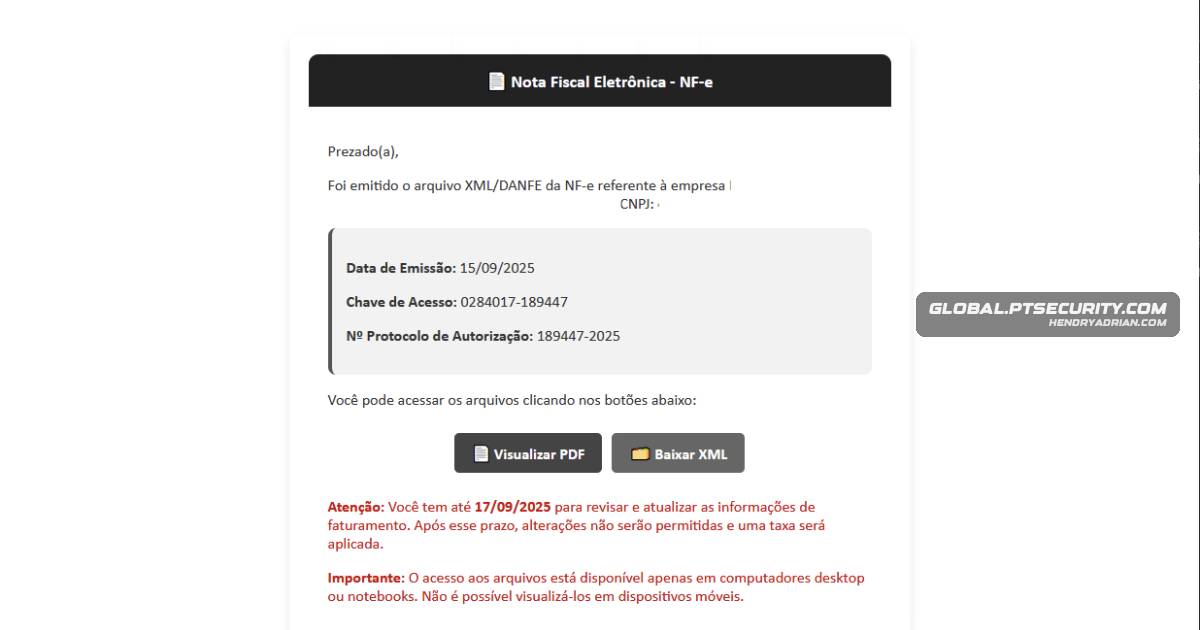
- Phishing invoice emails link victims to BAT or VBS scripts that download and run MSI installers.
- EnigmaUiLauncher manipulates browser windows and uses Chrome DevTools Protocol commands to install malicious extensions outside browser stores.
- The EnigmaBanker extension targets Brazilian banking credentials and captures user identifiers; attackers also check browser history for Brazilian banking sites.
- Attacks on organizations use remote management tools including PDQ Connect, Mesh Agent, ScreenConnect, and Syncro RMM.
- The attackers added a mouse-click blocker and use scheduled tasks, while shifting away from hosting extensions in the Chrome Web Store.
- From September to November 2025, the researchers identified about 5,390 initial-payload downloads and roughly 143 installer downloads; they also found around 15 files linked to attacks on organizations.
- The group’s infrastructure includes payload servers, command-and-control domains, and monitoring panels; server-side checks restrict some payload delivery to users in Brazil.
Article Details
- Attack Vectors
- Phishing invoice emails link users to malicious BAT or VBS scripts, which download and execute an MSI installer.
- The installer runs PowerShell scripts that install the EnigmaBanker browser extension; EnigmaUiLauncher manipulates browser windows and uses the Chrome DevTools Protocol to import the extension.
- The extension captures banking credentials and user identifiers entered on targeted banking pages and sends the data to attacker infrastructure.
- Phishing emails targeting organizations link to installers for PDQ Connect, Mesh Agent, ScreenConnect, or Syncro RMM, which provide attackers remote access.
- The BAT script downloads and extracts a password-protected payload archive from attacker-controlled loader endpoints.
- Defensive Notes
- The article reports that existing antivirus solutions were fairly effective at blocking the attackers' scripts, contributing to fewer installer downloads than initial-payload downloads.
Indicators of compromise
| Type | Indicator | Context |
|---|---|---|
| DOMAIN | bancopatrimonial[.]com | Domain observed serving payload downloads from the malicious server infrastructure. |
| DOMAIN | datasyncpanel[.]online | Domain identified by the researchers as malicious infrastructure associated with the attacker panels. |
| DOMAIN | novoservidor2026[.]com | C2 and logging infrastructure for EnigmaUiLauncher; also identified among the malicious domains. |
| DOMAIN | securepainelx[.]com | Domain identified by the researchers as malicious infrastructure associated with the attacker panels. |
| DOMAIN | sistemacloudx[.]com | Domain identified by the researchers as malicious infrastructure associated with the attacker panels. |
| IPV4 | 159[.]183[.]229[.]140 | Source IP address used to send phishing messages. |
| IPV4 | 168[.]245[.]108[.]233 | Source IP address used to send phishing messages. |
| IPV4 | 168[.]245[.]12[.]100 | Source IP address used to send phishing messages. |
| IPV4 | 198[.]37[.]159[.]134 | Source IP address used to send phishing messages. |
| MD5 | 077ce8f9fae6a4d3f8d9972c6a0fa684 | Checksum identified in the metadata for the malicious installer archive. |
| URL | hxxp[:]//systemcloud26[.]com/ | Malicious server URL displaying the login panel used to identify related attacker infrastructure. |
| URL | hxxps[:]//atual2025[.]com/getloader[.]php | Attacker-controlled payload-loader URL used by the BAT script. |
| URL | hxxps[:]//notifica-modulo[.]com/getloader[.]php | Attacker-controlled payload-loader URL used by the BAT script. |
| URL | hxxps[:]//webrelayapi[.]online/getloader[.]php | Attacker-controlled payload-loader URL used by the BAT script. |
MITRE ATT&CK
T1053.005 · Scheduled TaskThe installer creates and runs scheduled tasks, including KalebAutoRun and msee, to execute PowerShell scripts.T1056.003 · Web Portal CaptureThe malicious extension captures passwords and user identifiers entered on banking pages.T1059.001 · PowerShellPowerShell scripts install and run the browser extension and related components.T1059.003 · Windows Command ShellBAT scripts use Windows command-shell commands to download and install the payload.T1059.005 · Visual BasicVBS scripts are delivered as initial payloads in attacks on regular users.T1059.007 · JavaScriptThe malicious browser extension uses JavaScript to capture banking input and manipulate page content.T1071.001 · Web ProtocolsEnigmaUiLauncher sends activity logs to attacker infrastructure over HTTPS.T1105 · Ingress Tool TransferThe BAT script downloads the installer payload from attacker-controlled loader endpoints.T1140 · Deobfuscate/Decode Files or InformationThe BAT script decodes base64 data from the loader response to create the ZIP payload.T1204.002 · Malicious FileVictims ran the linked scripts or installers, enabling the infection or remote-access setup.T1217 · Browser Information DiscoveryEnigmaUiLauncher searches browser history for artifacts, including visits to Brazilian banking domains.T1219 · Remote Access ToolsThe organization-targeting attacks use RMM software, including PDQ Connect, Mesh Agent, ScreenConnect, and Syncro RMM, to establish remote access.T1566.002 · Spearphishing LinkPhishing invoice emails used links to deliver malicious scripts or RMM installers.
People
Threat Actors
Malware
EnigmaBankerChanges in the EnigmaBanker malicious extension codeEnigmaInterceptorThe installer runs a PowerShell script, which launches EnigmaUiLauncher together with EnigmaInterceptor.EnigmaUiLauncherThe installer runs a PowerShell script, which launches EnigmaUiLauncher together with EnigmaInterceptor.
Products
Braveis a hacking group believed to operate from Latin America. It uses a malicious extension for Chrome, Brave, Firefox, and other browsers. The group's primary objective is to profit by stealing credentials for userGoogle ChromeEnigma is a hacking group believed to operate from Latin America. It uses a malicious extension for Chrome, Brave, Firefox, and other browsers. The group's primary objective is to profit by stealing credentialsMicrosoft EdgeUser computers were infected via a malicious browser extension for Firefox, Google Chrome, and Microsoft Edge, while organizations' infrastructure was controlled by remote administration tools such as PDQ Connect andMozilla Firefox a hacking group believed to operate from Latin America. It uses a malicious extension for Chrome, Brave, Firefox, and other browsers. The group's primary objective is to profit by stealing credentials for user accounts
Tools
Mesh Agentorganizations' infrastructure was controlled by remote administration tools such as PDQ Connect and Mesh Agent.PDQ ConnectEdge, while organizations' infrastructure was controlled by remote administration tools such as PDQ Connect and Mesh Agent.ScreenConnectThe link leads to an installer for PDQ Connect, MeshAgent, ScreenConnect, or Syncro RMM.Syncro RMMThe group has adopted new remote monitoring and management (RMM) tools, including Syncro RMM.
Countries
Industries
Chemicalof the malicious campaign included consulting and management firms, as well as logistics, retail, chemical, and IT companies. The number of such attacks is significantly lower: we identified around 15 files.Consultingtelemetry and open-source data, we determined that potential targets of the malicious campaign included consulting and management firms, as well as logistics, retail, chemical, and IT companies. The number of suchInformation Technologylogisticsthat potential targets of the malicious campaign included consulting and management firms, as well as logistics, retail, chemical, and IT companies. The number of such attacks is significantly lower: we identifiedRetailtargets of the malicious campaign included consulting and management firms, as well as logistics, retail, chemical, and IT companies. The number of such attacks is significantly lower: we identified around 15