Huntress Details M365 Token-Replay Campaign Affecting 79 Organizations
Summary
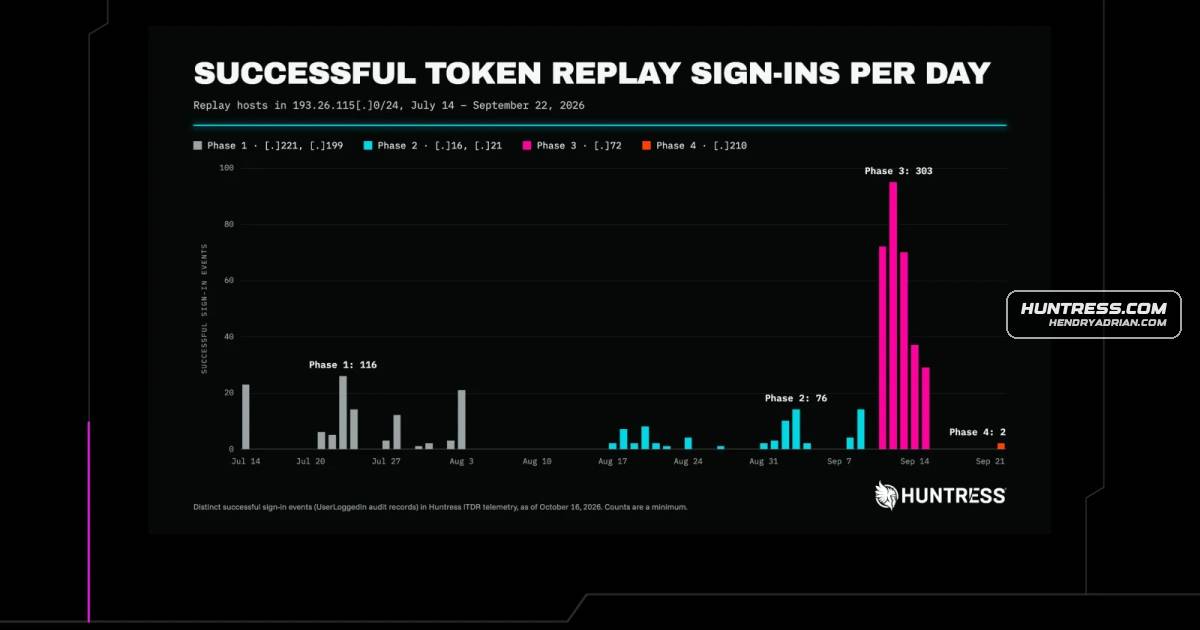
Huntress reports a 10-week Microsoft 365 token-replay campaign affecting 79 organizations, with at least 497 successful sign-ins. Attackers stole sessions through AiTM relays and other methods, then registered rogue devices, changed MFA and hid emails.
Key points
- From July 14 to September 22, 2026, Huntress observed at least 497 successful sign-ins across 79 organizations, alongside more than 200,000 failed attempts.
- The attackers obtained tokens through AiTM relays, device-code phishing and social engineering during legitimate sign-ins, then replayed them from hosting infrastructure including 193.26.115[.]0/24.
- The investigation identified two replay toolsets and rotating infrastructure. Blocking a single IP address would not have covered all six main replay hosts.
- Attackers registered at least 48 rogue Entra devices. In 19 organizations, existing MFA methods were wiped and a new method registered within three hours of the first campaign sign-in.
- Hidden inbox rules moved or deleted selected messages; in one incident, an attacker used a compromised mailbox to send a payroll-related email to an outside contact.
- Huntress recommends revoking sessions and resetting passwords, then auditing and removing unrecognized devices and MFA methods. A password reset alone may leave attacker access in place.
- Conditional Access blocked sign-ins from one campaign address in four organizations, while the article says the same campaign also succeeded in other organizations.
Article Details
- Attack Vectors
- Adversary-in-the-middle relays presented fake sign-in pages and captured victims' session tokens after they completed MFA.
- Device-code phishing tricked victims into entering codes on Microsoft's legitimate sign-in page, authorizing attacker sessions.
- Stolen Microsoft 365 tokens were replayed from rented hosting infrastructure in automated sign-in attempts.
- The attacker cleared and replaced victims' MFA methods and registered rogue Entra devices to maintain access.
- The attacker created inbox rules to hide or delete messages and used a compromised mailbox for spam and a payroll-related email.
- Defensive Notes
- Configure Conditional Access to require MFA or block access for all users, cloud apps, and client app types.
- For suspected compromise, revoke sessions and reset the password; also remove attacker-registered devices and unrecognized MFA methods.
- Audit Entra devices, MFA changes, and inbox rules, including rules with short or punctuation-only names and rules moving messages to obscure folders.
- Restrict device-code flow with Conditional Access authentication-flow policies.
- Investigate sign-ins from hosting infrastructure using OAuth2:Token or Cmsi:Cmsi, especially those involving user mailboxes or the Device Registration Service.
- Treat Conditional Access blocks as evidence of valid credentials and prioritize investigations based on credential validity rather than failed-attempt volume.
- Disable standard-user consent to new applications or require users to request application access.
Indicators of compromise
| Type | Indicator | Context |
|---|---|---|
| IPV4 | 124[.]198[.]132[.]33 | Campaign infrastructure used to continue a hijacked session. |
| IPV4 | 167[.]148[.]41[.]96 | Interserver address used to create inbox rules hiding responses to a payroll-related email. |
| IPV4 | 185[.]238[.]2[.]195 | Adversary-in-the-middle relay that captured a victim's session during the July 21 incident. |
| IPV4 | 192[.]159[.]99[.]172 | Campaign infrastructure used in a failed attempt to replay a stolen session. |
| IPV4 | 193[.]26[.]115[.]16 | Campaign host used for token replay and device-code phishing. |
| IPV4 | 193[.]26[.]115[.]199 | Build B session-replay host used during Phase 1 and later failed token-replay attempts. |
| IPV4 | 193[.]26[.]115[.]21 | Build A token-replay host that targeted SharePoint Online. |
| IPV4 | 193[.]26[.]115[.]210 | Build B session-replay host used during Phase 4. |
| IPV4 | 193[.]26[.]115[.]221 | Build A token-replay and rogue-device-registration host used during Phase 1. |
| IPV4 | 193[.]26[.]115[.]72 | Automated token-replay host used in the September campaign burst. |
| IPV4 | 45[.]83[.]31[.]44 | Campaign infrastructure used in a failed attempt to replay a stolen session. |
| IPV6 | 2400:8d60:2::1:841d:5dd | Evoxt relay used to capture a victim's session during Phase 4. |
MITRE ATT&CK
T1090.003 · Multi-hop ProxyThe campaign used rented VDI tunnel infrastructure and VPN addresses for attacker activity.T1098.005 · Device RegistrationThe attacker registered at least 48 rogue Entra devices in victim tenants.T1550.001 · Application Access TokenThe attacker replayed stolen Microsoft 365 session tokens from campaign infrastructure.T1556.006 · Multi-Factor AuthenticationThe attacker wiped victims' MFA methods and registered replacement authenticators.T1557 · Adversary-in-the-MiddleAiTM relays captured victims' sessions after they completed MFA.T1564.008 · Email Hiding RulesThe attacker created hidden inbox rules to mark, move, or delete messages.T1566.002 · Spearphishing LinkFake sign-in pages and device-code phishing tricked victims into completing authentication steps.
People
Andrea HatcherNamed as an author of the Huntress investigation.Andrew SchwartzNamed as an author of the Huntress investigation.Anton OvrutskyAcknowledged for contributions to the investigation and writeup.Matt PotoNamed as an author of the Huntress investigation.Susannah MattNamed as an author of the Huntress investigation.
Vendors
1337 Services GmbHrelays and replayed the stolen tokens from an IP address block owned by German hosting provider 1337 Services GmbH. We responded to related incidents at 79 organizations, observing at least 497 successful sign-inCrownCloudrogue device from the 1337 Services GmbH address, the attacker would often pivot to an ExpressVPN or CrownCloud address for further activity. Alongside it, 193.26.115[.]199 ran Build B, replaying browser sessionsDataWagonwas created from VPN or rented hosting, never from 1337 Services: ExpressVPN, NordVPN, CrownCloud, DataWagon, GLOBALTELEHOST, LeaseWeb, Dynu, and Interserver. The rule names were deliberately forgettable:Dynuhosting, never from 1337 Services: ExpressVPN, NordVPN, CrownCloud, DataWagon, GLOBALTELEHOST, LeaseWeb, Dynu, and Interserver. The rule names were deliberately forgettable:Evoxt Sdn. Bhd.The final address paired an AiTM relay at a different hosting provider, Evoxt Sdn. Bhd. (2400:8d60:2::1:841d:5dd), with replay from 193.26.115[.]210. It first appeared on September 2. On September 3, the attacker triedExpressVPNregistering the rogue device from the 1337 Services GmbH address, the attacker would often pivot to an ExpressVPN or CrownCloud address for further activity. Alongside it, 193.26.115[.]199 ran Build B, replayingGLOBALTELEHOSTfrom VPN or rented hosting, never from 1337 Services: ExpressVPN, NordVPN, CrownCloud, DataWagon, GLOBALTELEHOST, LeaseWeb, Dynu, and Interserver. The rule names were deliberately forgettable:Interserverany message mentioning payroll, direct deposit, bank, or bonus. Five minutes later, from the same Interserver address (167.148.41[.]96), they created a second rule named d that marked all email from the CPA'sLeaseWebor rented hosting, never from 1337 Services: ExpressVPN, NordVPN, CrownCloud, DataWagon, GLOBALTELEHOST, LeaseWeb, Dynu, and Interserver. The rule names were deliberately forgettable:MicrosoftOver a ten-week stretch, Huntress tracked a Microsoft 365 campaign that captured sign-in sessions through adversary-in-the-middle (AiTM) relays and replayed the stolen tokens from an IP address block owned by GermanNordVPNin this campaign was created from VPN or rented hosting, never from 1337 Services: ExpressVPN, NordVPN, CrownCloud, DataWagon, GLOBALTELEHOST, LeaseWeb, Dynu, and Interserver. The rule names were deliberately
Products
Device Registration ServiceMicrosoft Graph, Exchange Online, SharePoint Online, Device Registration ServiceEntra IDDESKTOP- plus eight hex characters. Microsoft independently flagged the same infrastructure: Microsoft Entra ID Protection raised verified threat actor IP detections against 193.26.115[.]221, 193.26.115[.]72,Exchange OnlineMicrosoft Graph, Exchange Online, SharePoint Online, Device Registration ServiceMicrosoft 365 Apps for EnterpriseOver a ten-week stretch, Huntress tracked a Microsoft 365 campaign that captured sign-in sessions through adversary-in-the-middle (AiTM) relays and replayed the stolen tokens from an IP address block owned by GermanMicrosoft Authentication BrokerMicrosoft Office, Microsoft Authentication BrokerMicrosoft Entra ID ProtectionDESKTOP- plus eight hex characters. Microsoft independently flagged the same infrastructure: Microsoft Entra ID Protection raised verified threat actor IP detections against 193.26.115[.]221, 193.26.115[.]72,Microsoft GraphMicrosoft Graph, Exchange Online, SharePoint Online, Device Registration ServiceMicrosoft OfficeMicrosoft Office, Microsoft Authentication BrokerOfficeHomeOfficeHome, Exchange OnlineSharePoint OnlineMicrosoft Graph, Exchange Online, SharePoint Online, Device Registration Service