Huntress Details Endpoint Rules That Disrupt ClickFix Attacks
Summary
Huntress describes endpoint rules that detect ClickFix commands by their structure and parent process, then terminate execution before payload retrieval. The article details a blocked attack, rule testing, and current coverage limits.
Key points
- ClickFix tricks users into pasting commands into Windows Run, often without dropping a file for conventional endpoint tools to scan.
- Huntress says backend alerts can arrive too late; its Attack Disruption engine instead evaluates command lines and process relationships locally.
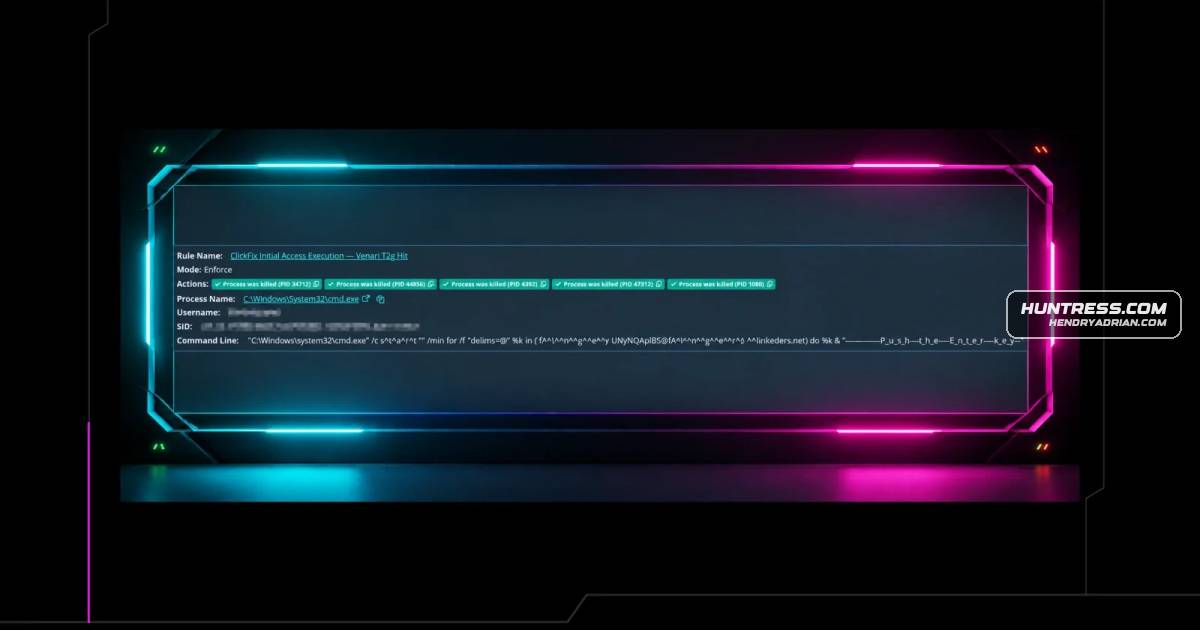
- In the described incident, rules killed four processes within 1.25 seconds, before the command could execute its retrieved payload; the user repeated the attempt five more times, and each was stopped.
- Huntress added a second rule to catch detached child processes when a launcher exits after spawning them.
- Rules run in audit mode before enforcement; Huntress says only rules meeting its 99% accuracy threshold are promoted.
- The described rules cover Windows and do not prevent users from running commands; new ClickFix variants may evade them.
Article Details
- Defense Focus
- Disrupt Windows ClickFix execution chains on the endpoint before payload retrieval and execution, using command-line behavior and parent-process context rather than file reputation.
- Detection Methods
- Match suspicious command-line structure, obfuscation, download cradles, and URLs at the root of a process chain or immediately adjacent to it.
- Gate command-line detections on parent-process context, particularly commands launched directly by explorer.exe in an interactive user session.
- Inspect the parent's command line to detect detached child runners, including randomly renamed runners, and terminate the live child even when the launcher has already exited.
- Use narrowly scoped sub-detections for homoglyph and Unicode abuse, scheme-less URIs, comment-block command construction, and additional LOLBIN execution patterns.
- Retain backend telemetry correlation as an investigative fallback when endpoint termination loses the race.
- Validate candidate rules in audit mode across customer environments for weeks before promoting rules meeting Huntress's stated 99% accuracy threshold to enforcement.
- Data Sources
- Process command lines and parent command lines
- Parent-child process relationships and execution-chain telemetry
- Interactive user-session context
- Process creation, termination, and lifetime timestamps
- Backend endpoint telemetry
- Audit-mode detection events and enforcement outcomes
- An internal dataset of 8,332 ClickFix-related items collected over a 60-day window
- Rule Types
- Endpoint-local behavioral command-line rules with parent-process gates
- Parent-command-line rules targeting detached child runners
- Independently controlled audit-mode and enforcement-mode sub-detections
- Backend telemetry correlation rules
- Defensive Actions
- Use endpoint-local enforcement to terminate matching processes and their execution chains before downstream payload execution.
- Terminate detached child runners rather than relying solely on killing the original launcher.
- Send accelerated alerts to the SOC after automatic termination for investigation, scoping, and remediation.
- Evaluate controls against fileless pasted commands and measure whether intervention occurs before payload execution, rather than merely whether an alert eventually fires.
- Validate enforcement safety through audit-mode observations and investigate false positives before enabling automatic termination.
- Apply hardening separately to address users' ability to run pasted commands; the described disruption rules do not prevent users from launching them.
- Do not resolve, visit, or execute the hostile infrastructure and command reproduced in the incident.
Indicators of compromise
| Type | Indicator | Context |
|---|---|---|
| HOSTNAME | finger[.]linkeders[.]net | Remote payload-retrieval host queried by finger.exe in the malicious pasted command; Huntress explicitly identifies the infrastructure as hostile. |
MITRE ATT&CK
T1027.010 · Command ObfuscationThe incident command inserts caret escape characters into start and finger to evade literal string matching while preserving execution after parsing.T1059.003 · Windows Command ShellThe pasted command invokes cmd.exe and uses start and a for /f loop to retrieve remote text and execute it through do %k.T1105 · Ingress Tool TransferThe download cradle invokes finger.exe against finger[.]linkeders[.]net to retrieve remote text intended for execution; Huntress reports that termination prevented the loop body from executing.T1204.004 · Malicious Copy and PasteClickFix prompts trick users into pasting an attacker-supplied command into the Windows Run dialog and pressing Enter; the incident user repeated the command six times.T1564.003 · Hidden WindowThe malicious command uses start with /min to hide the execution window by minimizing it.
People
Jonathan SemonCo-author of the article describing Huntress's ClickFix detection and disruption approach.Shivangi PandeyCo-author of the article describing Huntress's ClickFix detection and disruption approach.Tyler BohlmannAuthor of the referenced technical breakdown covering ClickFix, FileFix, TerminalFix, and DownloadFix artifacts and detection chokepoints.
Vendors
HuntressThe Fix for ClickFix: How Huntress Detects and Responds to a ClickFix AttackMicrosoftThe for /f construction captures that text and do %k executes it. So the download cradle is a signed Microsoft binary, the payload is a string, and /min hides the window. There is no file, no script, no curl, no
Products
Attack DisruptionThese rules run in the Attack Disruption engine inside the Huntress EDR agent: a lightweight micro-engine on the endpoint itself, matching behavior in real time.Huntress EDRThese rules run in the Attack Disruption engine inside the Huntress EDR agent: a lightweight micro-engine on the endpoint itself, matching behavior in real time.Managed EDRAttack Disruption is part of Managed EDR.Managed ESPMWe are not preventing the user from running the command. That's a hardening problem, and it belongs to Managed ESPM. If a vendor tells you they've prevented ClickFix outright, ask them what they do about a user pastingMicrosoft WindowsIf you're reading this, you probably don't need the ClickFix explainer. You've seen the fake CAPTCHA. You know a user is going to press Windows+R and paste something eventually. You may have already had the call.