ClickFix Campaign Hides Infostealer Shellcode in PNG Images
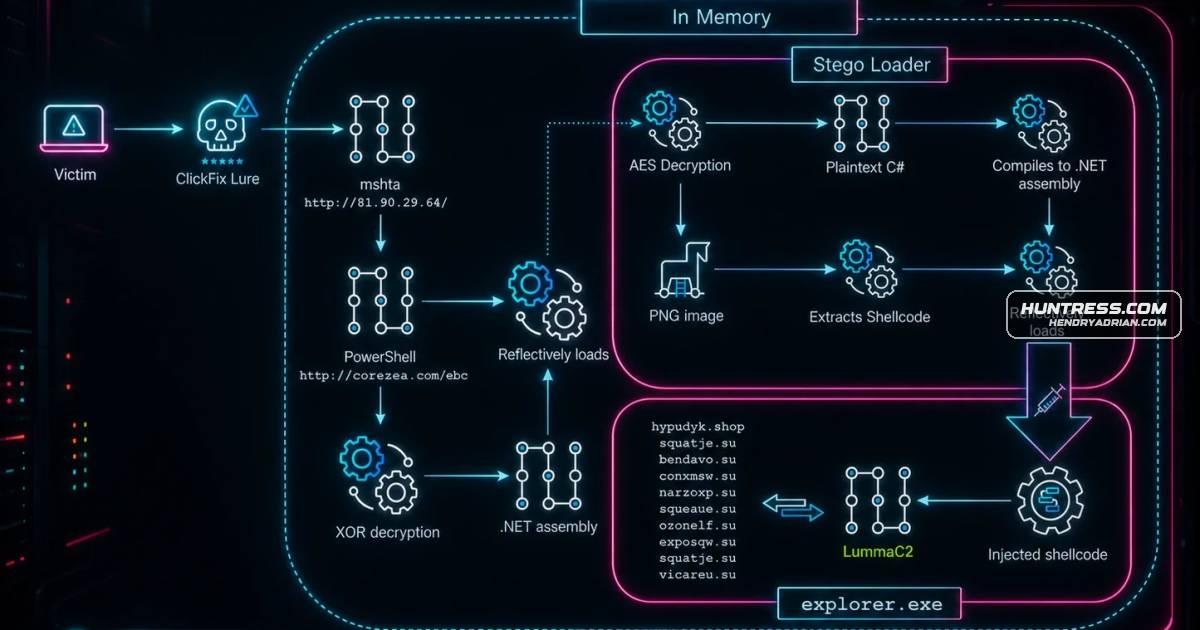
Summary
Huntress traced ClickFix lures to a multi-stage .NET loader that extracts Donut-packed shellcode hidden in PNG pixel data, then injects infostealers including LummaC2 and Rhadamanthys. Lures mimic verification checks or Windows Update.
Key points
- Victims are tricked into opening the Windows Run box and pasting a clipboard-copied command that launches mshta.exe.
- The command leads to PowerShell and reflectively loaded .NET assemblies, with junk code and obfuscation used to complicate analysis.
- A loader decrypts an embedded PNG and extracts shellcode from its red pixel values using a custom steganography algorithm.
- The extracted Donut-packed shellcode is injected into a target process; observed final payloads include LummaC2 and Rhadamanthys.
- A newer lure imitates a full-screen Windows Update process, while earlier lures used fake human-verification prompts.
- Huntress reported that active lure domains remained as of November 19, after Operation Endgame takedowns were announced, but said the associated Rhadamanthys payload appeared no longer to be hosted.
- Recommended defenses include blocking the Run prompt, training users not to paste commands from prompts, and monitoring suspicious process lineage and RunMRU registry activity.
Article Details
- Attack Vectors
- ClickFix social engineering lures prompt victims to open the Windows Run dialog and paste and execute a command copied to the clipboard.
- The command uses mshta.exe to retrieve a JScript payload, which runs PowerShell code that decrypts and reflectively loads .NET assemblies.
- A .NET loader decrypts a PNG resource and extracts Donut-packed shellcode from pixel data using a custom steganographic algorithm, then injects it into a process.
- A fake Windows Update lure displays a full-screen update animation before prompting users to run the copied command.
- Defensive Notes
- Disable the Windows Run prompt through Registry changes or Group Policy.
- Train users that legitimate CAPTCHA or Windows Update processes do not require pasting and running commands.
- Monitor EDR telemetry for explorer.exe spawning mshta.exe, powershell.exe, or other living-off-the-land binaries with unexpected command lines.
- Review the RunMRU Registry artifact at HKCU\Software\Microsoft\Windows\CurrentVersion\Explorer\RunMRU when investigating potential compromise.
Indicators of compromise
| Type | Indicator | Context |
|---|---|---|
| DOMAIN | cmevents[.]live | Windows Update ClickFix lure website listed among campaign indicators. |
| DOMAIN | cmevents[.]pro | Windows Update ClickFix lure website listed among campaign indicators. |
| DOMAIN | f6b04000[.]consent-verify[.]pages[.]dev | Malicious ClickFix lure website that hosted a human-verification prompt. |
| DOMAIN | galaxyswapper[.]pro | Windows Update ClickFix lure website listed among campaign indicators. |
| DOMAIN | hypudyk[.]shop | Domain listed as C2 infrastructure in the article's IOC section. |
| DOMAIN | virhtechgmbh[.]com | Windows Update ClickFix lure website listed among campaign indicators. |
| DOMAIN | xcvcxoipoeww[.]site | Windows Update ClickFix lure website associated with the reported payload chain. |
| DOMAIN | xmcniiadpwqw[.]site | Windows Update ClickFix lure website listed among campaign indicators. |
| DOMAIN | xoiiasdpsdoasdpojas[.]com | Reported as both a Windows Update ClickFix lure domain and a stage-two payload host. |
| DOMAIN | xpoalswwkjddsljsy[.]com | Windows Update ClickFix lure website listed among campaign indicators. |
| URL | hxxp[:]//141[.]98[.]80[.]175/ercx.dat | Stage-one mshta payload URL used in the Windows Update ClickFix campaign. |
| URL | hxxp[:]//141[.]98[.]80[.]175/gpsc.dat | Stage-one mshta payload URL used in the Windows Update ClickFix campaign. |
| URL | hxxp[:]//141[.]98[.]80[.]175/one.dat | Stage-one mshta payload URL reported in the Windows Update ClickFix campaign. |
| URL | hxxp[:]//141[.]98[.]80[.]175/rtdx.dat | Stage-one mshta payload URL used in the Windows Update ClickFix campaign. |
| URL | hxxp[:]//141[.]98[.]80[.]175/tick.odd | Stage-one mshta payload URL used in the Windows Update ClickFix campaign. |
| URL | hxxp[:]//141[.]98[.]80[.]175/very.dat | Stage-one mshta payload URL copied to the clipboard by the Windows Update lure. |
| URL | hxxp[:]//81[.]90[.]29[.]64/ebc/rps.gz | Stage-one mshta URL used to retrieve the ClickFix JScript payload. |
| URL | hxxp[:]//corezea[.]com/ebc | Stage-two URL hosting PowerShell code in the ClickFix execution chain. |
| URL | hxxp[:]//securitysettings[.]live | Stage-two PowerShell URL used in the Windows Update ClickFix chain. |
| URL | hxxp[:]//xoiiasdpsdoasdpojas[.]com | Stage-two PowerShell URL used in the Windows Update ClickFix chain. |
MITRE ATT&CK
T1027.003 · SteganographyThe loader conceals shellcode in PNG pixel data using steganography.T1027.013 · Encrypted/Encoded FileThe stage-one lure's JavaScript is encrypted and dynamically loaded to evade string-based detection.T1055.002 · Portable Executable InjectionThe loader uses VirtualAllocEx, WriteProcessMemory, and CreateRemoteThread to inject shellcode into a target process.T1055.012 · Process HollowingExtracted shellcode is injected into explorer.exe.T1059.001 · PowerShellThe retrieved PowerShell code runs in memory as part of the loader chain.T1059.007 · JavaScriptThe initial mshta.exe command executes a JScript payload.T1140 · Deobfuscate/Decode Files or InformationThe chain decrypts PowerShell, .NET assembly, configuration, image, and shellcode data before execution.T1204.002 · Malicious FileVictims are tricked into pasting and running a malicious command through the Windows Run prompt.T1620 · Reflective Code LoadingThe loader reflectively loads decrypted .NET assemblies in memory.
People
Malware
LummaC2chain, originating from a ClickFix lure, that leads to the delivery of infostealing malware, including LummaC2 and Rhadamanthys. A notable discovery during analysis was the campaign's use of steganography to concealRhadamanthysfrom a ClickFix lure, that leads to the delivery of infostealing malware, including LummaC2 and Rhadamanthys. A notable discovery during analysis was the campaign's use of steganography to conceal the final