
Huntress Traces Three IIS-Linked Attacks and the Attacker’s Trial-and-Error Tactics
Summary
Huntress analyzed three IIS-linked incidents, using endpoint and Windows logs to trace attempted malware execution, Windows Defender changes, and failed persistence. Similar tactics and infrastructure suggest the incidents may share an actor.
Key points
- Huntress connected three incidents through similar tactics, malware naming, operating folders, and IP addresses, suggesting—but not confirming—a common actor.
- The incidents began with command execution through IIS web server processes after POST requests to web pages; the researchers said a web application flaw may have enabled access.
- In the first incident, Windows Defender blocked an attempted certutil download. The attacker tried other executables, returned after detection and quarantine, and later deployed a renamed GotoHTTP tool.
- In the second and third incidents, the attacker added Windows Defender exclusions before deploying malware identified as SparkRAT.
- Attempts to establish persistence by creating a Windows service failed in the second and third incidents.
- Huntress’s analysis shows the actor changing tactics after earlier setbacks, while also repeating techniques that failed.
Article Details
- Attack Vectors
- Commands were executed through Microsoft IIS worker process w3wp.exe after POST requests to web application pages; the article suggests flaws in the page code may have been exploited, but does not establish the specific vulnerability.
- An attacker attempted to download and run agent.exe using certutil.exe; Windows Defender blocked that command in Incident 1.
- In Incidents 2 and 3, PowerShell commands added Windows Defender exclusions before follow-on activity.
- The attacker attempted persistence by creating a Windows service named WindowsUpdate to launch dllhost.exe; the service failed to start.
- Defensive Notes
- Monitor IIS-originated process activity and POST requests, and correlate IIS logs with EDR telemetry and Windows Event Logs.
- Alert on unexpected certutil.exe downloads and execution of files from C:\Users\Public.
- Monitor unauthorized PowerShell changes to Windows Defender exclusions and investigate new exclusions promptly.
- Investigate suspicious service creation and failures, including services configured to launch executables from unusual paths.
- The article reports that endpoint isolation and quarantine interrupted attacker activity in Incident 1.
Indicators of compromise
| Type | Indicator | Context |
|---|---|---|
| IPV4 | 103[.]36[.]25[.]169 | Client IP address in an IIS POST log entry preceding detected activity in Incident 2. |
| IPV4 | 103[.]36[.]25[.]171 | Client IP address associated with the December 8 return in Incident 1 and an active connection before endpoint isolation. |
| IPV4 | 110[.]172[.]104[.]95 | IP address used to host the attempted agent.exe download in Incident 1; the article reports a malware-associated reputation. |
| IPV4 | 188[.]253[.]121[.]101 | Client IP address in an IIS POST log entry preceding detected activity in Incident 3. |
| IPV4 | 188[.]253[.]126[.]202 | Client IP address appearing in web server logs associated with attacker activity in Incidents 1 and 2. |
| IPV4 | 188[.]253[.]126[.]205 | Client IP address in the IIS log entry associated with initial command execution in Incident 1. |
| SHA256 | 272de450450606d3c71a2d97c0fcccf862dfa6c76bca3e68fe2930d9decb33d2 | SHA256 hash of test.exe, identified in the article as ShellcodeRunner. |
| SHA256 | 66a28bd3502b41480f36bd227ff5c2b75e0d41900457e5b46b00602ca2ea88cf | SHA256 hash associated with agent.exe and dllhost.exe in Incidents 2 and 3; the article identifies the file as SparkRAT. |
| SHA256 | 909460d974261be6cc86bbdfa27bd72ccaa66d5fa9cbae7e60d725df13d7e210 | SHA256 hash of 815.exe, an executable retrieved from the Incident 1 endpoint. |
MITRE ATT&CK
T1012 · Query RegistryThe attacker ran Get-MpPreference and selected exclusion settings to check Defender configuration.T1016 · System Network Configuration DiscoveryThe attacker ran ipconfig /all to enumerate network configuration.T1049 · System Network Connections DiscoveryThe attacker ran netstat -an to inspect network connections.T1059.001 · PowerShellPowerShell commands added and checked Windows Defender exclusions in Incidents 2 and 3.T1059.003 · Windows Command ShellCommands including whoami.exe, netstat, net user, and ipconfig were run through cmd.exe via the IIS web server process.T1087.001 · Local AccountThe attacker ran net user admin$ during post-access enumeration.T1105 · Ingress Tool TransferThe attacker attempted to use certutil.exe to download a resource from 110.172.104[.]95 to C:\Users\Public\agent.exe.T1543.003 · Windows ServiceThe attacker used sc.exe to create a Windows service named WindowsUpdate configured to launch dllhost.exe; the service failed to start.T1562.001 · Disable or Modify ToolsPowerShell Add-MpPreference commands added Defender exclusions for paths and file extensions in Incidents 2 and 3.T1564.001 · Hidden Files and Directoriesattrib.exe set the hidden and system attributes on the copy of agent.exe named dllhost.exe.
Malware
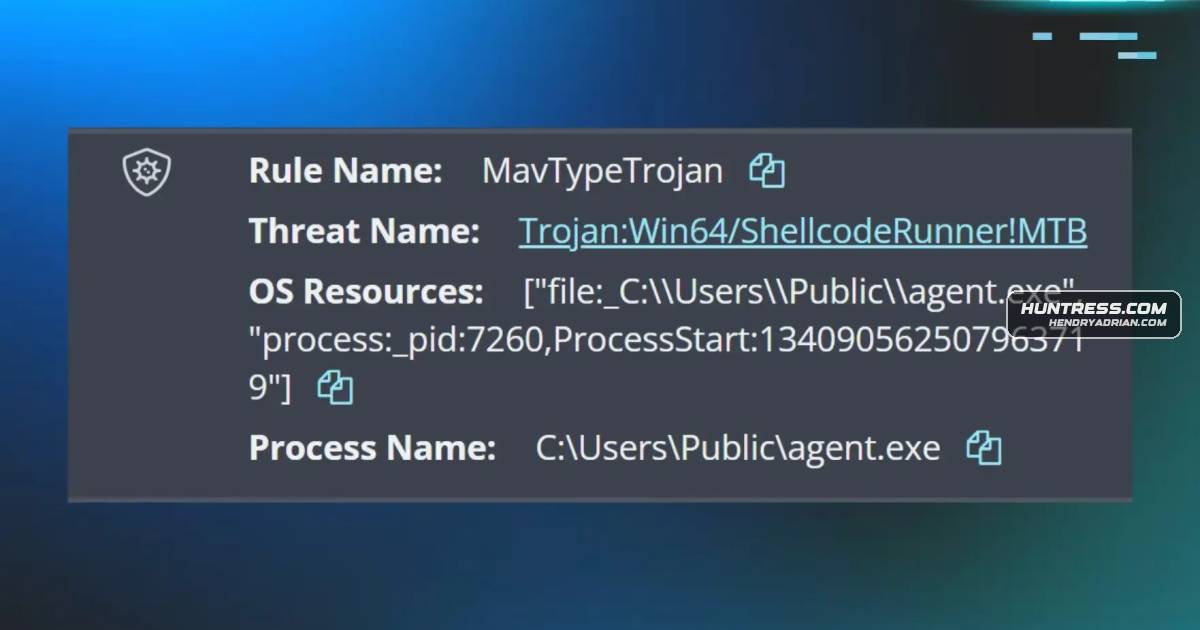
ShellcodeRunnerThen, almost 48 hours later, following a Windows Defender update, the file was detected as “ShellcodeRunner” and quarantined, as illustrated in Figure 2.SparkRATBased on hash comparison, the file dllhost.exe is a copy of agent.exe, which in this incident, was identified via VirusTotal as SparkRAT.
Vendors
HuntressFor example, we saw a series of threat actor fumbles in a November incident that the Huntress team highlighted, which involved the Velociraptor digital forensics and incident response (DFIR) platform.MicrosoftOn November 6, Huntress reported an attack on a residential development firm that originated via the Microsoft Internet Information Server (IIS) web server process, w3wp.exe.
Products
GotoHTTPThis time, the client IP address in the web server logs was 103.36.25.171, and a renamed copy of the freely available GotoHTTP RMM tool was dropped on the endpoint.VelociraptorFor example, we saw a series of threat actor fumbles in a November incident that the Huntress team highlighted, which involved the Velociraptor digital forensics and incident response (DFIR) platform.Windows Defenderthreat actors behaved behind-the-scenes when confronted with “challenges” in the environment (like Windows Defender) or how they made missteps (such as failing to start executables).Windows SysmonThis endpoint had the Microsoft Sysmon system monitoring application installed, alongside the Huntress EDR product.
Tools
Industries
ManufacturingOn November 17, Huntress reported an attack on a manufacturing customer that originated via the Microsoft Internet Information Server (IIS) web server process, w3wp.exe; this attack included security tools beingResidential developmentOn November 6, Huntress reported an attack on a residential development firm that originated via the Microsoft Internet Information Server (IIS) web server process, w3wp.exe.