
CYFIRMA Identifies Three Untested Security Risks in AI Agent Infrastructure
Summary
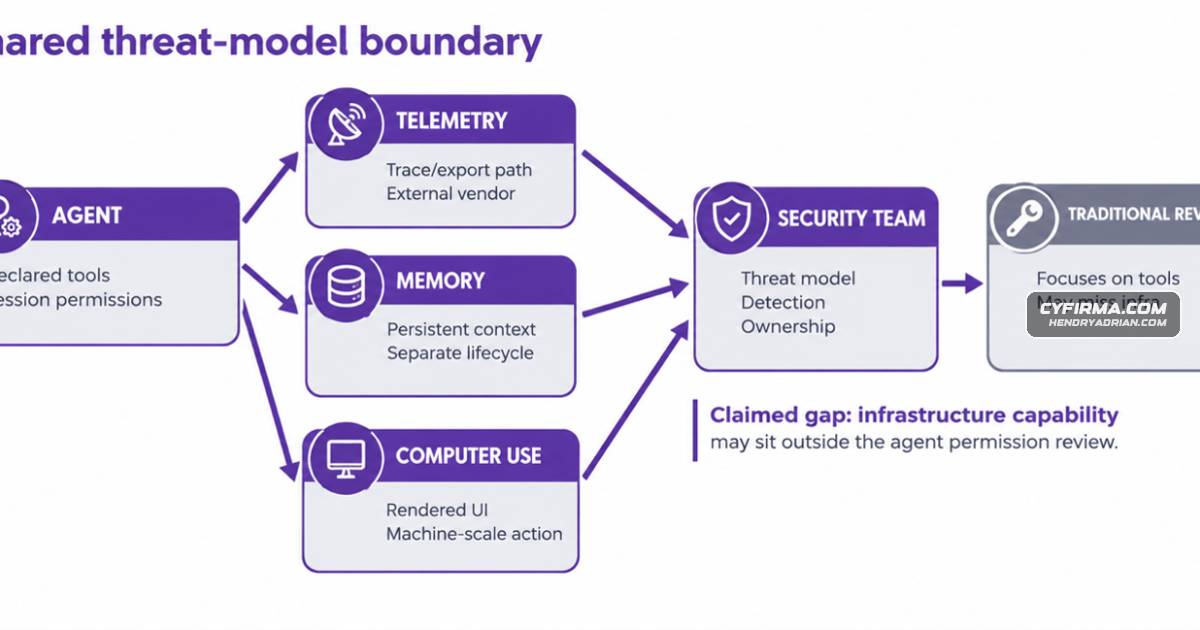
CYFIRMA analyzes risks involving agent telemetry, persistent memory and computer-use automation. It presents documented capabilities and test plans, but says the proposed attack mechanisms were not tested and are not reported incidents.
Key points
- The report examines three separate areas: telemetry export, memory that persists beyond a conversation, and computer-use agents operating at machine scale.
- Trace Drain hypothesizes that compromised code could redirect or augment telemetry, potentially using an approved observability channel; the proposed lab validation was not executed.
- The report says saved memories can have a different lifecycle from their source conversations, creating a forensic challenge; it does not establish that memory poisoning works against the named products.
- Computer-use agents may reduce the rate-limiting effect of UI friction, but the report says this needs measurement and does not claim they bypass authorization.
- The findings are architectural analyses, not incident reports or demonstrated attacks; the report distinguishes documented facts from inference and untested hypotheses.
- Recommendations include routing telemetry through an organization-controlled collector, limiting application egress, preserving memory-write provenance, and using server-side controls and action budgets.
Article Details
- Publisher
- CYFIRMA
- Scope
- Architectural analysis of agent telemetry, persistent-memory lifecycle asymmetry, and computer-use automation; not an incident report or controlled capability evaluation.
- Sample Size
- No proof of concept, controlled attack, vendor-production test, or computer-use capability evaluation was executed.
- Recommendations
- Route agent telemetry through an organization-controlled collector, restrict application egress to that collector, keep vendor credentials there, and redact sensitive content before export.
- Monitor telemetry endpoint, credential, exporter, proxy, certificate, and disable-setting changes; forward alerts outside the application's trust domain and correlate independent network and endpoint evidence.
- Pin dependencies, verify package hashes and provenance, maintain an SBOM, apply release-age cooldowns, and detect new or modified executable .pth files.
- Define memory provenance, review, deletion, and audit requirements; deliberately align memory and session-log retention or preserve evidence linking their different lifecycles.
- Set computer-use agent action, volume, and time budgets, and independently enforce server-side rate limiting or bot-management controls rather than relying on UI friction.
MITRE ATT&CK
T1195 · Supply Chain CompromiseThe report cites the LiteLLM and Bitwarden CLI package compromises as supply-chain code-execution precedents for the Trace Drain attacker precondition, not as evidence of telemetry manipulation.T1567 · Exfiltration Over Web ServiceThe proposed Trace Drain mechanism would move sensitive trace content through an approved observability web service, potentially to an attacker-controlled tenant. This exfiltration hypothesis and its claimed detection advantage were not tested.
Vendors
AnthropicAnthropic documents that memory persists across chats and that deleting or expiring a conversation does not itself remove related memory entries [C].Bitwardencapabilities; independent reporting on the March 2026 LiteLLM supply-chain incident and the April 2026 Bitwarden CLI package compromise; current MITRE ATT&CK, MITRE ATLAS, and OWASP GenAI 2025 security mappings; andOpenAIOpenAI documents that saved memories are stored separately from chat history and are not necessarily deleted when the source chat is deleted [C].
Products
Bitwarden CLIindependent reporting on the March 2026 LiteLLM supply-chain incident and the April 2026 Bitwarden CLI package compromise; current MITRE ATT&CK, MITRE ATLAS, and OWASP GenAI 2025 security mappings; andLiteLLMfor tracing, memory, and computer-use capabilities; independent reporting on the March 2026 LiteLLM supply-chain incident and the April 2026 Bitwarden CLI package compromise; current MITRE ATT&CK, MITREOpenTelemetry CollectorRoute agent telemetry through an organization-controlled OpenTelemetry Collector and restrict application egress to that collector only.OpenTelemetry PythonThis plan validates one mechanism in one lab against OpenTelemetry Python with the OTLP HTTP exporter.