
StepSecurity Details Controls for Routing CI and Developer Installs Through Private Registries
Summary
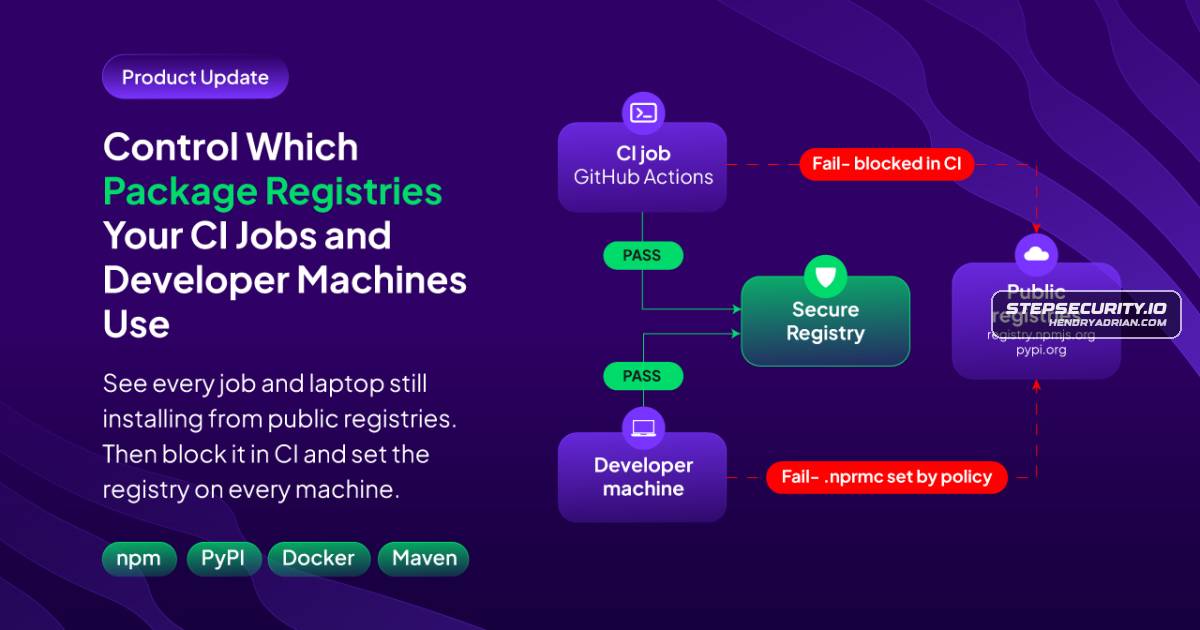
StepSecurity describes controls that detect public-registry requests from CI jobs and inspect developer-machine package settings, plus egress blocking, centralized configuration and registry policies to reduce exposure to compromised packages.
Key points
- The CI control checks actual outbound network calls and flags attempts to reach public registries, including calls blocked by network policy; job details can identify the process making a request.
- The developer-machine control reads effective npm and pip registry settings and reports the configuration source; it does not monitor network traffic.
- Developer-machine checks are tenant-wide and evaluated separately for each device and package manager.
- StepSecurity recommends blocking public registry egress in CI and centrally configuring developer machines to use a private registry.
- The article describes Secure Registry policies including cooldown periods, compromised-package blocking and typosquatting protection.
- The article cites malicious axios versions, two litellm releases and a republished @bitwarden/cli package as examples of package supply-chain risks.
Article Details
- Event Type
- Security guidance and product-control overview addressing public package registry use in CI jobs and developer machines.
- Impact
- The article describes malicious package releases that delivered credential-stealing code, including a republished @bitwarden/cli package that allegedly harvested SSH keys, cloud credentials, and GitHub tokens and used the tokens to inject malicious workflows into CI. It presents registry visibility and enforcement controls intended to reduce exposure to malicious package versions.
MITRE ATT&CK
Vendors
Products
AxiosThis year that simple fact put malicious code behind some very familiar names. Malicious versions of axios, the HTTP client downloaded tens of millions of times every week, were published to npm. Two litellmBitwarden CLIthe published wheels, so there was nothing for repository scanning to look at. And a republished @bitwarden/cli ran a credential stealer on the developer machine that did the install, harvested SSH keys, cloudDev Machine GuardCategory: Developer Machines. Severity: Medium. Evaluated by Dev Machine Guard.Harden Runneris behavioral, not declarative. It does not read your workflow file and look for a registry setting. Harden Runner monitors the job's actual outbound network calls during its runs, so a job that sets a privateLiteLLMof axios, the HTTP client downloaded tens of millions of times every week, were published to npm. Two litellm releases on PyPI carried an identical credential stealer, hidden two different ways inside the publishedStepSecurity Secure Registrywhether that is JFrog Artifactory, Sonatype Nexus, Cloudsmith, Google Artifact Registry, or StepSecurity Secure Registry, so that policies like cooldown periods and compromised package blocking apply before a