Analysis Uncovers “Zenith” Backdoor Hidden in Signed QuartzLine PDF Viewer
Summary
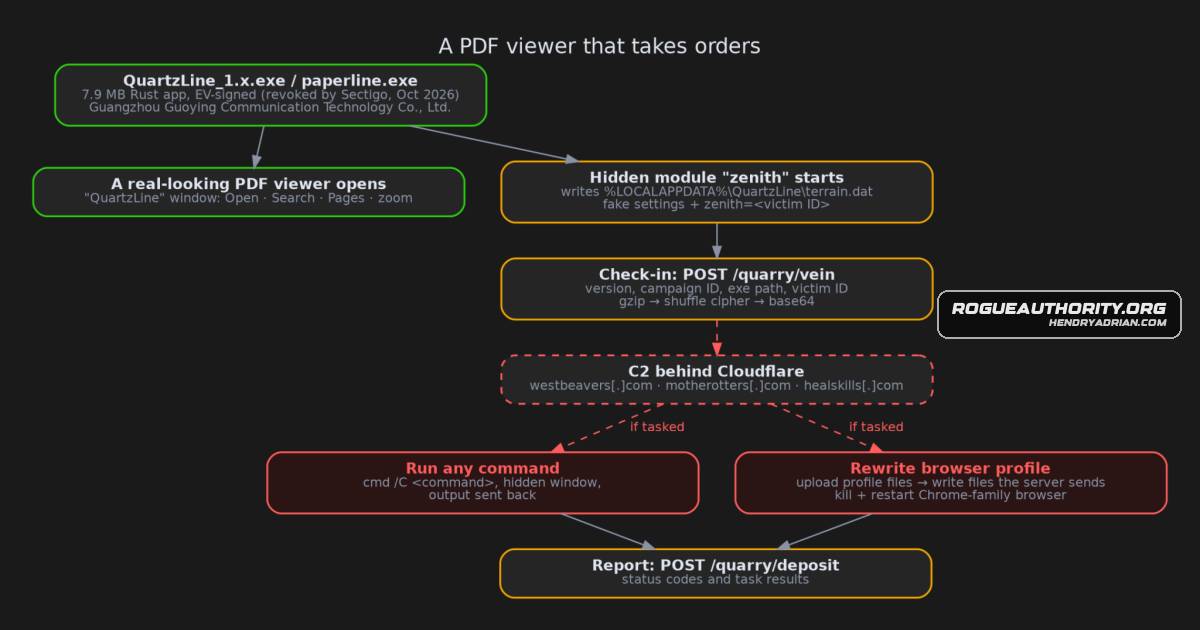
Analysis of a signed QuartzLine PDF viewer found a hidden backdoor that checks in with C2 servers and can run commands or alter browser profiles. Four decrypted sessions showed no tasks; Sectigo has revoked the signing certificate.
Key points
- The Windows viewer contains a hidden Rust module called “zenith,” which assigns the machine an ID and checks in with one of three C2 domains: westbeavers[.]com, motherotters[.]com, or healskills[.]com.
- Code analysis shows the server can direct zenith to run Windows commands and read or replace Chromium-family browser profile files. Neither task was observed in the analyzed sessions.
- Researchers decoded traffic from four of seven sandbox sessions. All four decrypted server replies indicated there was no work; three other sessions could not be decrypted.
- The sample uses compression and custom scrambling inside HTTPS. The article says the method is obfuscation rather than strong cryptography.
- The sample was EV-signed using a certificate issued to Guangzhou Guoying Communication Technology Co., Ltd.; Sectigo had revoked it as of 9 October 2026.
- Public sandbox scores were low or clean, but the analysis says the working PDF viewer, quiet C2 behavior, and scrambled traffic obscured the backdoor’s capabilities.
- The article recommends checking for %LOCALAPPDATA%\QuartzLine\terrain.dat, requests to /quarry/vein or /quarry/deposit, and command-shell or browser-restart activity from a document viewer.
Article Details
- Attack Vectors
- The signed Windows executable presents itself as a working PDF viewer while concealing the unrelated zenith backdoor module.
- zenith checks in with its C2 over HTTPS using the paths /quarry/vein and /quarry/deposit; the traffic is additionally compressed, XOR-chained, bit-rotated, shuffled, and Base64-encoded.
- According to code analysis, the server can instruct zenith to run commands through cmd /C and return their output.
- According to code analysis, the server can direct zenith to read or replace browser-profile files, close the browser, and restart it with the selected profile. No such task was observed during analysis.
- Defensive Notes
- Look for %LOCALAPPDATA%\QuartzLine\terrain.dat and the zenith= entry in settings-style files.
- Alert on POST requests to /quarry/vein or /quarry/deposit, including requests with no User-Agent header.
- Watch for cmd.exe /C launched by a document viewer and for non-browser processes that run taskkill /F against a browser before restarting it with --user-data-dir.
- Block the reported C2 domains and use the reported file hashes to search for the sample.
- Treat a mismatch between an application's file details, signer, and displayed name as suspicious; the article reports that Sectigo revoked the certificate used to sign this sample.
Indicators of compromise
| Type | Indicator | Context |
|---|---|---|
| DOMAIN | healskills[.]com | Reported C2 domain used by zenith to check in. |
| DOMAIN | motherotters[.]com | Reported C2 domain used by zenith to check in. |
| DOMAIN | westbeavers[.]com | Reported C2 domain used by zenith to check in. |
| MD5 | d62d4b7811e37ce789b40ff9343e3458 | MD5 hash reported for the malicious QuartzLine sample. |
| SHA256 | 7f1db334fd3302cf98dd4afddf6f90e98e2a496fe7e86bf1832b89d02f3d73c3 | SHA-256 hash reported for the malicious QuartzLine sample. |
MITRE ATT&CK
T1027 · Obfuscated Files or InformationThe C2 messages are compressed and then obfuscated using chained XOR, bit rotations, a seeded shuffle, and Base64 encoding.T1041 · Exfiltration Over C2 ChannelThe analyzed code can send command output and requested browser-profile files back to the C2 server; the article says these tasks were not observed in live traffic.T1059.003 · Windows Command ShellThe backdoor's command handler can run server-supplied commands through cmd /C and return the output.T1071.001 · Web Protocolszenith checks in with its C2 over HTTPS using the reported /quarry/vein and /quarry/deposit paths.
Vendors
Products
EdgeA separate handler works with a browser profile folder laid out the way Chromium-based browsers (Chrome, Edge and similar) lay theirs out.Google ChromeIt can also tell it to tamper with a Chrome-family browser profile.QuartzLineIt opens a real-looking PDF viewer called QuartzLine, with a working PDF parser built in.
Tools
ANY.RUNTools used: Malcat (including KesaKode), capstone, Python, capa, FLOSS, StringSifter, speakeasy, a locally sandboxed Wine run, the ANY.RUN sandbox and Hatching Triage.Hatching TriageTools used: Malcat (including KesaKode), capstone, Python, capa, FLOSS, StringSifter, speakeasy, a locally sandboxed Wine run, the ANY.RUN sandbox and Hatching Triage.KesaKodeTools used: Malcat (including KesaKode), capstone, Python, capa, FLOSS, StringSifter, speakeasy, a locally sandboxed Wine run, the ANY.RUN sandbox and Hatching Triage.MalcatTools used: Malcat (including KesaKode), capstone, Python, capa, FLOSS, StringSifter, speakeasy, a locally sandboxed Wine run, the ANY.RUN sandbox and Hatching Triage.