
Trojanized Q-Dir and DesktopOK Downloads Deliver Python RAT
Summary
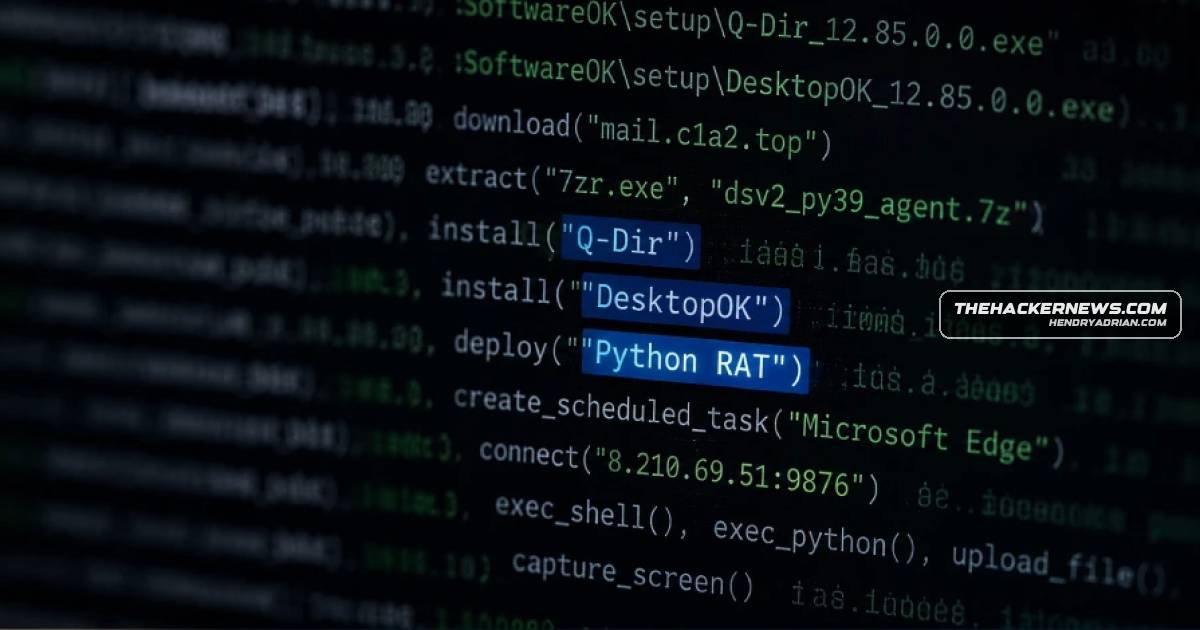
AhnLab reported that official Q-Dir and DesktopOK installers and updates were trojanized to install a Python RAT. It can run commands, transfer files, capture screenshots, collect system data, and profile security products.
Key points
- AhnLab said malicious files were distributed through the official SoftwareOK site and could also be generated during updates of legitimate installations.
- Installer hash discrepancies and added code to download and automatically execute files were used to identify poisoned versions; the article does not specify version numbers.
- The installers download two payloads from mail.c1a2[.]top; 7-Zip extracts and runs the Python RAT.
- A scheduled task impersonating Microsoft Edge launches py_client_dsv2.py for persistence. The RAT connects to 8.210.69[.]51:9876 for commands.
- The RAT can execute shell commands and Python code, transfer files, capture screenshots, and collect system metadata.
- It checks running processes for security products and sends identified products to the C2 server, which AhnLab says could help attackers plan later stages or evade detection.
- No threat actor has been identified. Chinese-language code comments suggest, but do not establish, a Chinese-speaking environment. AhnLab advised checking installer hashes and systems for RAT traces; reinstalling the programs alone may not remove it.
Article Details
- Attack Vectors
- Trojanized Q-Dir and DesktopOK installers distributed through the official SoftwareOK website, including files generated during direct downloads and updates.
- The malicious installers launch the legitimate programs while downloading payloads from an external server; 7-Zip extracts and runs the Python-based RAT.
- The RAT establishes persistence through a scheduled task impersonating Microsoft Edge and communicates with its C2 server to receive commands.
- The RAT can execute shell commands and Python code, transfer files, capture screenshots, collect system metadata, and report detected security software to the C2 server.
- Defensive Notes
- Verify the hashes of downloaded Q-Dir and DesktopOK installers, especially files installed or updated recently.
- Check for suspicious Python execution environments, scheduled tasks, related files, and external network communications; uninstalling and reinstalling the programs may not remove an installed RAT.
- Update antivirus software and perform a full system scan.
Indicators of compromise
| Type | Indicator | Context |
|---|---|---|
| DOMAIN | mail[.]c1a2[.]top | External server used to deliver two payloads for the trojanized installers. |
| IPV4 | 8[.]210[.]69[.]51 | C2 server contacted by the RAT to receive tasks and run them; the article gives port 9876. |
MITRE ATT&CK
T1036.005 · Match Legitimate Resource Name or LocationThe scheduled task impersonates Microsoft Edge to make the RAT activity less noticeable.T1053.005 · Scheduled TaskA scheduled task configured to launch py_client_dsv2.py provides persistence.T1057 · Process DiscoveryThe RAT gathers a list of running processes.T1059.006 · PythonThe RAT executes Python code, including through the py_client_dsv2.py script.T1082 · System Information DiscoveryThe RAT collects system metadata based on attacker-issued commands.T1105 · Ingress Tool TransferThe malicious installer downloads two payloads from an external server, and the RAT is retrieved and deployed.T1113 · Screen CaptureThe RAT can capture screenshots.T1195.002 · Compromise Software Supply ChainQ-Dir and DesktopOK installation files distributed through the official SoftwareOK website were tampered with; the replacement mechanism is unknown.T1518.001 · Security Software DiscoveryThe RAT checks running processes against an internal list of security products.
Products
7-ZipThe attack chain is fairly straightforward in that it uses the 7-Zip tool binary to extract and run the Python RAT. The malware then sets up persistence on the host by means of a scheduled task that impersonatesDesktopOKCybersecurity researchers have disclosed details of a software supply chain attack that has tampered with Q-Dir and DesktopOK installation files distributed via the official SoftwareOK website.Microsoft EdgeRAT. The malware then sets up persistence on the host by means of a scheduled task that impersonates Microsoft Edge to fly under the radar. The task is configured to execute the RAT by launching a Python script namedQ-DirCybersecurity researchers have disclosed details of a software supply chain attack that has tampered with Q-Dir and DesktopOK installation files distributed via the official SoftwareOK website.