
Dragos Finds Customer Prompts Exposed Across AI Provider Routes
Summary
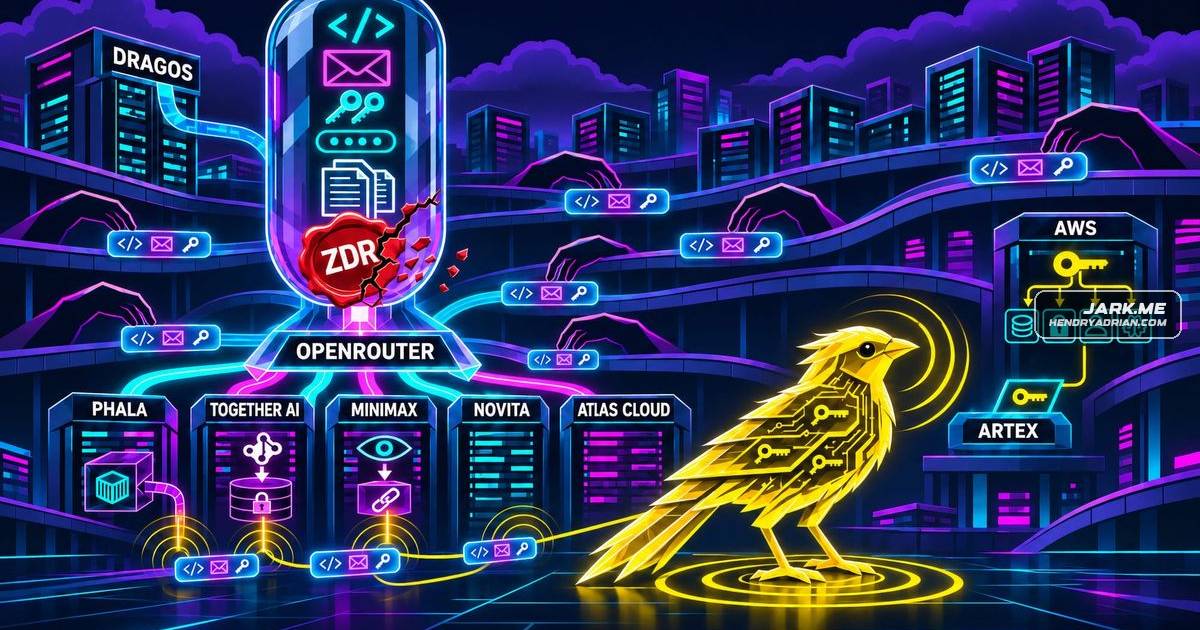
Dragos says canary tests found prompts accessed across AI-provider routes, including requests marked zero data retention. Phala and Together AI disclosed separate exposures; Phala reported 152,092 requests reached a compromised deployment. Some provider links remain un.
Key points
- Dragos says it sent about two million prompts containing unique canary links and credentials to AI services from July to November 2026, finding access at three providers. Canary hits show those seeded prompts were accessed, not the full scope of exposure.
- Dragos found that some accessed requests were marked Zero Data Retention (ZDR), but the tests did not establish that every customer prompt leaked.
- Phala reported that an intruder compromised an experimental DeepSeek deployment handling OpenRouter traffic from October 21 to November 1. Phala said 152,092 requests reached the deployment.
- Phala said a default Grafana password and an unauthenticated virtual-machine management interface enabled the intrusion; a rootkit read incoming requests. Phala does not know where the data went.
- Phala also reported that the intruder obtained its legacy key-management service’s root key. As of November 21, 2,179 of 2,271 affected confidential virtual machines had moved to new keys.
- Together AI said an unauthorized party downloaded stored prompt samples after an AI coding agent committed a repository credential to public code. The provider was still assessing what information was exposed and which customers needed notification.
- Novita and Atlas Cloud reported MiniMax-related request routing or link access, but why the links were opened remains unresolved. OpenRouter dropped three providers and removed 125 model listings from ZDR eligibility.
Article Details
- Attack Vectors
- An intruder used a default Grafana administrator password and an unauthenticated local management interface to alter a Phala confidential virtual machine's startup script.
- A public code commit exposed a credential for Together AI's private prompt-sample repository, allowing an unauthorized party to download the samples.
- Attackers tested cloud credentials found in leaked prompts, searched for secrets, and attempted to enable hosted AI models.
- Some marketplace sellers retained prompts through request logging and subsequently tried credentials contained in them.
- Novita and Atlas Cloud reported that links in prompts were opened after requests reached MiniMax; the reason for the access remains unconfirmed.
- Defensive Notes
- Rotate credentials sent to the affected Phala deployment or through providers about which OpenRouter notified customers; treat secrets sent through the identified MiniMax routes as exposed.
- Restrict router provider lists, disable fallback providers, deny data collection where supported, and document downstream handling in contracts.
- Plant canary credentials, use short-lived and narrowly scoped credentials, and block secrets from repository pushes.
- Monitor CloudTrail for unfamiliar Bedrock access, new Bedrock keys and IAM users, and the artex-agent and artex-judge-r121 user agents.
- Phala advises dstack operators to upgrade to at least 0.5.13 or 0.6.2, authenticate VMM management endpoints, and enforce key-release policies.
Indicators of compromise
| Type | Indicator | Context |
|---|---|---|
| IPV4 | 159[.]223[.]110[.]159 | Phala lists this address as a threat actor source in the November intrusion. |
| IPV4 | 82[.]29[.]131[.]62 | Phala identified this address as the source of the first recorded scan against its hosts in the November intrusion. |
MITRE ATT&CK
T1005 · Data from Local SystemThe containerized rootkit read request bodies reaching the compromised DeepSeek deployment.T1021.004 · SSHA person in France manually tried prompt-derived passwords against a canary SSH server as root.T1078 · Valid AccountsAn unauthorized party used an exposed repository credential to access Together AI's private prompt-sample repository.T1078.001 · Default AccountsThe Phala intruder logged into a Grafana monitoring virtual machine using its default administrator password.T1078.004 · Cloud AccountsThe canary key thief tested stolen AWS credentials and used working keys to make cloud API calls.T1098.004 · SSH Authorized KeysA modified prelaunch script added the intruder's SSH key to the DeepSeek virtual machine's authorized keys.T1136.003 · Cloud AccountThe canary key thief created IAM users to retain access to AWS accounts.T1190 · Exploit Public-Facing ApplicationIn the later Phala KMS intrusion, the actor used unauthenticated gateway and attestation paths to reach management services and change state.T1496.004 · Cloud Service HijackingThe canary key thief attempted to enable Bedrock models and created Bedrock keys using stolen cloud credentials.T1530 · Data from Cloud StorageThe unauthorized party downloaded Together AI's stored prompt samples from a private Hugging Face repository.T1552.001 · Credentials In FilesAn unauthorized party obtained a private repository credential that an AI coding agent had committed to public code.T1555.006 · Cloud Secrets Management StoresA virtual machine impersonating the Phala Cloud gateway obtained an application key, and the legacy KMS released its root key to callers including the threat actor.T1610 · Deploy ContainerThe Phala intruder left a rootkit running in a container that read incoming requests.T1619 · Cloud Storage Object DiscoveryThe canary key thief listed S3 storage buckets using working credentials.
People
Vendors
AtlasCloudPhala and Together AI, which run AI models for customers, have published notices. So have Novita and Atlas Cloud, which resell access to models from other developers.MiniMaxNews notes. Neither company has said whether the two lists match. Novita and Atlas Cloud both point to MiniMax, a Chinese AI developer, as the place where secret links planted in the bait prompts were opened afterNovitaservice says. Phala and Together AI, which run AI models for customers, have published notices. So have Novita and Atlas Cloud, which resell access to models from other developers.OpenRouterOpenRouter, a service routing customers' AI requests to a pool of outside providers, dropped three of them on November 22. OpenRouter also stopped offering ZDR on 125 model listings and notified all potentially affectedPhalaPrompts often contain source code, internal messages, business plans, and passwords. At Phala, a provider selling AI on hardware meant to keep customer data sealed, an intruder could read the 152,092 requests sent toTogether AIcustomers. The findings showed no breach of OpenRouter itself, the routing service says. Phala and Together AI, which run AI models for customers, have published notices. So have Novita and Atlas Cloud, which
Products
DeepSeek V4 Flash 0731On October 20, Phala started an experimental DeepSeek V4 Flash 0731 deployment on GPU3, a new graphics processor server, and the deployment took real OpenRouter traffic before getting production security controls. A CVMdstackChinese developer DeepSeek. Phala runs each customer workload in a confidential virtual machine (CVM) on dstack, its open framework, behind trusted execution environment (TEE) hardware. The TEE hardware worked asGrafanathe deployment took real OpenRouter traffic before getting production security controls. A CVM running Grafana monitoring software, set up beside the deployment, still had its default administrator password. At 20:15OpenRouterOpenRouter, a service routing customers' AI requests to a pool of outside providers, dropped three of them on November 22. OpenRouter also stopped offering ZDR on 125 model listings and notified all potentially affected
Tools
Countries
Chinaboth eCrime, financially motivated cyber crime, and espionage. Microsoft tied ARTEX use to Storm-0940, a China state-aligned adversary active since 2021, as earlier analysis of the framework records. A European UnionFranceSSH servers. A root password for an SSH server, aimed at hands-on intrusion. These caught a person in France typing logins by hand.United Stateshad their links fetched. The scraper typically arrived two or three days after the request. Several American companies resell the lab's models, and prompts sent to those resellers triggered the lab's scraper too.