
GTIG Finds Agentic AI Use Expanding Across Threat Operations
Summary
GTIG and Mandiant report threat actors using multi-agent frameworks to automate intrusions and vulnerability exploitation, LLMs for influence operations and phishing, and stolen cloud credentials for LLMJacking, based on incident response and threat tracking.
Key points
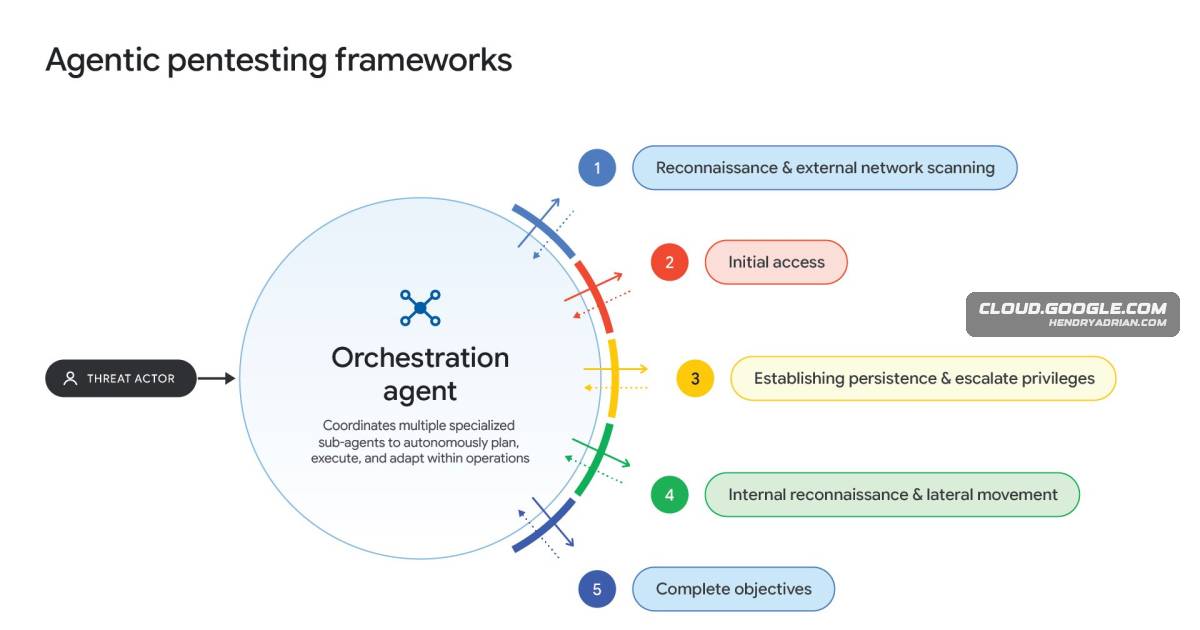
- GTIG observed CAIRN and PentAGI deployed in intrusions and tracked experimentation with CyberStrikeAI and HexStrike AI.
- A framework dubbed exploit_agent automated patch-difference analysis, exploit drafting and execution, and post-compromise tasks; server telemetry indicated interest in French media, entertainment, and education targets.
- The report describes LLM-assisted vulnerability research accelerating exploitation of patched flaws, alongside a rise in claimed but nonfunctional proof-of-concept exploits that defenders must verify.
- Mandiant investigated LLMJacking involving stolen credentials, session hijacking, and unauthorized cloud accounts; one bot or proxy service generated millions of LLM API calls in about 24 hours.
- GTIG observed influence-operation platforms using LLMs to generate personas and media and automate distribution; one platform was designed to manage over 100,000 accounts.
- In intrusions targeting cryptocurrency organizations, a suspected MIDNIGHT NEPTUNE cluster allegedly modified Claude Code configuration files to trigger the SOMBERMEME backdoor.
Article Details
- Publisher
- Google Threat Intelligence Group (GTIG) and Mandiant
- Report Period
- 2026; includes Q3 activity and subsequent observations, with the exact reporting window not disclosed
- Scope
- Adversary use of generative AI across cybercrime, espionage, and information operations; based on incident response, threat tracking, and platform defense observations.
- Sample Size
- Not disclosed
- Key Statistics
- Overall vulnerability disclosures and exploits nearly doubled between January and August 2026; the report does not provide the underlying counts.
- Monthly zero-day exploits averaged 8 in 2025 and 11 in 2026, then reached 22 in August 2026.
- Some LLMJacking incidents generated more than $100,000 in fraudulent charges in a single day; the most severe cases reached $1 million in cumulative resource abuse before remediation.
- A botnet or proxy service generated millions of LLM API calls in approximately 24 hours before the credentials were revoked.
- Observed LLM Mixer prices ranged from $0.10 to $25 per million tokens.
- Recommendations
- Use Google Security Operations behavioral and volumetric rulepacks to detect ARTEX activity.
- Apply the Mandiant hardening guide and architectural defense framework designed to counter LLM-enabled offensive tooling.
MITRE ATT&CK
T1068 · Exploitation for Privilege EscalationA threat actor exploited CVE-2026-40217, described as a LiteLLM sandbox escape, to elevate limited-access inference keys to full administrative credentials.T1078 · Valid AccountsThreat actors used stolen or otherwise compromised legitimate credentials to access targeted environments.T1098.003 · Additional Cloud RolesThreat actors attached administrative policies to service roles to gain elevated cloud permissions.T1102.001 · Dead Drop ResolverThe report describes PRC-nexus actors abusing LLM platforms and file-hosting backends for dead drop C2.T1110 · Brute ForceScripts found with the exploit_agent framework were capable of facilitating brute-forcing during post-compromise activity.T1136.003 · Cloud AccountThreat actors created unauthorized service accounts in cloud environments.T1190 · Exploit Public-Facing ApplicationThreat actors reportedly exploited two PaperCut vulnerabilities as zero-days; the vulnerabilities could be chained for unauthenticated remote code execution.T1195.001 · Compromise Software Dependencies and Development ToolsA suspected MIDNIGHT NEPTUNE cluster modified .claude/settings.json files so Claude Code would automatically download the SOMBERMEME backdoor, described as an internal supply-chain attack vector.T1204.002 · Malicious FileFraudulent meeting platforms presented ClickFix lures that prompted targets to run diagnostic fix scripts.T1496 · Resource HijackingThreat actors abused compromised organizations' cloud compute resources, including provisioning GPU instances, to run LLM tooling.T1505.003 · Web ShellScripts found with the exploit_agent framework were capable of installing webshells during post-compromise activity.T1550.004 · Web Session CookieThe report describes session hijacking and harvesting active session tokens to access targeted environments.T1552.001 · Credentials In FilesThreat actors harvested valid credentials from public GitHub repositories.T1567.002 · Exfiltration to Cloud StorageA threat actor abused a frontier model's file-hosting infrastructure and backend API to stage lure archives and exfiltrate stolen data and intranet documents.T1595 · Active ScanningA customized PentAGI-based platform was used for systematic reconnaissance and vulnerability scanning against organizations in Asia.T1656 · ImpersonationA suspected MIDNIGHT NEPTUNE cluster created fraudulent recruiter profiles to deceive targets in cryptocurrency organizations.
CVE
CVE-2026-109618PHP Group · PHP; Siemens · AMIS TS; +105 moreThe PHP vulnerabilities (CVE-2026-109618 and CVE-2026-109619) also highlight several of these trends.CVE-2026-109619PHP Group · PHP; Siemens · AMIS TS; +106 moreThe PHP vulnerabilities (CVE-2026-109618 and CVE-2026-109619) also highlight several of these trends.CVE-2026-40217Litellm · LitellmWe also observed a threat actor exploit CVE-2026-40217, a sandbox escape in LiteLLM that allows an attacker to elevate limited-access inference keys ("Virtual Keys") into full administrative credentials.CVE-2026-81578PaperCut · PaperCut MF/NGservers as zero-days that, when chained together, allow for unauthenticated remote code execution: CVE-2026-81578, an authentication bypass flaw; and CVE-2026-82078, an unsafe dynamic class loading vulnerability.CVE-2026-82078PaperCut · PaperCut MF/NGallow for unauthenticated remote code execution: CVE-2026-81578, an authentication bypass flaw; and CVE-2026-82078, an unsafe dynamic class loading vulnerability.
Threat Actors
CALANQUE IONGTIG describes this Iranian government-backed actor as using LLMs, including Gemini, for reconnaissance and targeted social engineering. The report says it was previously tracked as APT42.LEAKY CASTLEDescribed as a PRC contractor associated with using LLMs to analyze, translate, and interpret exfiltrated data, including for intelligence reports sold to customers; the report says this activity overlaps with public reporting.MIDNIGHT NEPTUNEGTIG describes a suspected threat cluster that used LLM-enabled social engineering and abused organizations' AI tools as a supply-chain attack vector in intrusions targeting cryptocurrency organizations.
Malware
Vendors
GoogleIn this update, Google Threat Intelligence Group (GTIG) and Mandiant examine how adversaries across the cyber crime, espionage, and information operations spectrum are operationalizing generative AI to compress attackMandiantIn this update, Google Threat Intelligence Group (GTIG) and Mandiant examine how adversaries across the cyber crime, espionage, and information operations spectrum are operationalizing generative AI to compress attack
Products
Claude Codeto the organization: modifying .claude/settings.json configuration files so that when users started up Claude Code, it would automatically trigger the download of the SOMBERMEME backdoor.GeminiIn August 2026, GTIG investigated threat activity leveraging the Gemini API alongside tools from multiple AI providers to build an end-to-end IaaS platform designed to target public sentiment on regional politicalGemini 4 CarbonIn addition to our proactive platform defenses, we’ve recently introduced Gemini 4 Carbon, our strongest model with state-of-the-art cybersecurity and long horizon capabilities.Google AI Threat Defenseactivity through proactive disruption of bad actor projects and accounts, and use our autonomous Google AI Threat Defense architecture and BeyondZero to operationalize security, continuous monitoring, and responding atLiteLLMWe also observed a threat actor exploit CVE-2026-40217, a sandbox escape in LiteLLM that allows an attacker to elevate limited-access inference keys ("Virtual Keys") into full administrative credentials.PaperCutFor example, in late August 2026, threat actors exploited two vulnerabilities in PaperCut print management servers as zero-days that, when chained together, allow for unauthenticated remote code execution:Spectra (Ultimate Addons for Gutenberg)Figure 4: Agentic framework inspecting access control implementations in the Spectra (Ultimate Addons for Gutenberg) WordPress plugin, version 2.19.25WordPressFigure 4: Agentic framework inspecting access control implementations in the Spectra (Ultimate Addons for Gutenberg) WordPress plugin, version 2.19.25
Tools
Agent Zeroservices, such as ZeroHollow, an inference service used for exploit development and LLM routing, and Agent Zero, an open source agent framework which features autonomous code execution and dynamic tool generation.ARTEXto transition beyond manual prompting to deploying autonomous multi-agent offensive frameworks—such as ARTEX, CAIRN, CyberStrikeAI, and PentAGI—to execute multi-stage intrusions at greater operational velocity.Big SleepIn 2024 we introduced Big Sleep, an AI agent developed by Google DeepMind and Google Project Zero, that actively searches and finds unknown security vulnerabilities in software.Cairnbeyond manual prompting to deploying autonomous multi-agent offensive frameworks—such as ARTEX, CAIRN, CyberStrikeAI, and PentAGI—to execute multi-stage intrusions at greater operational velocity.CodeMenderand secure-by-default libraries with continuous, automated scanning using specialized AI agents such as CodeMender to discover, patch, and remediate vulnerabilities before and after release.CyberStrikeAImanual prompting to deploying autonomous multi-agent offensive frameworks—such as ARTEX, CAIRN, CyberStrikeAI, and PentAGI—to execute multi-stage intrusions at greater operational velocity.exploit_agentMore specifically, GTIG identified an exposed staging server hosting a multi-agent vulnerability research and weaponization framework, dubbed exploit_agent, that integrates with multiple frontier and local LLMs.HexStrike AIGTIG has independently observed open source tools CAIRN and PentAGI deployed in the wild, and has seen experimentation with CyberStrikeAI and HexStrike AI.PentAGIto deploying autonomous multi-agent offensive frameworks—such as ARTEX, CAIRN, CyberStrikeAI, and PentAGI—to execute multi-stage intrusions at greater operational velocity.ZeroHollowThese observations additionally extend to the use of other tools and services, such as ZeroHollow, an inference service used for exploit development and LLM routing, and Agent Zero, an open source agent framework which
Countries
ChinaGTIG analyzed numerous LLMJacking vendor advertisements on Russian- and Chinese-language underground marketplaces, and found that most services offer access to multiple models, including frontier and jailbroken modelsFranceVictim telemetry on the server suggests the operator was specifically interested in targeting French websites associated with the media and entertainment industries, as well as the education sector.IranAcross all tracked categories—state-sponsored groups, including those attributed to Russia, the PRC, and Iran, commercial "Influence-as-a-Service" (IaaS) vendors, and inauthentic political monetization (IPM)North KoreaWe also continue to see threat actors from the Democratic People’s Republic of Korea (DPRK) using LLM tools to support DPRK IT worker activity, such as generating resumes and preparing for job interviews at WesternRussiaAcross all tracked categories—state-sponsored groups, including those attributed to Russia, the PRC, and Iran, commercial "Influence-as-a-Service" (IaaS) vendors, and inauthentic political monetization (IPM)United StatesGTIG observed CAIRN used in intrusion activity against targets including in the aerospace sector in the US.
Industries
AerospaceGTIG observed CAIRN used in intrusion activity against targets including in the aerospace sector in the US.CryptocurrencyIn recent intrusions targeting cryptocurrency organizations in North America and Europe, the threat actor exploited LLM software architectures as a lateral execution surface.E-commerceby cybercriminals to deploy and manage highly convincing phishing campaigns, with a particular focus on e-commerce fraud.EducationVictim telemetry on the server suggests the operator was specifically interested in targeting French websites associated with the media and entertainment industries, as well as the education sector.Financial ServicesMandiant and GTIG described a set of common TTPs we observed across intrusions that affected financial services, retail, transportation, and technology organizations in North America, South America, and the AsiaMedia and entertainmentVictim telemetry on the server suggests the operator was specifically interested in targeting French websites associated with the media and entertainment industries, as well as the education sector.Retailand GTIG described a set of common TTPs we observed across intrusions that affected financial services, retail, transportation, and technology organizations in North America, South America, and the Asia PacificTechnologycommon TTPs we observed across intrusions that affected financial services, retail, transportation, and technology organizations in North America, South America, and the Asia Pacific region.Transportationa set of common TTPs we observed across intrusions that affected financial services, retail, transportation, and technology organizations in North America, South America, and the Asia Pacific region.