
October’s CVE Surge: AI-Driven Discovery, Faster Attacks and a Defensive Gap
Summary
The article argues that CVE publication is surging faster than tracked exploitation, while AI may accelerate vulnerability discovery and attacks. It cites gaps in NIST enrichment and CISO readiness, and urges prioritization and faster remediation.
Key points
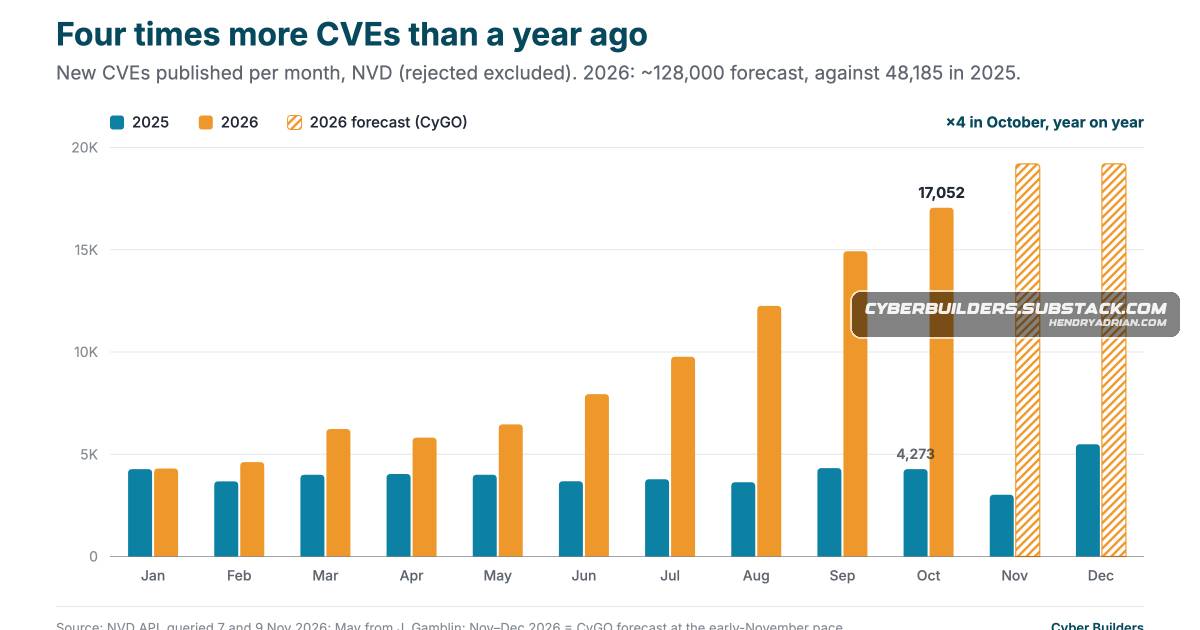
- The author reports 48,185 CVEs published in 2025 and 17,052 in October 2026, and forecasts about 128,000 for 2026; the latter is the author’s projection.
- The article says NIST stopped enriching every CVE in the NVD and estimates about 29,000 older entries will lack enrichment, including severity scores and affected-product lists.
- PHP released fixes for CVE-2026-109618 and CVE-2026-109619 on October 21; CISA added both to KEV five days later. The article says PHP 8.1 and earlier have no fix and cites CISA’s advice to take those systems offline.
- Reuters reported NorForge’s findings of a campaign using Cairn agents against more than 1,200 sites; the investigation attributed compromises of more than 100 companies’ sites to exploitation of older weaknesses. Data theft was not established.
- The article cites estimates that only a small share of CVEs are exploited and notes that CISA’s KEV additions have risen more slowly than CVE publications. It presents several possible explanations, including under-detection and attacks that do not map neatly to published CVEs.
- In a survey of 100 CISOs, 87% expected security budgets to grow in 2027, while 36% were comfortable letting AI agents act independently on low-risk tasks. The author recommends prioritizing with KEV and EPSS and measuring time to fix or mitigate exploited systems.
Article Details
- Event Type
- Analysis of rising CVE publication and AI-assisted vulnerability discovery and exploitation, alongside reported website compromises and a major cryptocurrency theft.
- Impact
- The article reports that attackers compromised websites belonging to more than 100 companies in a campaign targeting over 1,200 sites across the United States, Canada, Australia, and Japan. It also reports that two PHP remote-code-execution vulnerabilities were added to CISA's Known Exploited Vulnerabilities catalog five days after fixes were released. Separately, attackers reportedly stole about $6.3 billion from Binance; Binance says it froze close to $3 billion and will cover the remainder. The article says the theft was attributed to a North Korea-linked group, which North Korea denies. It does not establish how much data was stolen in the website campaign.
MITRE ATT&CK
CVE
CVE-2026-109618PHP Group · PHP; Siemens · AMIS TS; +105 moreOn 21 October, PHP released fixes for two critical RCE bugs (CVE-2026-109618 and CVE-2026-109619), both scored 9.2. These affect all PHP installations that are serving web requests (mod_php, PHP-FPM, php-cgi,CVE-2026-109619PHP Group · PHP; Siemens · AMIS TS; +106 moreOn 21 October, PHP released fixes for two critical RCE bugs (CVE-2026-109618 and CVE-2026-109619), both scored 9.2. These affect all PHP installations that are serving web requests (mod_php, PHP-FPM, php-cgi,
People
Vendors
AnthropicApril 2026: Anthropic launched Project Glasswing around Mythos, claiming to have found thousands of high and critical findings in open source and gave vendors early access to the patches.GoogleAug 2025: Big Sleep agent at Google reported 20 bugs, and the teams in the finals of DARPA's AI Cyber Challenge found 18 real ones.OpenAIOct 2025: OpenAI launched Aardvark, an agentic security researcher that reported over ten open-source CVEs.
Products
Google ChromeTal Be’ery asked a good question last week: are vulnerabilities sparse or dense? He looked at Chrome’s patch history, and his answer is dense. Google fixed 1,072 security bugs in Chrome 149 and 150 alone—more than inPHPSince Summer 2026: AI has discovered a number of long-standing PHP vulnerabilities.Zend FrameworkThey did not need anything exotic. The break-ins exploited old, known weaknesses: memcached sessions, unsafe PHP objects, and outdated Zend Framework code.
Tools
AardvarkOct 2025: OpenAI launched Aardvark, an agentic security researcher that reported over ten open-source CVEs.Big SleepAug 2025: Big Sleep agent at Google reported 20 bugs, and the teams in the finals of DARPA's AI Cyber Challenge found 18 real ones.CairnSnorre Fagerland of NorForge uncovered. A Chinese-speaking operator was seen pointing open-source Cairn agents at company websites with instructions of under 100 characters. Fagerland was able to read theMythosApril 2026: Anthropic launched Project Glasswing around Mythos, claiming to have found thousands of high and critical findings in open source and gave vendors early access to the patches.XBOWJune 2025: XBOW, an autonomous agent, topped the HackerOne US bug bounty leaderboard. Agents are now competing against the very best human hunters.
Countries
Australiathe attacker's control panels, which were left completely open. Over 1,200 sites in the US, Canada, Australia and Japan were attacked with over 1,100 attack projects in a single cluster. More than 100 companies'Canadaable to read the attacker's control panels, which were left completely open. Over 1,200 sites in the US, Canada, Australia and Japan were attacked with over 1,100 attack projects in a single cluster. More than 100Japancontrol panels, which were left completely open. Over 1,200 sites in the US, Canada, Australia and Japan were attacked with over 1,100 attack projects in a single cluster. More than 100 companies' sites wereNorth Korea$3 billion before it could be laundered and says it will cover the rest. The theft is attributed to a North Korea-linked group, though North Korea denies it. Who is on the other side? Organized crime and state-backedUnited StatesNIST now enriches only the CVEs in CISA's KEV catalog (software the US government uses and that's deemed critical). Everything else gets a number and the label "Not Scheduled".