
European Refrigeration Attacks Highlight Exposed OT Risks; Attribution Remains Contested
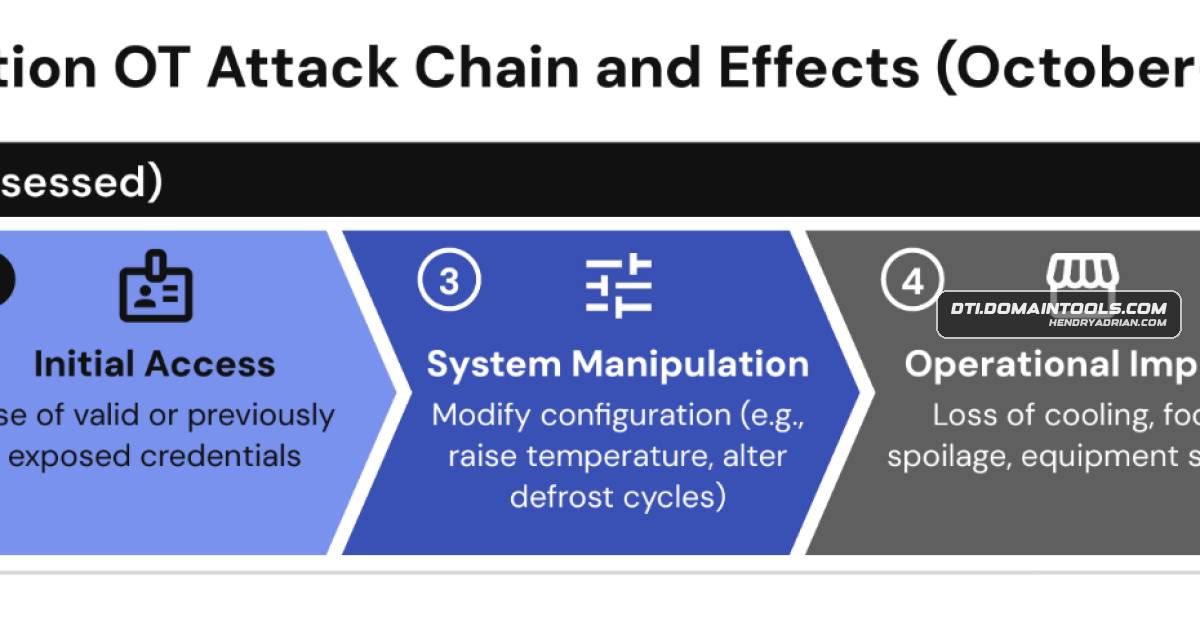
Summary
An assessment describes October–November attacks on European refrigeration controllers, citing exposed interfaces and weak or default configurations. France attributed its October incidents to Iran’s Shahid Kaveh, while Russian-aligned groups also claimed responsibility
Key points
- The article reports that about 700 French supermarkets were affected on October 11–12, 2026; later incidents were reported across Europe, alongside attempted intrusions against UK meat processors.
- Attackers reportedly changed temperature settings and defrost cycles through refrigeration management interfaces. Weak or default configurations are implicated, but exploitation of known CVEs has not been established as the cause.
- Flare identified at least 2,667 public IP addresses associated with exposed refrigeration interfaces; 356 of 547 sampled addresses exposed additional services.
- France attributed the October French attacks to IRGC unit Shahid Kaveh in report CERTFR-2026-CTI-009, but the public report did not release forensic artifacts for independent reproduction.
- NoName057(16) and Z-Pentest Alliance claimed responsibility, but the article says their claim lacks independent proof; Romanian authorities reportedly offered a different assessment of state involvement.
- The IP 188.208.141.210 attempted default-credential logins against a Danfoss honeypot, all unsuccessful; the article says no forensic evidence links it to affected European victims.
- Recommended measures include restricting remote access, removing default credentials, updating or isolating legacy controllers, monitoring configuration and temperature changes, and preserving logs.
Article Details
- Attack Vectors
- Internet-accessible refrigeration management interfaces in default installation or configuration states reportedly enabled unauthorized control; the exact initial-access mechanism for the November wave remains unresolved.
- Attackers reportedly changed controller settings such as temperature setpoints and defrost schedules using legitimate management functions, without installing bespoke malware or modifying firmware.
- French investigators reported that operators used FOFA to identify publicly accessible interfaces. Use of the platform alone does not establish attribution.
- The address 188.208.141[.]210 attempted authentication against a Danfoss honeypot using factory-default credentials; all three attempts failed, and the activity has not been linked to European victims.
- Defensive Notes
- Identify internet-accessible refrigeration management interfaces, including systems installed or configured by maintenance contractors, and remove direct internet exposure.
- Restrict administrative access to protected internal networks or properly secured VPN connections.
- Remove default credentials, enforce unique administrative passwords, minimize privileged access, and enable multifactor authentication where supported.
- Update supported controllers according to manufacturer guidance; isolate end-of-life controllers and prioritize replacing unsupported equipment.
- Monitor temperature setpoints, defrost schedules, alarm thresholds, and controller configurations for unauthorized changes.
- Use temperature monitoring independent of primary refrigeration controllers and alert on abnormal physical conditions.
- Preserve controller logs, configuration records, authentication events, and remote-access telemetry before resetting affected systems, when safety permits.
- Before restoring connectivity, verify that exposed interfaces, compromised credentials, and insecure remote-access configurations have been remediated.
Indicators of compromise
| Type | Indicator | Context |
|---|---|---|
| IPV4 | 188[.]208[.]141[.]210 | Source address observed making reconnaissance requests and unsuccessful factory-default credential attempts against a Danfoss honeypot; not forensically linked to the European refrigeration campaign. |
MITRE ATT&CK
T0831Attackers reportedly changed refrigeration controller temperature settings and defrost schedules, including an extended defrost cycle at a Gradignan supermarket.T0859The article says default credentials and configurations enabled unauthorized administrative control of refrigeration management systems; their use is not established for every incident.T0883The affected refrigeration management interfaces were reportedly accessible from the internet, exposing controllers to unauthorized access.T1110.001 · Password GuessingThe source address 188.208.141[.]210 made three unsuccessful authentication attempts against a Danfoss honeypot using documented factory-default credentials; this activity is not linked to the European incidents.T1596.005 · Scan DatabasesFrench investigators reported that operators used FOFA to discover publicly accessible refrigeration management interfaces.
CVE
CVE-2023-25913Vendor / Product unavailableCVE-2023-25913 Authentication bypass and sensitive information disclosure 7.5 High Upgrade to firmware 3.3 or laterCVE-2023-25914Vendor / Product unavailableCVE-2023-25914 Path traversal allowing unauthorized access to system files 7.5 High Upgrade to firmware 3.3 or laterCVE-2023-25915Vendor / Product unavailableCVE-2023-25915 Remote command execution through improper input validation 9.8 Critical Upgrade to firmware 3.3 or laterCVE-2025-41450Danfoss · AK-SM 8xxA SeriesCVE-2025-41450 Authentication bypass Upgrade to firmware 4.2 or laterCVE-2025-41451Danfoss · AK-SM8xxA SeriesCVE-2025-41451 Authenticated OS command injection Upgrade to firmware 4.3.1 or laterCVE-2025-41452Danfoss · AK-SM8xxA SeriesCVE-2025-41452 Web-server configuration manipulation Upgrade to firmware 4.3.1 or later
People
Hamid Reza LashgarianThe French report identifies him as head of the IRGC Electronic and Cyber Centre; it does not establish his personal involvement in the refrigeration attacks.Mahdi LashgarianThe French report identifies him as a commander of Shahid Kaveh; it does not establish his personal involvement in the refrigeration attacks.Reza SalarvandThe French report identifies him as a commander of Shahid Kaveh; it does not establish his personal involvement in the refrigeration attacks.
Threat Actors
Cyber Isnaad FrontThe French report identifies this as a public-facing identity attributed to Shahid Kaveh and used to claim selected operations.CyberArmyofRussia_RebornU.S. authorities previously attributed a 2024 refrigeration-related attack against a Los Angeles meat-processing facility to this group; the article presents it as historical context, not as an actor in the European incidents.CyberAv3ngersThe French report identifies this as a public-facing identity attributed to Shahid Kaveh and used to claim selected operations.CyberAveng3rsThe French report identifies this as a public-facing identity attributed to Shahid Kaveh and used to claim selected operations.Islamic Revolutionary Guard Corps (IRGC)The French assessment identifies the IRGC as directing the October 2026 operation; this is a formal French attribution that the article says cannot be independently reproduced from released artifacts.NoName057(16)The group reportedly claimed responsibility for the supermarket attacks, but the claim has not been independently substantiated and is not supported by disclosed victim-specific forensic evidence.Shahid KavehFrance formally attributed the October 2026 attacks on French supermarkets to this unit. The article notes that the public report did not release forensic artifacts for independent reproduction.Z-Pentest AllianceThe group reportedly claimed responsibility for the supermarket attacks, but the claim has not been independently substantiated and is not supported by disclosed victim-specific forensic evidence.
Vendors
CopelandSystems such as the Danfoss AK-SM family and Copeland/Dixell XWEB platforms are deployed in environments where availability and reliable operation are essential. Their connectivity provides operational efficiency but itDanfossa video on November 4 claiming responsibility for the supermarket attacks. The groups identified Danfoss and Dixell equipment as the attack vector and asserted that they manipulated existing controllerDixellon November 4 claiming responsibility for the supermarket attacks. The groups identified Danfoss and Dixell equipment as the attack vector and asserted that they manipulated existing controller functions withoutRockwellKaveh has possessed scripts for scanning, and attempting to control Schneider Electric, Siemens, and Rockwell industrial equipment since at least June 2024. In April 2026, the unit conducted large-scaleSchneider ElectricFrench investigators additionally identified concurrent targeting of Schneider Electric equipment at small hydroelectric installations. C4 associated this activity with the refrigeration operation and reported moderateSiemensthat Shahid Kaveh has possessed scripts for scanning, and attempting to control Schneider Electric, Siemens, and Rockwell industrial equipment since at least June 2024. In April 2026, the unit conducted
Products
Copeland/Dixell XWEB platformsSystems such as the Danfoss AK-SM family and Copeland/Dixell XWEB platforms are deployed in environments where availability and reliable operation are essential. Their connectivity provides operational efficiency but itDanfoss AK-SM 800The older Danfoss AK-SM 800 and AK-SC 355 models are end-of-life products and require particular attention because normal security patching may no longer be available. These vulnerabilities are one of the security risksDanfoss AK-SM 800Athat have been published. Claroty Team82 documented three significant vulnerabilities affecting Danfoss AK-SM 800A refrigeration management systems.Danfoss AK-SM familySystems such as the Danfoss AK-SM family and Copeland/Dixell XWEB platforms are deployed in environments where availability and reliable operation are essential. Their connectivity provides operational efficiency but it
Tools
Countries
Belgiumwave occurred October 11th–12th in France. A second wave on November 1st–2nd affected retailers across Belgium, Luxembourg, Sweden, the Netherlands, Ireland, Estonia, and Portugal. Subsequent reporting has addedEstoniaon November 1st–2nd affected retailers across Belgium, Luxembourg, Sweden, the Netherlands, Ireland, Estonia, and Portugal. Subsequent reporting has added Italy, Finland, Germany, and Romania, with attemptedFinlandSweden, the Netherlands, Ireland, Estonia, and Portugal. Subsequent reporting has added Italy, Finland, Germany, and Romania, with attempted attacks against British meat-processing facilities as well.Franceand other temperature-sensitive industrial systems. Beginning with hundreds of affected supermarkets in France during October 2026, the incidents expanded across numerous European countries in early November,GermanySweden, the Netherlands, Ireland, Estonia, and Portugal. Subsequent reporting has added Italy, Finland, Germany, and Romania, with attempted attacks against British meat-processing facilities as well.Indiathe 188.208.141.0/24 netblock, announced by AS132335 LeapSwitch Networks Private Limited. This is an India-based hosting provider operating geographically distributed infrastructure. Iransupermarkets to Shahid Kaveh, an offensive cyber unit operating within the Electronic and Cyber Centre of Iran's Islamic Revolutionary Guard Corps (IRGC). However, two Russian-aligned hacktivist organizations,Irelandsecond wave on November 1st–2nd affected retailers across Belgium, Luxembourg, Sweden, the Netherlands, Ireland, Estonia, and Portugal. Subsequent reporting has added Italy, Finland, Germany, and Romania, withItalyLuxembourg, Sweden, the Netherlands, Ireland, Estonia, and Portugal. Subsequent reporting has added Italy, Finland, Germany, and Romania, with attempted attacks against British meat-processing facilities as well.LuxembourgOctober 11th–12th in France. A second wave on November 1st–2nd affected retailers across Belgium, Luxembourg, Sweden, the Netherlands, Ireland, Estonia, and Portugal. Subsequent reporting has added Italy,NetherlandsFrance. A second wave on November 1st–2nd affected retailers across Belgium, Luxembourg, Sweden, the Netherlands, Ireland, Estonia, and Portugal. Subsequent reporting has added Italy, Finland, Germany, and Romania,Portugal1st–2nd affected retailers across Belgium, Luxembourg, Sweden, the Netherlands, Ireland, Estonia, and Portugal. Subsequent reporting has added Italy, Finland, Germany, and Romania, with attempted attacks againstRomaniaNetherlands, Ireland, Estonia, and Portugal. Subsequent reporting has added Italy, Finland, Germany, and Romania, with attempted attacks against British meat-processing facilities as well.Russiaand Z-Pentest have a history of claiming attacks on OT (Operational Technology) systems in support of Russia.Sweden11th–12th in France. A second wave on November 1st–2nd affected retailers across Belgium, Luxembourg, Sweden, the Netherlands, Ireland, Estonia, and Portugal. Subsequent reporting has added Italy, Finland, Germany,United KingdomSubsequent reporting has added Italy, Finland, Germany, and Romania, with attempted attacks against British meat-processing facilities as well.
Industries
Energyasserted that the operation did not require malware. They also threatened further attacks against water, energy, industrial, and food-storage infrastructure. The claim is aligned with previous Z-Pentest postsFood retailof carrying out a cyberattack last month that disrupted refrigeration systems at approximately 700 food retail stores in France.