
SOCRadar Maps n0n Ransomware Operations From Exposed Operator Workspace
Summary
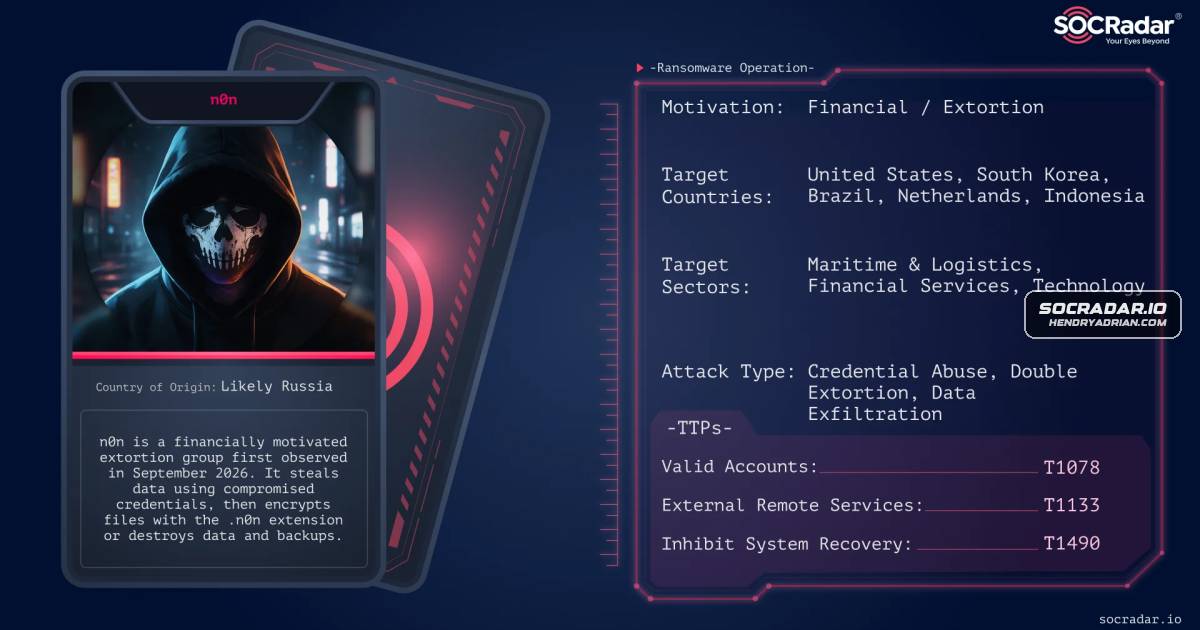
SOCRadar researchers say an exposed operator workspace let them reconstruct n0n’s credential-based intrusions, data theft and destructive extortion, including its locker, infrastructure and AI-assisted tooling. They found no exploit code or CVE references.
Key points
- SOCRadar’s Threat Research Unit says snapshots of an exposed Python file server revealed 1,719 files and activity linked to at least 23 organizations in 14 countries.
- The documented intrusions used weak or compromised credentials, including FortiGate SSL-VPN credential stuffing, RDP and WinRM password sweeps, and exposed AWS keys; researchers found no exploit code or CVE references.
- The recovered C++ locker source describes an AES-256-CBC encryptor; the compiled binaries were not recovered, and operator scripts handled additional actions such as stopping services and deleting backups.
- The investigation describes victim-specific exfiltration pipelines and data destruction. For three staged cloud-database cases labeled “gl-0day,” the access vector remains unknown.
- The operator used the opencode AI coding agent, configured with 154 model entries and more than $7,216 in API spending; researchers characterized the operation as human-directed, not fully autonomous.
- SOCRadar counted 93 entities on n0n’s leak portal and $283.7 million in listed demands as of October 19, 2026; these portal listings and demands do not independently verify every claimed compromise.
- Recommended defenses include strengthening MFA and remote-access controls, limiting cloud-key permissions, and maintaining offline or immutable backups.
Article Details
- Attack Vectors
- Credential stuffing against FortiGate SSL-VPN appliances using residential proxy pools.
- RDP and WinRM sweeps using default or weak passwords.
- Use of exposed, long-lived AWS IAM keys and stolen administrative browser sessions for hosting-provider portals.
- Harvesting SaaS and CI/CD API tokens and cloud credentials from source code and deployment pipelines.
- Persistence through hidden administrator accounts, SSH authorized keys, scheduled tasks, and OpenSSH on port 2222.
- Credential and session collection from browser stores, IMAP mailboxes, and incoming MFA codes.
- Exfiltration through Base64-encoded ZIP POSTs to C2, SigV4 requests over Tor, SSH-tunneled TAR archives, and public file-hosting services.
- Encryption and destructive actions including S3 object deletion, shadow-copy deletion, free-space wiping, and changing firewall rules to BLOCK.
- Defensive Notes
- Enforce phishing-resistant MFA on RDP, SSL-VPN, and administrative portals; monitor FortiGate /remote/logincheck for credential stuffing and invalidate credentials found in infostealer logs.
- Restrict firewall-management interfaces with IP allow-lists and MFA, remove shared or default credentials, require approval for policy changes, and monitor REST token creation from unfamiliar IPs.
- Replace long-lived cloud keys with short-lived roles, separate S3 list/read/delete permissions, enable Object Lock and versioning, and alert on high-volume DeleteObjects calls.
- Maintain air-gapped or immutable backups because the operation deletes shadow copies, wipes free space, and may delete provider-hosted backups.
- Isolate management browsers and keep MFA passcodes out of local administrator mailboxes.
- Hunt for C:\Users\Public\n0n\, .n0n file renames following service stops, SYSTEM tasks such as SvcSync or NetAssist, Chrome remote-debugging use, authorized_keys entries ending in root@3090-AI, Snort rule n0n-lock (sid 2100001), and JSON POSTs to /x/i containing ippay-web.
Indicators of compromise
| Type | Indicator | Context |
|---|---|---|
| DOMAIN | n0n-cases[.]net | Domain used to send direct extortion emails to victims from the n0n operation. |
| DOMAIN | n0n[.]to | Clearnet domain for the n0n leak site; reported inactive at the time of the article's checks. |
notice@n0n-cases[.]net | Sender address used for direct extortion emails sent to victims. | |
| IPV4 | 185[.]157[.]161[.]148 | Operator-controlled staging server that exposed the live working directory and hosted the AI coding agent and kserver C2 panel. |
| IPV4 | 188[.]214[.]135[.]130 | Operator infrastructure identified as the leak-site backend, victim-record host, and host for wallet and C2-related services. |
| IPV4 | 81[.]161[.]239[.]10 | Operator-controlled loot vault where exfiltrated data terminated and leak-building and C2 services were hosted. |
MITRE ATT&CK
T1041 · Exfiltration Over C2 ChannelData was exfiltrated to C2 as ZIP archives encoded in Base64 and sent by POST.T1053.005 · Scheduled TaskLocker and audit runs were configured as scheduled tasks, including recurring SYSTEM tasks.T1059.001 · PowerShellPowerShell scripts were used for strikes, exfiltration, and implant activity.T1070.004 · File DeletionThe operator overwrote the toolkit multiple times and deleted it; launchers also self-deleted.T1078.004 · Cloud AccountsThe operator used exposed, long-lived AWS IAM access keys to access cloud resources.T1110.004 · Credential StuffingThe operator used residential proxy pools to credential-stuff FortiGate SSL-VPN appliances.T1133 · External Remote ServicesInitial access used internet-facing FortiGate SSL-VPN, RDP, and WinRM services.T1136.001 · Local AccountThe operator created hidden local administrator accounts such as svc_upd and svc_reg.T1485 · Data DestructionThe operator deleted S3 data and, in one claimed case, removed servers and backups.T1486 · Data Encrypted for ImpactThe custom n0n locker encrypted files on Windows and Linux, with an OpenSSL stage also used against FMC appliances.T1489 · Service StopThe Windows wrapper stopped MSSQL, MySQL, and W3SVC before encryption.T1490 · Inhibit System RecoveryThe operation deleted shadow copies and wiped free space to impede recovery.T1530 · Data from Cloud StorageThe operator performed bulk S3 pulls with per-bucket byte caps.T1547.001 · Registry Run Keys / Startup FolderA Run key was set to open the ransom note at user logon.T1562.001 · Disable or Modify ToolsThe Windows wrapper stopped and disabled Symantec Endpoint Protection.
Threat Actors
Malware
Vendors
Amazon Web ServicesCloud credentials: Long-lived AWS IAM keys with list, read and delete rightsCiscoFMC appliance stage Cisco FMC (Linux), OpenSSL Firewall-manager victimsCyberLogitecsecurity research tied at least 21 of the 38 to customers of South Korean maritime software provider CyberLogitec, but CyberLogitec has not confirmed an incident, and one listing reuses another victim’s sample file,
Products
Cisco Firepower Management CenterInter (ISP, Venezuela): The operator ran inter_lock.py directly on the ISP’s Cisco Firepower Management Center, switched all access-control rules to BLOCK, and claimed to have severed national network traffic onFortiGate SSL-VPNThe directory exposed the operation end to end: credential stuffing against FortiGate SSL-VPN appliances, hijacked firewall management centers, mass S3 deletion, a custom C++ locker, and an AI coding agent backed bySymantec Endpoint ProtectionWindows wrapper stages tooling in C:\Users\Public\n0n\, stops MSSQL, MySQL and W3SVC, disables Symantec Endpoint Protection, runs vssadmin delete shadows /all /quiet, wipes free space with cipher /w, and reruns
Tools
GOSTOther persistence includes root resets through GRUB init=/bin/bash over OCR-driven VNC consoles, a gost SOCKS5 proxy disguised as a scheduled task, and OpenSSH on port 2222.opencodeThe operator works with opencode, an open-source AI coding agent, configured with 154 model entries across 7 providers, including commercial gateways, “uncensored” and “abliterated” models with safety training removed,
Countries
GermanyDediserve (cloud hosting, Ireland/Germany): Stolen admin browser credentials led to takeover of the provider’s management stack; the operator ran commands through Zabbix scripts and OnApp recipes named “disk usageIrelandDediserve (cloud hosting, Ireland/Germany): Stolen admin browser credentials led to takeover of the provider’s management stack; the operator ran commands through Zabbix scripts and OnApp recipes named “disk usageSouth KoreaTracking logged 93 victims across 27 countries, with the heaviest concentration in the United States and South Korea.United StatesTracking logged 93 victims across 27 countries, with the heaviest concentration in the United States and South Korea.VenezuelaInter (ISP, Venezuela): The operator ran inter_lock.py directly on the ISP’s Cisco Firepower Management Center, switched all access-control rules to BLOCK, and claimed to have severed national network traffic on
Industries
Cloud hostingDediserve (cloud hosting, Ireland/Germany): Stolen admin browser credentials led to takeover of the provider’s management stack; the operator ran commands through Zabbix scripts and OnApp recipes named “disk usageGovernmentDemands ranged from 0.5 BTC for a government ministry to 33.04 BTC for the United Federation of Teachers.managed IT servicesChiBiTek (managed IT services, US): Reached through the FortiGate credential-stuffing pipeline, profiled in operator scripts, and listed on the leak site on October 11RetailThe staging server’s data covers 23 organizations across 14 countries in 15 distinct sectors, with Software/SaaS and retail tied at three victims each.