
Researchers Trace PeckBirdy Infrastructure Through DNS and WHOIS Analysis
Summary
An investigation of PeckBirdy-related indicators analyzed DNS, WHOIS and threat-intelligence data, linking domains and IPs to phishing and malware activity and identifying additional infrastructure. The article attributes the framework to China-aligned APTs.
Key points
- The article describes PeckBirdy as a JavaScript-based C2 framework used by China-aligned APT actors since 2023, with associated campaigns involving HOLODONUT, MKDOOR, stolen code-signing certificates, Cobalt Strike payloads and CVE-2020-16040.
- Researchers analyzed 56 indicators, including domains, subdomains, IP addresses and WHOIS artifacts; they assessed all 28 initially identified domains as illegitimate.
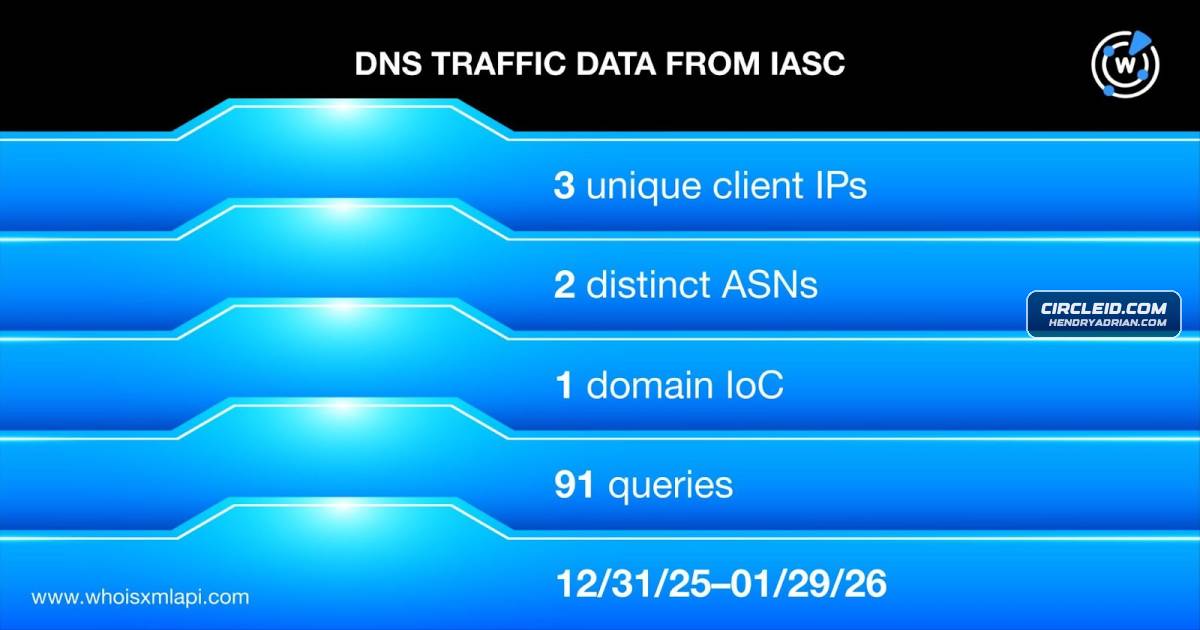
- DNS traffic data showed three client IP addresses queried an IoC domain 91 times between December 31, 2025, and January 29, 2026.
- Historical data showed 22 IoC domains had 2,205 domain-to-IP resolutions; six domains were registered 122–804 days before being reported as malicious.
- WHOIS history connected 35 email addresses to 21 IoC domains; follow-up analysis identified 64 additional email-connected domains.
- Of 23 additional IP addresses found through current domain resolutions, threat-intelligence data classified 20 as previously weaponized for phishing or malware distribution.
Article Details
- Attack Vectors
- PeckBirdy is described as a JavaScript-based command-and-control framework used in campaigns since 2023; the article does not specify how it is executed on victim systems.
- The reported campaigns also involved the modular backdoors HOLODONUT and MKDOOR, stolen code-signing certificates used to sign Cobalt Strike payloads, and exploitation of CVE-2020-16040.
- The researchers reported that some identified domains and IP addresses were associated with malware distribution and phishing; the article does not establish that all were used in PeckBirdy campaigns.
- Defensive Notes
- The article recommends conducting supplementary investigations to corroborate entities identified as malicious, noting that their status may change or later be deemed harmless.
- The reported indicators may support threat detection and response; the article does not provide specific remediation steps.
Indicators of compromise
| Type | Indicator | Context |
|---|---|---|
| DOMAIN | a1icdn[.]com | Listed as a domain IoC; the article reports that the 28 initially identified IoC domains were confirmed illegitimate. |
| DOMAIN | githubgressaccess[.]info | Listed as a domain IoC; the article reports that the 28 initially identified IoC domains were confirmed illegitimate. |
| DOMAIN | img-cache[.]com | Listed as a domain IoC; the article reports that the 28 initially identified IoC domains were confirmed illegitimate. |
| DOMAIN | js-cdn[.]xyz | Listed as a domain IoC; the article reports that the 28 initially identified IoC domains were confirmed illegitimate. |
| DOMAIN | jsunpkg[.]com | Listed as a domain IoC; the article reports that the 28 initially identified IoC domains were confirmed illegitimate. |
| DOMAIN | microsoft-ads[.]com | Listed as a domain IoC; the article reports that the 28 initially identified IoC domains were confirmed illegitimate. |
| DOMAIN | mkdmcdn[.]com | Listed as a domain IoC; the article reports that the 28 initially identified IoC domains were confirmed illegitimate. |
| DOMAIN | ppcn-cdn[.]xyz | Listed as a domain IoC; the article reports that the 28 initially identified IoC domains were confirmed illegitimate. |
| DOMAIN | static-alicdn[.]com | Listed as a domain IoC; the article reports that the 28 initially identified IoC domains were confirmed illegitimate. |
| DOMAIN | update[.]myrnicrosoft[.]com | Subdomain IoC that the article reports was involved in distributing malware. |
| DOMAIN | updates[.]oss-cdn[.]com | Subdomain IoC that the article reports was involved in distributing malware. |
| IPV4 | 104[.]21[.]24[.]113 | The article identifies this IP as weaponized and associates it with malware distribution and phishing. |
| IPV4 | 104[.]21[.]25[.]105 | The article identifies this IP as weaponized and associates it with phishing and malware distribution. |
| IPV4 | 104[.]21[.]44[.]46 | The article identifies this IP as weaponized and associates it with phishing and malware distribution. |
| IPV4 | 104[.]21[.]63[.]97 | The article identifies this IP as weaponized and associates it with phishing and malware distribution. |
| IPV4 | 104[.]21[.]90[.]19 | The article identifies this IP as weaponized and associates it with phishing and malware distribution. |
| IPV4 | 43[.]156[.]94[.]185 | Listed as an IP IoC in the article's DNS-resolution analysis. |
| IPV4 | 8[.]218[.]50[.]207 | Listed as an IP IoC in the article's DNS-resolution analysis. |
| IPV4 | 8[.]222[.]143[.]246 | Listed as an IP IoC in the article's DNS-resolution analysis. |
MITRE ATT&CK
T1059.007 · JavaScriptPeckBirdy is described as a JavaScript-based C2 framework designed to execute across multiple environments.T1553.002 · Code SigningThe article reports that a stolen code-signing certificate was used to sign Cobalt Strike payloads.T1566 · PhishingThe article reports that some discovered IP addresses had been weaponized for phishing; it does not describe a specific phishing method.T1583.001 · DomainsThe article reports malicious domains among the infrastructure and says six IoC domains were registered 122–804 days before being identified as malicious.
CVE
Malware
HOLODONUTa JavaScript-based C2 framework used by China-aligned APTs since 2023 and linked to modular backdoors (HOLODONUT, MKDOOR), stolen code-signing certificates, Cobalt Strike payloads, and exploits includingMKDOORC2 framework used by China-aligned APTs since 2023 and linked to modular backdoors (HOLODONUT, MKDOOR), stolen code-signing certificates, Cobalt Strike payloads, and exploits including CVE-2020-16040.
Tools
Cobalt Strikesince 2023 and linked to modular backdoors (HOLODONUT, MKDOOR), stolen code-signing certificates, Cobalt Strike payloads, and exploits including CVE-2020-16040.PeckBirdyTrend Micro’s report exposes PeckBirdy, a JavaScript-based C2 framework used by China-aligned APTs since 2023 and linked to modular backdoors (HOLODONUT, MKDOOR), stolen code-signing certificates, Cobalt Strike