DarkMe RAT Campaign Uses Phishing and PIF Files Instead of Exploits
Summary
Huntress analyzed two DarkMe infections delivered through phishing emails and disguised PIF files. The campaign uses a multi-stage VB6 loader, custom protocol-handler persistence, and process hollowing, with technical indicators and detection guidance provided.
Key points
- Huntress identified DarkMe in two customer environments on August 31, 2026; users were tricked into running a PIF file linked from email.
- The PIF downloaded a remote MSI, which unpacked scripts and three VB6 loader DLLs before launching the RAT.
- Unlike earlier DarkMe campaigns that used WinRAR and SmartScreen vulnerabilities, this campaign relied on social engineering rather than exploits.
- The malware registers a custom Locked:// protocol handler and a Run key to persist and obscure its launch through Explorer.
- A process gate checks for 329 user applications; the final loader hollows a signed Microsoft clspack.exe copied into AppData.
- The RAT can steal cryptocurrency wallets, capture screenshots, enumerate antivirus products, manipulate files, and execute commands.
- Huntress reported C2 at thatawful[.]boutique and 67.43.50[.]11:7712, and recommended hunting for the execution chain and removing the malware’s files and persistence.
Article Details
- Attack Vectors
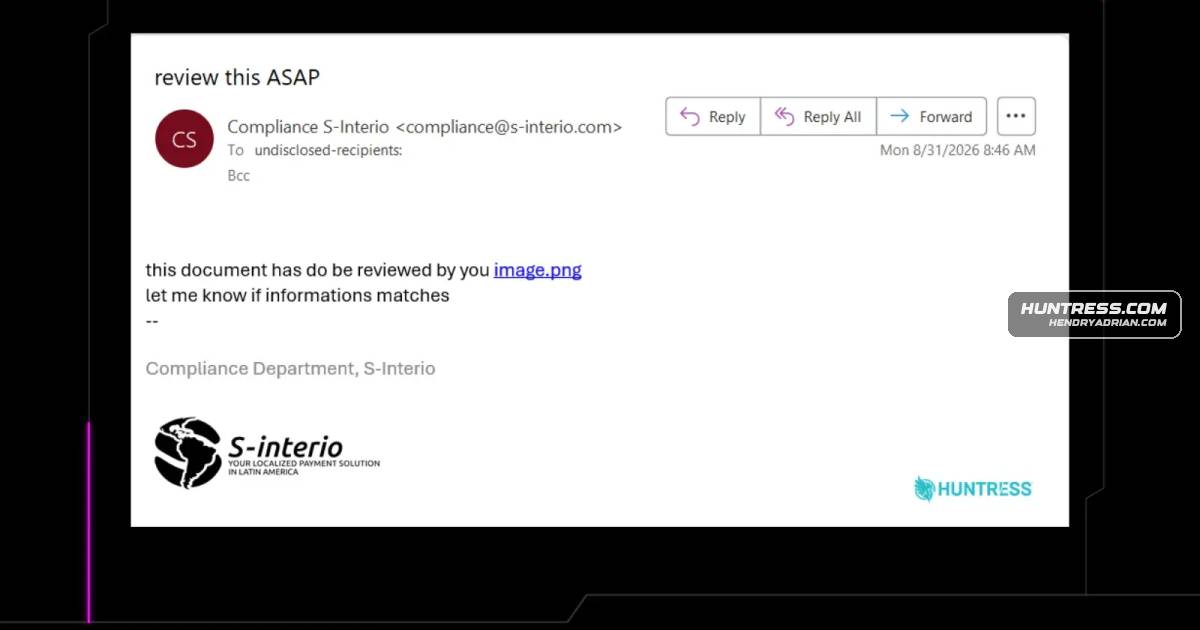
- A phishing email linked to a URL presented as an image; the server delivered an executable PIF file instead.
- The PIF launched msiexec to download and quietly run an MSI installer from attacker-used infrastructure.
- The MSI extracted files and ran a WSF staging script, which registered a COM server and invoked it through rundll32.exe /sta.
- The malware checked running processes for user applications and exited if none of its listed applications were found.
- The loaders registered a custom Locked:// protocol handler and a Run key that launched explorer.exe with that URI to restore execution at logon.
- The final loader decrypted a payload and used process hollowing to run it inside a signed clspack.exe copied to the user's AppData directory.
- Defensive Notes
- Alert on rundll32.exe invoked with /sta and a GUID but no DLL path, and on msiexec fetching a remote MSI through a URL argument to /i.
- Alert on reg.exe importing files from user-writable locations and on wscript.exe or cscript.exe running WSF files from AppData, especially when they launch reg.exe or rundll32.exe.
- Monitor execution of PIF files and signed Microsoft binaries such as clspack.exe running from AppData instead of System32 or SysWOW64.
- Inspect nonstandard protocol handlers under HKCU\Software\Classes\*\shell\open\command and Run-key entries that invoke explorer.exe with a custom URI scheme.
- Monitor outbound TCP port 7712 for possible DarkMe C2 traffic.
- For remediation, isolate affected hosts, terminate the hollowed clspack.exe process, remove the staging files and persistence registrations, and reset affected-user credentials; treat cryptocurrency wallets used on the host as compromised.
Indicators of compromise
| Type | Indicator | Context |
|---|---|---|
| DOMAIN | advancedfuturetechnology[.]com | Identified as a host that served the malicious PIF payload during the campaign. |
| DOMAIN | megchartedbk7[.]com | Domain reported to resolve to the same IP as the DarkMe C2 server. |
| DOMAIN | onlineview365[.]com | Attacker-used MSI staging host for the DarkMe infection chain. |
| DOMAIN | readonline365[.]com | Malicious delivery host that served the PIF payload. |
| DOMAIN | sharedfuturetech[.]com | Identified as a host that served the DarkMe payload and later hosted a separate malicious ClickFix lure. |
| DOMAIN | storageonline[.]me | Identified as a host serving the malicious PIF delivery campaign. |
| DOMAIN | thatawful[.]boutique | DarkMe C2 domain recovered by decrypting the malware's configuration. |
| DOMAIN | viewdocument[.]live | Identified as a host serving the malicious PIF delivery campaign. |
| IPV4 | 67[.]43[.]50[.]11 | DarkMe C2 server IP; the malware communicated with it over TCP port 7712. |
| SHA256 | 1c923c685f97e556f241d0f1880283500a61dc7ecae8cafe75f34c720ff6b918 | Hash of the malicious prnfig.wsf staging script. |
| SHA256 | 2915efecf2a01ce0b3ef49c47666ec43c326e7804df10e5859db5f08eeca8a37 | Hash listed for the signed clspack.exe binary hollowed to host the DarkMe payload. |
| SHA256 | 3052352ac811c48590f0239281312c35560fc06b4dc39790e365eb1e7cab8634 | Hash of the DarkMe stage-2 loader, Use.dll. |
| SHA256 | 394c93dfbb7581c66a23c52b20cd90b31415c0825a2eab7107e60ee3fe693c04 | Hash of the malicious image.pif initial dropper. |
| SHA256 | 4a18f65ab7de7be385cbcebc78c9ae49334294f93726822b8900f9b7a324a6b0 | Hash of the DarkMe stage-1 COM loader, Coconout.dll. |
| SHA256 | 52b242047a8055c0936b384b952c1c16c1072a590610140b01f4acefa8ae883a | Hash of filetext2.txt, used to import the malicious COM registration. |
| SHA256 | 54ed18aa883b53794810be0428b3a0167758183c5b3ba5660af747dc81dd5b76 | Hash of the encrypted DarkMe payload stored as company.cer. |
| SHA256 | 9fb5888f9ac99227a35f3e08ca08bfb9eed676e1f91638599eba0d7a5aac847f | Hash of the exemsi-wrapped MSI used to stage the DarkMe loaders. |
| SHA256 | d7185bd7b450b478c793ece3025bdd867eed70bb7b739a5f26375b5ba6cf0d93 | Hash of the DarkMe stage-3 loader, Finalized.dll. |
| URL | hxxps[:]//onlineview365[.]com/propi[.]msi | URL used by the PIF to download the malicious staging MSI. |
| URL | hxxps[:]//readonline365[.]com/view/image[.]png | Phishing-link URL that delivered the malicious image.pif file. |
MITRE ATT&CK
T1027 · Obfuscated Files or InformationLoader strings were hex-encoded, and the payload and C2 configuration were encrypted.T1036.008 · Masquerade File TypeThe PIF was presented through a link ending in image.png and disguised as an image.T1055.012 · Process HollowingThe loader hollowed a signed clspack.exe process and ran the DarkMe payload inside it.T1057 · Process DiscoveryUse.dll enumerated running processes to check for applications on its 329-name list.T1059.003 · Windows Command ShellThe staging chain used cmd.exe to import the generated registry file and invoke rundll32.exe.T1059.005 · Visual BasicThe installer ran the prnfig.wsf staging script, identified in the article as a VBScript.T1082 · System Information DiscoveryFinalized.dll gathered host, hardware, service, policy, display, and locale information for a profile report.T1095 · Non-Application Layer ProtocolThe RAT used a custom TCP channel for remote file manipulation and command execution.T1112 · Modify RegistryThe staging script and loader modified registry values for COM registration and persistence.T1113 · Screen CaptureThe reported DarkMe capabilities included screenshot capture via GDI+.T1140 · Deobfuscate/Decode Files or InformationFinalized.dll decrypted the payload before passing it to the process-hollowing routine.T1204.002 · Malicious FileUsers downloaded and double-clicked the PIF file, initiating execution.T1218.007 · MsiexecThe PIF invoked msiexec to download and execute a remote MSI installer.T1218.011 · Rundll32The loader used rundll32.exe /sta with a CLSID to invoke the registered COM loader.T1497.001 · System ChecksThe malware used an application-presence gate described as an anti-sandbox and VM check.T1518.001 · Security Software DiscoveryThe malware queried installed antivirus products through WMI.T1547.001 · Registry Run Keys / Startup FolderUse.dll created a user Run key that launched explorer.exe with the Locked://Newest URI at logon.T1566.002 · Spearphishing LinkA phishing email linked to a URL that delivered the malicious PIF.
CVE
CVE-2023-38831Two years ago, DarkMe developed a reputation by leveraging two separate zero days to deliver its malware: WinRAR (CVE-2023-38831) and Windows Defender SmartScreen (CVE-2024-21412).CVE-2024-21412Two years ago, DarkMe developed a reputation by leveraging two separate zero days to deliver its malware: WinRAR (CVE-2023-38831) and Windows Defender SmartScreen (CVE-2024-21412).
People
Threat Actors
Malware
Vendors
Products
Microsoft WindowsTwo years ago, DarkMe developed a reputation by leveraging two separate zero days to deliver its malware: WinRAR (CVE-2023-38831) and Windows Defender SmartScreen (CVE-2024-21412).Visual Basic 6DarkMe is a Visual Basic 6 (VB6) spy-RAT previously attributed to the financially-motivated APT tracked as Water Hydra and the EvilNum-led Operation DarkCasino.Windows Defender SmartScreenTwo years ago, DarkMe developed a reputation by leveraging two separate zero days to deliver its malware: WinRAR (CVE-2023-38831) and Windows Defender SmartScreen (CVE-2024-21412).WinRARTwo years ago, DarkMe developed a reputation by leveraging two separate zero days to deliver its malware: WinRAR (CVE-2023-38831) and Windows Defender SmartScreen (CVE-2024-21412).
Tools
CensysAnalysis via Censys on 67.43.50[.]11 (hosted via Voxility/ColoGuys in Prague) reveals a sloppy Windows Server deployment exposing a wealth of remote management ports, including RDP (3389), WinRM (5985, 47001), andFLOSSWiden to UTF-16 with a tool like FLOSS and the persistence mechanism appears:Hollows HunterFigure 17: The Hollows Hunter utility finds process hollowing present in the clspack.exe componentVBReFormerFigure 19: The RC4-encrypted C2 domain in VBReFormerVirusTotalVirusTotal records seven domains serving this .pif file in the wild, and working through them resolves to five genuine delivery hosts:
Industries
Cryptocurrencyfinancially motivated, targeting forex traders, stock-trading forums, online gambling platforms, and cryptocurrency users.Forex tradingonline gamblingIts campaigns are typically financially motivated, targeting forex traders, stock-trading forums, online gambling platforms, and cryptocurrency users.Stock trading