
Google Details Enterprise Defenses for AI-Accelerated Vulnerability Exploitation
Summary
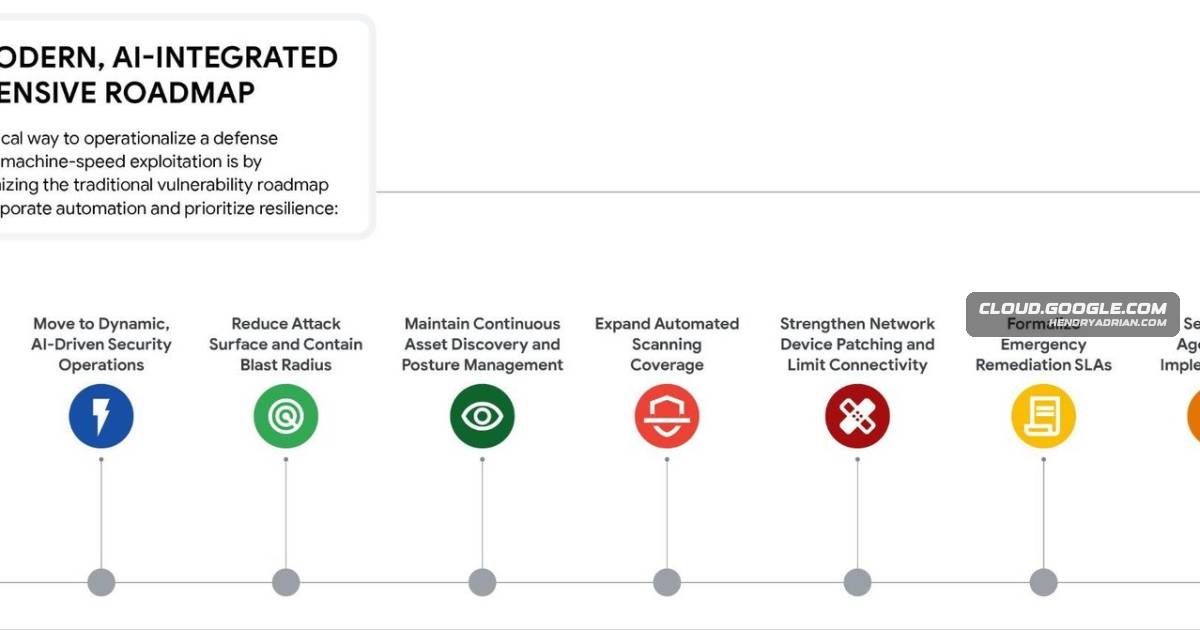
Google outlines an enterprise defense roadmap for AI-accelerated vulnerability discovery and exploitation, emphasizing automated vulnerability management, code and CI/CD security, continuous asset visibility, zero-trust controls, and safeguards for AI agents.
Key points
- The article says general-purpose AI models are increasingly able to identify vulnerabilities and help generate functional exploits, potentially lowering the skill barrier and compressing attack timelines.
- Google Threat Intelligence Group (GTIG) has observed threat actors using LLMs for exploit-related purposes and marketing such capabilities in underground forums.
- The article recommends securing code repositories, secrets, CI/CD systems, build runners, and software supply-chain components, with scanning to find weaknesses that could be chained.
- It urges continuous asset discovery and broader automated vulnerability scanning, alongside remediation SLAs that prioritize exposed and high-risk systems.
- Recommended containment measures include zero-trust network design, segmentation, identity-based access controls, and monitoring outbound connections from network devices.
- For AI deployments, the article recommends applying Google’s Secure AI Framework and screening AI inputs and outputs for prompt injection and sensitive-data leakage.
- It also advocates AI-assisted security operations for alert triage and investigation, while presenting Google, Mandiant, and Wiz products and services as supporting options.
Article Details
- Defense Focus
- Modernize vulnerability management and security operations for AI-accelerated vulnerability discovery and exploitation through automation, continuous asset visibility, and resilient controls.
- Detection Methods
- Continuously scan source code, code libraries, repositories, and build systems for vulnerabilities and exposed secrets.
- Use static and dynamic code scanning to identify exploitable weaknesses and combinations of lower-severity flaws.
- Automate vulnerability scanning across endpoints, servers, network devices, and major operating systems.
- Maintain continuous asset discovery to identify exposed, unmanaged, cloud, and ephemeral assets.
- Baseline normal outbound connections from network devices and investigate anomalous external communications.
- Use AI-assisted alert triage, investigation, signal correlation, and threat hunting for suspicious behavior.
- Data Sources
- Source code repositories, code libraries, and secrets findings
- CI/CD pipelines, build runners, and automated execution systems
- Vulnerability scan results and remediation status
- Asset inventories covering endpoints, servers, network devices, cloud environments, and Kubernetes pods
- Outbound network connection baselines and observed connections
- Security alerts and telemetry correlated across tools
- AI system inputs and outputs
- Platforms
- Windows
- macOS
- Linux
- Kubernetes
- Defensive Actions
- Restrict code repository access to trusted networks, managed identities, or other strongly controlled access paths.
- Remove plaintext credentials and remediate secrets exposed in code repositories.
- Secure build runners, CI/CD pipelines, and other automated execution mechanisms.
- Apply network segmentation and identity-based access controls to limit the impact of a compromised edge device.
- Block unnecessary outbound connections from internal network devices and investigate exceptions.
- Define emergency remediation SLAs and pre-approved temporary mitigations, including restricting public access or isolating affected systems.
- Prioritize remediation for internet-facing systems, critical infrastructure, and high-risk vulnerabilities.
- Use compensating controls and coordinated remediation processes for medical, industrial control, and other high-sensitivity devices.
- Screen AI model inputs and outputs, apply fine-grained IAM to AI connections, and secure AI agents against prompt injection and sensitive-data leakage.
MITRE ATT&CK
T1190 · Exploit Public-Facing ApplicationThe article describes AI-enabled actors rapidly developing and deploying exploits against internet-exposed systems.T1195 · Supply Chain CompromiseThe article warns that attackers may exploit compromised code libraries and vulnerable supply-chain components.T1552.001 · Credentials In FilesThe article identifies plaintext credentials and secrets in code repositories as information defenders should scan for and remove.
Vendors
Products
Google Cloud Model ArmorTools like Google Cloud Model Armor or similar industry solutions can also serve as a protective layer for large language model environments by screening inputs and outputs for prompt injection, jailbreak attempts, andGoogle Cloud Sensitive Data Protectionby screening inputs and outputs for prompt injection, jailbreak attempts, and Google Cloud Sensitive Data Protection can prevent sensitive data leakage.Google Security Operationsspecialized AI agents such as Google Cloud’s Triage and Investigation Agent and Gemini in Google Security Operations, teams can automate alert triage, analyze suspicious code without manual reverse engineering,Google Threat IntelligenceGoogle Threat Intelligence: To combat the unprecedented volume of AI-generated exploits, Google Threat Intelligence enables a proactive ‘assume breach’ mentality.Wiz#Wiz #Mandiant
Tools
Big SleepAI models would become capable of vulnerability discovery—which is why we’ve been using AI tools like Big Sleep, CodeMender, and OSS-Fuzz to proactively find and fix vulnerabilities over the years.CodeMenderwould become capable of vulnerability discovery—which is why we’ve been using AI tools like Big Sleep, CodeMender, and OSS-Fuzz to proactively find and fix vulnerabilities over the years.OSS-Fuzzof vulnerability discovery—which is why we’ve been using AI tools like Big Sleep, CodeMender, and OSS-Fuzz to proactively find and fix vulnerabilities over the years.Triage and Investigation Agentconstrained by manual workflows, By deploying specialized AI agents such as Google Cloud’s Triage and Investigation Agent and Gemini in Google Security Operations, teams can automate alert triage, analyze suspiciousWiz SITFOrganizations should leverage frameworks like Wiz SITF to map their SDLC threat model and identify “attack chains” where minor, isolated weaknesses are combined by AI to create a critical breach.